Two regulatory clocks are running at the same time for anyone who moves pallets in and out of trailers: OSHA’s powered industrial truck rule in the United States, and the European Union’s Machinery Regulation (EU) 2023/1230. Neither document was written specifically for the loading dock. Both land squarely on it, because that is where forklifts meet trailers and where a large share of avoidable incidents happen.
Below is a plain-language read on what actually changes, what does not, and which pieces of dock equipment are worth reviewing before your next audit.
United States: OSHA 1910.178(l) Is Not a One-Off Course
Forklift operator training in the US sits in 29 CFR 1910.178(l). The requirements have not changed recently, but they are widely under-implemented in small and mid-size warehouses. Three points matter most:
Training has three parts, and all three are mandatory. Formal instruction (classroom, video, interactive), practical training with the actual equipment, and an evaluation of the operator’s performance in the actual workplace. An online course satisfies only the first part. OSHA does not accept online-only training.
There is no government forklift license in the United States. The employer certifies competence. That certification record must identify the operator, the date of training, the date of evaluation, and the person who performed the training and evaluation.
Re-evaluation is required at least every three years, plus refresher training whenever an operator is seen driving unsafely, is involved in an accident or near-miss, receives an evaluation showing unsafe operation, or is assigned to a different type of truck.
| Requirement | Citation | What it means on the dock |
|---|---|---|
| Training before unsupervised operation | 1910.178(l)(1) | No new hire touches a trailer until trained |
| Three-part training format | 1910.178(l)(2)(ii) | Classroom plus hands-on plus workplace evaluation |
| Qualified trainer only | 1910.178(l)(2)(iii) | Trainer needs knowledge, training and experience |
| Re-evaluation | 1910.178(l)(4)(iii) | At least once every three years |
| Ramps and sloped surfaces | 1910.178(l)(3)(ii)(G) | Ramp and dock-plate operation is a required training topic |
| Load composition and stability | 1910.178(l)(3)(ii)(B) | Off-centre loads are a training topic, not a judgement call |
The Dock Is Where the Cited Hazards Concentrate
Powered industrial trucks stay in the top ten of OSHA’s most frequently cited standards, with roughly 2,248 citations issued in the 2024 fiscal year. The violations are rarely about driving in open aisles. They cluster at the trailer interface: unsecured trailers, dock plates that shift under load, working on a slope, and pedestrian traffic in the same lane as the truck.
Two items are worth checking this quarter. First, trailer restraint. A trailer that is not restrained can creep or tip as the forklift’s weight transfers onto the nose. Second, the ramp or plate itself. A plate that is too short for the height difference produces a slope the operator cannot see past, and a ramp rated for the static load but not for the dynamic load of a loaded forklift braking on the incline.
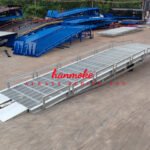
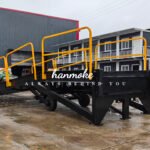
If your facility uses portable equipment rather than a pit-mounted leveler, the equipment list matters as much as the training file. A properly rated mobile yard ramp removes the trailer-height variable entirely, because the load never leaves the ground on the wrong angle.
European Union: the Machinery Regulation Applies from 20 January 2027
Regulation (EU) 2023/1230 was adopted on 14 June 2023 and published in the Official Journal on 29 June 2023. It applies on a mandatory basis from 20 January 2027 — the same date on which Directive 2006/42/EC is repealed. There is no window in which either text may be applied at will; the regime switches on a single date.
| Date | What applies |
|---|---|
| Until 19 January 2027 | Machinery Directive 2006/42/EC only |
| 20 January 2027 onward | Machinery Regulation (EU) 2023/1230 only |
| Before 20 January 2027 | Equipment lawfully placed on the EU market under the Directive remains valid (Article 50(2)) |
| 14 January 2024 | Notified Body provisions already in force |
What is genuinely new. Software that performs a safety function is now itself a safety component, requiring CE marking and technical documentation in its own right. The Regulation adds provisions for AI-powered safety functions and for cyber-safety of compliance-relevant software. It also clarifies that instructions for use and the declaration of conformity may be supplied in digital form, and it splits the higher-risk category list into Part A (notified body involvement mandatory) and Part B.
The practical consequence for importers. A unit shipped in December 2026 and a unit shipped in February 2027 arrive with two different paperwork packages, even if the steel is identical. If you are planning dock equipment capex across that boundary, ask your supplier which conformity route each shipment follows, and get the answer in writing on the order confirmation.
What Loading-Dock Teams Should Do Before Then
- Audit the certification file, not just the training. If you cannot produce operator name, training date, evaluation date and trainer identity for every current operator, you are exposed today, not in 2027.
- Re-read the load rating on every plate and ramp. Confirm the rating against the heaviest loaded forklift you actually run, not the nominal fleet capacity.
- Check trailer restraint for every loading position, and make “no restraint, no entry” a written rule rather than a habit.
- Put the 2027 date in your capital plan. Equipment ordered in the second half of 2026 should have its conformity route confirmed at order stage.
- Keep technical files for the equipment you import. Under the Regulation, documentation obligations follow the economic operator, and a missing file is a commercial problem long before it becomes a legal one.
Frequently Asked Questions
Does OSHA accept online-only forklift training?
No. Online content can satisfy the formal instruction portion only. Practical training on the actual equipment and an evaluation in the actual workplace are both required, and neither can be delivered remotely.
Is equipment bought before 20 January 2027 still legal in the EU after that date?
Yes. Machinery lawfully placed on the EU market before 20 January 2027 under Directive 2006/42/EC remains on the market under Article 50(2) of the Regulation. The Regulation is not applied retroactively. What changes is the conformity route for units placed on the market on or after that date.
Is a loading ramp covered by the EU Machinery Regulation?
Yes. A powered dock leveler or a lift-assisted yard ramp is machinery under Article 2(1). Because the load is lifted by a drive system rather than human effort, it falls inside the scope, with the essential health and safety requirements of Annex III applying.
How often must forklift operators be re-evaluated in the US?
At least once every three years, and sooner whenever refresher training is triggered by an observed unsafe practice, an accident or near-miss, an unsatisfactory evaluation, or a change of truck type or workplace conditions.
Regulatory deadlines have a way of arriving with a capital request attached. If you are reviewing dock equipment now — whether to fix a slope problem, replace a plate that shifts, or plan a 2027 purchase — tell us the trailer height range and the heaviest loaded forklift you run, and we will come back with the dimensions that actually fit. Our dock leveler and dock plate ranges cover pit-mounted and portable configurations, and you can put the question to our engineering team directly through the contact page.