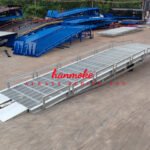
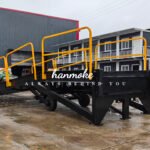
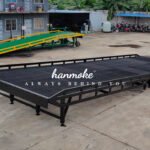
Most mobile yard ramps that end up unused were not badly built. They were bought against the wrong specification. The purchasing decision usually starts from capacity and price, when the two variables that decide whether operators actually use the ramp are slope and usable deck width.
After thirty years of building these units in Foshan, we can usually tell within four questions whether a customer is about to buy the right ramp. Here are the seven specifications that matter, in the order they should be settled.
1. Capacity: Rate the Ramp for the Dynamic Load
Ramp capacity is not the forklift’s rated capacity. It is the combined weight of the truck plus the load plus the operator, multiplied by a safety factor that accounts for braking and turning on an incline.
Work the sum backwards from your worst case, not your average case:
- Forklift service weight: often 4,500-8,000 lb (2,000-3,700 kg) for a 2.5-3.5 t class truck
- Load: the heaviest pallet or stillage you actually move
- Operator, attachments, and a full fuel or battery pack
A 3 t forklift with a 1 t load does not need a 4 t ramp. It needs a 5 t ramp, because the dynamic factor is real. If your heaviest move is a 2.5 t load on a 5 t truck, buy a 10 t ramp and stop thinking about it.
Our mobile yard ramp range runs from 6 t to 20 t for exactly this reason: the capacity step is usually decided by the dynamic load, not the truck.
2. Ramp Length and Slope: the Number That Decides Whether It Gets Used
Slope is a function of two things: the height difference between ground and trailer bed, and the ramp’s length. Grade is expressed as a percentage or as a ratio.
Practical limits for a loaded forklift travelling up and down all shift:
| Grade | Ratio | Angle | Practical read |
|---|---|---|---|
| 10% | 1:10 | 5.7° | Comfortable, minimal load loss, longer ramp |
| 15% | 1:6.7 | 8.5° | The working standard for most yards |
| 20% | 1:5 | 11.3° | Acceptable for light and occasional use |
| Above 25% | 1:4 | 14°+ | Operators slow down, loads shift, avoid if you can |
Now apply it to real trailer heights:
| Trailer bed height | Ramp length at 15% grade | Ramp length at 20% grade |
|---|---|---|
| 1.0 m / 3.3 ft | 6.7 m / 22 ft | 5.0 m / 16 ft |
| 1.2 m / 3.9 ft | 8.0 m / 26 ft | 6.0 m / 20 ft |
| 1.4 m / 4.6 ft | 9.3 m / 31 ft | 7.0 m / 23 ft |
Here is the trade-off nobody mentions at quotation stage. A longer ramp gives a gentler grade but takes more yard space, weighs more, and costs more. A shorter ramp is cheaper and easier to reposition but produces a grade your operators will complain about within a week. If your yard is tight, decide which trailer heights you will serve at 15% and which ones you will accept a steeper grade for.
3. Usable Deck Width, Not Overall Width
Ask for two numbers: overall width and usable width between the side curbs. The difference is typically 100-150 mm (4-6 in) on each side, and that is the number your operator has to hit.
For a 2.5-3.5 t forklift, a usable width of 2,000-2,200 mm (79-87 in) is comfortable. Below 1,800 mm (71 in), operators slow down and start missing the centring, particularly in rain or with a load that blocks the view forward. Reverse loading up the ramp effectively doubles the difficulty.
If you also need to move pallet trucks or a small tractor, or if your loads include wide stillages, factor the deck width from that traffic, not from the forklift.
4. Lift System: Hydraulic, Electro-Hydraulic or Mechanical
Mobile yard ramps raise the approach end to meet the trailer bed. How that lift happens is a maintenance decision as much as a convenience one.
| System | How it works | Best for | Watch out for |
|---|---|---|---|
| Mechanical (manual pump / hand lift) | Operator pumps or winds the ramp up | Low-frequency use, sites without power at the ramp position | Physically demanding; slow to reposition |
| Hydraulic (foot or hand pump) | Hydraulic cylinder, manual actuation | Small yards, occasional moves | Pump seal servicing |
| Electro-hydraulic (380 V / 220 V) | Electric power pack lifts and lowers | Daily, multi-shift operation | Power supply and cable management |
If the ramp stays in one position six days a week and only gets repositioned for different trailer heights, a mechanical lift is money saved. If it gets moved every shift, the electro-hydraulic version pays for itself in operator time within a year.
Our galvanized series is worth considering if the unit lives outdoors in a coastal or high-rainfall environment; galvanizing adds cost up front and subtracts repainting from your maintenance budget for the next decade.
5. Deck Surface and Grip
The deck is the part your operator touches every minute. Two specifications decide how it behaves:
- Plate specification. Checkered or anti-slip steel, typically 4-6 mm depending on capacity. Ask for the actual plate thickness, not the frame section.
- Wet and cold performance. A pattern that grips a dry deck in July can be marginal with rain, mud or frost. Sites in northern Europe and Canada should specify a pattern depth and, where relevant, a finish that resists polishing under steel wheels.
Side curbs matter here too. A 100 mm curb on each side is not decoration: it is the last line of defence when a wheel drifts on a slope.
6. Mobility: How It Actually Gets Moved
Ask who moves the ramp and how. The answer determines the wheel configuration and whether you need a tow bar.
Solid rubber or cast nylon wheels are the usual choice. Larger wheels roll over yard debris and expansion joints; smaller wheels are more manoeuvrable in tight docks. If a forklift will tow it, confirm the tow bar and hitch are rated for the towing load, and check the turning radius against your yard layout before ordering.
One detail that causes real accidents: the ramp must be stable when someone is on it. Whatever wheel arrangement you choose, the loaded ramp must be chocked or braked, and the trailer must be restrained. A mobile ramp that rolls mid-load is a liability claim, not an inconvenience.
7. Safety Hardware You Should Never Let a Supplier Drop
Every item on this list should appear on the quotation. If a supplier cannot point to it in writing, you are not comparing like with like:
- Load rating plate, permanently fixed to the ramp
- Wheel chocks or an integrated brake system
- Side curbs or wheel guides over the full deck length
- Lifting eyes or forklift pockets for repositioning
- Transition lip that sits properly on the trailer bed, without a step or gap
- Operation and maintenance manual, in the language of the operator
What Actually Drives the Price
Two ramps at the same capacity can differ by 100% in price. The difference is almost always in these places: plate thickness, cylinder and seal quality, power pack components on electro-hydraulic units, paint or galvanizing specification, and how much welding is done on the frame.
Indicative EXW price bands from a Chinese factory, for orientation only:
| Type | Capacity | Indicative EXW band (USD) |
|---|---|---|
| Container ramp / dock plate | 6-10 t | 850 – 2,400 |
| Standard hydraulic mobile yard ramp | 10 t | 3,900 – 6,900 |
| Heavy-duty hydraulic / electro-hydraulic | 15-20 t | 6,500 – 11,500 |
| Galvanized finish | any | add 12% – 18% |
These are orientation bands, not quotations. Deck size, lift system, finish, documentation and quantity all move the number, and freight and duties sit on top. Treat any supplier who quotes a suspiciously low figure without asking about plate thickness as a risk.
Five Questions to Send Your Supplier Before Ordering
- What is the ramp’s rated capacity, and what dynamic safety factor was applied to it?
- What ramp length do you recommend for my trailer height range at a 15% grade, and what grade would a shorter unit produce?
- What is the usable deck width between the curbs, in millimetres?
- What plate thickness is used on the deck, and what surface pattern?
- Which safety items are included as standard, and which are optional extras?
A supplier who can answer these five in specific numbers, without deflecting to a brochure, is a supplier worth a purchase order. For product-level specifications across our range, start from the dock ramp platforms and portable dock ramps categories, or send us your trailer height range and forklift weight and we will size it for you.
Frequently Asked Questions
What is the maximum safe slope for a mobile yard ramp?
For loaded forklift travel across a full shift, keep the grade at or below 15% (a ratio of about 1:6.7, or 8.5 degrees). Grades up to 20% are workable for light and occasional use. Above 25% the load becomes unstable, visibility suffers and cycle times lengthen noticeably.
How do I calculate the ramp length I need?
Divide the trailer bed height by the grade you want, as a decimal. For a bed 1.2 m above ground at a 15% grade: 1.2 / 0.15 = 8.0 m, or about 26 ft. The same height at 20% gives 6.0 m. Always check the result against the usable yard space in front of the dock.
Does a mobile yard ramp need a pit or concrete work?
No. That is the point of a mobile ramp. It sits on the existing yard surface and the approach end is raised to meet the trailer bed, so no pit, no civil works and no dock construction are required. A fixed free-standing platform is the option when you want a permanent working level without digging.
Can a mobile yard ramp be used with different trailer heights?
Yes, within the lift range of the unit. The ramp raises to meet the trailer bed, so it can serve everything from a low flatbed to a high cube trailer. Each reposition takes seconds on an electro-hydraulic unit and minutes on a mechanical one.