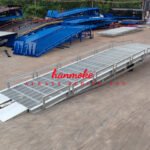
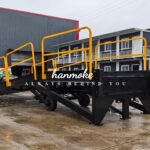
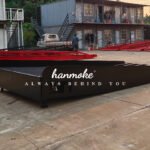
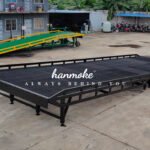
Every week someone asks for a ramp that will unload “whatever truck shows up”. None does. Most yards with one or two unloading positions and a mixed trailer fleet need less: a 10-ton hydraulic mobile yard ramp with a rectangular tube frame and a hand pump. That is the HRYS.
What the HRYS Actually Is
A welded rectangular tube frame with a hinged approach slope, a level platform and a movable lip that lands on the trailer bed. Load is carried by the side beams, not the deck panels. The deck is 5 mm diamond safety mesh as standard, steel grating optional. Lifting is a manual hydraulic pump with twin cylinders: no power supply, no battery, no cable run. The tube frame keeps weight down and spreads wheel load.
| Specification | HRYS standard build |
|---|---|
| Rated load (dynamic) | 10 t (22,046 lb) |
| Overall length | 7,570 mm slope + 2,630 mm platform = 10,200 mm (33 ft 6 in) |
| Overall width | 2,200 mm (7 ft 3 in) |
| Working height range | 1,200–1,680 mm (3 ft 11 in – 5 ft 6 in) |
| Main beams | 160 × 80 × 5 mm (6.3 × 3.1 × 0.2 in) steel rectangular tube |
| Deck | 5 mm (0.2 in) diamond safety mesh; steel grating optional |
| Lifting system | Manual hydraulic pump, twin cylinders |
| Lip | Movable, 755 × 400 × 12 mm (29.7 × 15.7 × 0.5 in), two pieces |
| Guard rails | 200 mm (7.9 in) above deck |
| Support legs | Load-bearing, fast/slow two-stage adjustment |
| Moving method | Forklift pockets plus towing eye |
Length and Grade: The Numbers Buyers Get Wrong
Matching tonnage and ignoring length is the most common specification error we see. At 10,200 mm (33 ft 6 in) overall the HRYS is a mid-length ramp: 7,570 mm (24 ft 10 in) of slope plus a 2,630 mm (8 ft 8 in) level platform. Grade comes from the slope, not the whole ramp — where a lot of desk arithmetic goes wrong. Against a 1,200 mm (3 ft 11 in) container floor the grade is about 15.9%, or 9.0°. Against a high-cube bed at 1,400 mm (4 ft 7 in) it is about 18.5%, or 10.5°. At the top of the working range, 1,680 mm (5 ft 6 in), it reaches roughly 22%, or 12.5°.
Those figures are normal for a mobile yard ramp, and steeper than a fixed dock leveler, where EN 1398 caps the working range at 12.5%. They also cross an OSHA line: under 29 CFR 1910.178(n)(7)(i), a powered industrial truck on a grade steeper than 10% must travel with the load uphill. On a 15.9% ramp, train drivers on it.
Bed height is the second constraint. Anything outside the 1,200–1,680 mm range needs different geometry — we would rather quote another model than sell a ramp that cannot sit flat.
The Manual Pump: A Choice, Not a Compromise
The pump lifts the deck with moderate lever effort and holds it while the legs are set. Once pinned, the ramp stands on steel, not fluid: it does not sag overnight, and a seal failure shows up as slow lifting rather than a collapse.
| Consideration | Manual pump (HRYS) | Electro-hydraulic pack |
|---|---|---|
| Height change time | About 2–4 minutes including setting the legs | Under 1 minute |
| Power supply needed | None | AC mains or DC battery |
| Failure modes | Seals, check valve, hose — field-serviceable | Adds motor, battery, charger, control box |
| Best fit | 1–3 height changes per shift; remote yards | High-cycle docks, single-operator sites |
| Relative unit cost | Baseline | Typically 15–25% higher |
Our rule of thumb: count the trailer heights you serve in a shift. One or two, take the HRYS. Four or more, and the labour cost of pumping shows up within a season.
Where a 10-Ton Rating Sits in a Real Fleet
A dynamic 10 t (22,046 lb) rating is not “a 10-ton forklift can drive up it”. It covers the combined weight of truck, load and attachment, with the load roughly centred. A 2.5 t counterbalance with a 1.5 t load and a side-shifter is a 4.2 t combination. A 5 t diesel with a 4 t load is 9.2 t — inside the rating on paper, but only just, and a truck drifting to one side of a 2,200 mm deck is no longer loading the frame as the calculation assumed. For that duty the heavy-duty hydraulic model is the right answer.
Two field notes: capacity assumes the ramp sits at its design height, and over-extending the legs to reach a very high bed changes the load path. The lip also needs real overlap on the bed, not a perch on the edge — more tonnage does not fix a ramp that is too short.
Deck, Legs and Details That Age Well
The 5 mm diamond mesh drains well and grips a wet tyre better than plain plate. Steel grating earns its upgrade in rain or with broken pallets: debris falls through rather than sitting on the surface. Two-stage legs set coarse height fast and land the lip accurately; 200 mm guard rails are standard where anyone walks beside a moving forklift.
Ordering, Lead Time and Budget
Indicative EXW Foshan ranges below are guidance, not a quotation. Freight and duty sit on top.
| Item | Indicative figure |
|---|---|
| Unit price, HRYS 10 t standard build (EXW) | USD 6,800–9,200 |
| Steel grating deck instead of diamond mesh | Adds roughly USD 400–700 |
| Built weight | Approx. 2,900–3,400 kg (6,400–7,500 lb) |
| Production lead time | 20–30 days after deposit and drawing approval |
| Container loading | Two units per 40 ft HQ when nested and partly disassembled; confirm the loading plan before booking freight |
Ask for the packed weight before booking receiving equipment: a 3 t crate is not a pallet-truck job.
HRYS Versus the Rest of the Range
The HRXS mechanical ramp is the value option, best where the ramp rarely changes height. The HRYS adds hydraulic control at modest cost, which is why it is our most popular standard model. Above about 14 t of combined load, or in continuous-use yards, step up to the HRHS heavy-duty or the HRES electro-hydraulic. The whole family sits on the mobile yard ramps category page.
Front lip, tail board, guard rails and deck upgrades come with the range. Send bed heights, forklift model and load weights through the contact page for a drawing with the slope in degrees plus a delivered-cost estimate.
Is the HRYS 10 t or 10,000 kg?
Same number, different unit: 10,000 kg or 22,046 lb of dynamic load, meaning the combined weight of forklift, load and attachment moving across the deck.
Can the HRYS be used in the rain?
Yes. The diamond mesh deck drains and the hydraulic circuit is enclosed. Steel grating suits daily wet-weather work better: water and debris fall through.
How many people does it take to move the HRYS?
None in the normal case. It is repositioned with a forklift using the pockets, or towed slowly by a yard vehicle from the towing eye. It is not designed to be pushed by hand at roughly 3 t.
Does the HRYS work with a high-cube trailer at 1,400 mm?
Yes, at a slightly steeper grade than a 1,200 mm container floor. The working range covers that bed height; send the exact figure and we will confirm the slope for your build.