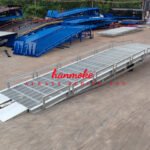
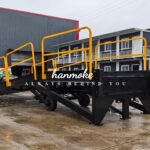
Ask a ramp supplier why the price went up and you will usually hear “steel”. That answer is true often enough to be annoying, and unhelpful every time, because a yard ramp is not a steel price with wheels bolted on. Between 2021 and 2026 the steel benchmarks moved by hundreds of dollars a tonne, and yet the factory price of a standard 10-ton hydraulic mobile yard ramp moved far less in percentage terms. This article goes through the mechanism, the current index data, and the parts of a quote that are sensitive to steel and the parts that are not.
What the Index Did, 2021 to 2026
Two benchmarks matter to a buyer outside China. The first is the Chinese domestic hot-rolled coil price, because that is what a Foshan factory actually pays for the beams and deck plate. The second is the regional price in your own market, because tariffs and carbon costs have long since broken the link between the two.
World export hot-rolled coil roughly doubled between mid-2020 and its 2021 peak, when offers were quoted near USD 1,000/t, then fell for three straight years into the mid-USD 400s. That round trip of several hundred dollars a tonne is the whole story buyers remember. What matters more in October 2026 is the split: Chinese prices flat and soft, American prices pushed to a 2026 high by a run of weekly mill increases, and European prices carrying a carbon cost that did not exist in 2021.
| Indicator | Latest reading | Date and source |
|---|---|---|
| China HRC, Q235B 4.75 mm, national spot, incl. 13% VAT | CNY 3,292/t (USD 491/t) | Mysteel, 9 Oct 2026 |
| China HRC, Q235B 4.75 mm, national average | CNY 3,277/t | Mysteel, 15 Oct 2026 |
| US HRC, Nucor consumer spot price | USD 1,240/short ton | Nucor, 12 Oct 2026 |
| US HRC, Kallanish assessment | USD 1,210–1,220/short ton | Kallanish, 2 Oct 2026 |
| EU CBAM certificate price, Q3 2026 | EUR 82.32/t CO2e | European Commission, 5 Oct 2026 |
Put two of those rows side by side and the arbitrage is obvious. Nucor’s spot price of USD 1,240 per short ton is about USD 1,367 per tonne. Chinese HRC at USD 491/t is therefore roughly 2.8 times cheaper, and that gap is not a market inefficiency that some clever buyer will close. It is policy, and it has been policy for years.
How Much of a Ramp Is Steel Cost?
Most buyers assume steel is nearly the whole cost. On a standard hydraulic mobile yard ramp it is not.
Take a 10-ton standard hydraulic ramp at roughly 3,000 kg finished weight. Not all of that is purchased steel at index price. The figure includes the hydraulic power pack, cylinders, hoses, wheels, pins, paint or galvanising, and the labour and energy that turn plate into a welded frame. Steel in the structural sense — beams, deck, lip, guard rails, support legs — is a large majority of the mass but a smaller share of the cost once you add fabrication, welding hours, surface treatment and the hydraulic kit.
A working rule from our own cost sheets: on a standard hydraulic ramp, the steel input accounts for roughly 35–45% of the ex-works cost. On a mechanical ramp with no hydraulics it can be nearer 45–55%. On an electro-hydraulic heavy-duty unit the share falls to about 30–35% because the power pack and controls add cost without adding much mass.
| Model type | Typical finished weight | Steel share of EXW cost | Sensitivity to a 10% steel move |
|---|---|---|---|
| Mechanical mobile yard ramp, 10 t | ~2,600–3,000 kg (5,700–6,600 lb) | 45–55% | 4.5–5.5% of unit price |
| Standard hydraulic, 10 t (HRYS class) | ~2,900–3,400 kg (6,400–7,500 lb) | 35–45% | 3.5–4.5% of unit price |
| Electro-hydraulic heavy-duty, 20 t | ~7,000–8,000 kg (15,400–17,600 lb) | 30–35% | 3–3.5% of unit price |
That sensitivity figure is the one to remember. A 10% move in the steel index is not a 10% move in your ramp price. It is roughly a third to a half of that, and it usually arrives with a lag of one to two production cycles, because a fabricator consumes the coil it bought weeks ago.
Why the Pass-Through Is Slow in Both Directions
Steel prices fall faster than ramp prices do, and this is not a conspiracy. Three mechanisms explain it.
Inventory lag. A fabricator holding eight weeks of purchased steel is selling you steel bought at the old price. When the index falls, the factory’s cost does not fall until that inventory clears. When the index rises, the factory wears the increase on the inventory it already owns before it can pass anything on.
Contract commitments. Many factories quote on a 30-day validity and then honour the quote even if the index moves. That is a real cost to them, and it is why a sudden index spike produces either a pause in quoting or a specific steel surcharge clause rather than a blunt price rise.
The non-steel costs do not fall with steel. Labour, electricity, hydraulic components and container freight have not tracked steel down since 2022. On our own cost sheets, the non-steel portion of a ramp has risen steadily while the steel portion fell. The net effect is that a ramp that should have got cheaper in 2024 did not get as cheap as the steel index alone would suggest.
Tariffs, Carbon and the Split Market
US hot-rolled coil has traded at close to three times the Chinese price through 2026, held up by the Section 232 tariff structure and by import volumes that have fallen well below the 2022–2024 range. European flat steel is supported by safeguard measures and now by carbon pricing at the border, which is a new line in the landed cost of anything steel-intensive arriving from Asia.
The EU carbon border adjustment mechanism entered its definitive phase on 1 January 2026. Imports of iron and steel above a 50-tonne annual threshold now carry a certificate obligation, priced at the quarterly average of EU emissions allowance auctions: EUR 75.36 for Q1 2026, EUR 75.28 for Q2 and EUR 82.32 for Q3. Certificates for 2026 imports go on sale on 1 February 2027 and are surrendered with the first annual declaration by 30 September 2027, so the cash-flow hit is deferred but the obligation is real.
How big is it for a ramp? The default embedded-emissions value for Chinese hot-rolled flat steel runs at roughly 3.5 tonnes of CO2e per tonne of steel. At EUR 82.32 that is about EUR 288 of certificate value per tonne of steel before the free-allocation adjustment, which in 2026 still removes the large majority of it. A 3-tonne ramp does not therefore arrive with a EUR 900 carbon bill. But the direction is one-way, the free allocation falls every year to 2034, and the supplier who can document actual emissions instead of default values will be cheaper to import from. Ask for the emissions data with the quotation, not after the order.
On the Chinese side, the export licence regime that took effect on 1 January 2026 under MOFCOM and GACC Announcement No. 79 of 2025 covers 300 customs codes, including hot-rolled coil and plate. Exporters now lodge the contract and a producer’s quality inspection certificate to obtain a licence. For equipment buyers the practical reading is narrow: this is administrative friction on steel movement, not a wall. Ramp exports continue; documentation and steel procurement lead times get slightly longer.
Reading a Quote That Moves
When a supplier tells you the price has changed, the fair question is which part changed. A good quote separates the two.
A steel-linked line is legitimate if it references a named index, a named grade and a date, for example “base price valid for 30 days at a Mysteel Q235B 4.75 mm national spot average of CNY 3,292/t; adjustment applies if the 30-day average moves more than 5%”. That is a checkable clause. A clause that says only “steel surcharge may apply” is not a clause, it is an option held by the seller alone.
Two more practical points. First, ask what grade the ramp is actually built from. A quote that specifies Q235B or Q355B for the beams and a stated thickness for the deck is a quote you can compare; one that says “high-strength steel” is not. Second, ask whether the price includes galvanising. Hot-dip galvanising is a zinc and energy cost, not a steel cost, and zinc has its own cycle that has nothing to do with the coil price.
| Line in the quote | What a defensible answer looks like | Red flag |
|---|---|---|
| Price validity | A stated number of days plus the base date | “Subject to change without notice” |
| Steel basis | Named grade and index, e.g. Q235B 4.75 mm, 30-day average | “Steel market conditions” |
| Adjustment trigger | A percentage threshold, e.g. applies only above a 5% index move | Any move, any direction, seller-instigated |
| Plate thickness | Deck and beam wall thickness in mm and in | “Heavy gauge”, “reinforced” |
| Surface treatment | Galvanised or painted, priced as a separate line, with zinc weight | Bundled into the unit price with no detail |
| Hydraulic spec | Cylinder count, pump type, voltage and phase if powered | No voltage stated on an electric build |
What the Next Twelve Months Look Like
worldsteel’s October 2026 Short Range Outlook forecasts global steel demand essentially flat in 2026 at 1,722 Mt, then growth of 1.7% in 2027 to 1,752 Mt. Demand outside China grows 1.5% in 2026 and accelerates to 4.0% in 2027, while China contracts 2.0% then 1.0%. That mix — weak China, firm everywhere else — points to continued divergence rather than a return to a single global price.
For a buyer, the planning implication is unglamorous but useful. Chinese-origin ramp pricing should stay broadly flat into the first half of 2027, with movement driven more by exchange rates, freight and galvanising than by hot-rolled coil. European and North American buyers should expect their domestic alternatives to stay expensive, which keeps the landed cost case for imported equipment intact. And anyone with a capex approval cycle should ask for a 60-day or 90-day price hold rather than a discount, because a hold is worth more than a small reduction when the index is volatile.
What We Do Differently Because of This
Three practices have come out of watching five years of this.
We quote in the currency and validity window we can actually honour, and we say what the base date is. If a customer needs a 90-day hold for a board approval, we will price the hold rather than pretend it is free. We specify steel grade and plate thickness in the quotation rather than in the drawing only, so a cheaper competing quote can be compared line by line. And we separate galvanising, power pack voltage and deck upgrades as line items, because those are the three places where two quotes that look the same are usually not.
If you are building a budget for a fleet rather than a single unit, the number that matters is not today’s coil price but the cost per loading position over five years, which is the same arithmetic that separates a 10-ton standard build from a heavy-duty hydraulic ramp once you count the extra steel, the bigger power pack and the longer service life. For a current price band on a specific model, the HRYS standard hydraulic page and the mobile yard ramps category are the right starting points, and the contact page gets you a dated quote with the steel basis written into it.
Will ramp prices fall if Chinese steel keeps sliding?
Modestly, and with a lag. Steel is only 30–45% of a standard hydraulic ramp’s ex-works cost, so a 10% index fall translates to roughly 3–4.5% of unit price, and usually only after existing inventory clears. Non-steel costs such as labour, power packs and galvanising have not fallen.
Why is US steel nearly three times the Chinese price?
Trade policy, mainly. Section 232 tariffs in the US and safeguard measures plus carbon border costs in the EU have insulated those markets from world export prices. In October 2026 Nucor’s hot-rolled coil spot price was USD 1,240 per short ton, while Chinese HRC was assessed at USD 491 per tonne including VAT.
Does the EU carbon border adjustment affect a ramp imported from China?
It can. CBAM applies to the embedded emissions of covered goods, so the cost depends on the emissions data the supplier can document rather than on the invoice price of the steel. Ask your supplier for the carbon documentation with the quotation, not after the order.
Should I lock a price now or wait?
If you have an approved budget and a clear loading need, ask for a 60- or 90-day price hold. Waiting for a steel correction that may be 3–4% of unit price is rarely worth delaying a loading position that is already constrained.