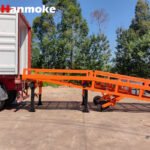
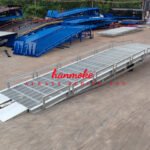
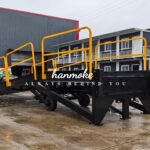
Ask three suppliers why a mobile yard ramp is 2,200 mm wide and you will get three answers: stability, forklift clearance, and “that is the standard”. None of them is the real reason. The real reason is a container door. Two thousand two hundred millimetres is the widest deck that still ships inside a standard 40 ft high-cube box with enough margin for the loading crew to walk it in, and most of the industry has been designing backwards from the shipping constraint ever since.
That is not a scandal. It is a design compromise that works for the majority of buyers, because the majority of buyers run 2.0–3.0 t forklifts with palletised loads. It stops working the moment your fleet gets wider, your loads get longer, or your site approach is not square. This article gives you the numbers to check your own case instead of accepting the default.
Where 2,200 mm Actually Comes From
A 40 ft high-cube container has an internal width of about 2,352 mm (92.6 in) and a door opening of about 2,340 mm (92.1 in). A 2,200 mm deck therefore enters with 76 mm of clearance per side inside the box and 70 mm per side at the door. That is a tight but routine loading job: the ramp goes in on its side or on a skid, and the crew walks it through with pinch bars.
Push the deck to 2,400 mm and the arithmetic collapses. It will not pass the door. You are then shipping on a flat rack or as breakbulk, which changes the freight from a few hundred dollars inside a shared container to a dedicated booking with lashing, port handling and a much longer transit. On a single 10 t ramp, that difference is often USD 1,800–3,500 per unit, and it is the reason 2,500 mm ramps are rare rather than better.
Two other constraints reinforce the number. European road vehicles are limited to 2,550 mm overall width, so a 2,600 mm deck cannot travel legally on a standard trailer without an escort regime. And the standard pallet is 1,200 × 800 mm: two pallets side by side give 1,600 mm, which leaves 600 mm of deck for the forklift to be less than perfect.
The Number That Matters: Clear Width
Overall width is a marketing figure. What the operator sees is clear width between the guard rails, and that is where the 2,200 mm promise quietly shrinks. A typical ramp carries a 200 mm high rail on a 60 mm post plus a 40 mm kerb plate. Take 100 mm off each side and a 2,200 mm deck gives you roughly 2,000 mm of usable travel width.
| Deck overall width | Rails and kerbs (each side) | Clear travel width | Forklift width 1,200 mm leaves | Forklift width 1,500 mm leaves |
|---|---|---|---|---|
| 1,800 mm / 5’11” | 100 mm | 1,600 mm | 200 mm per side | 50 mm per side |
| 2,000 mm / 6’7″ | 100 mm | 1,800 mm | 300 mm per side | 150 mm per side |
| 2,200 mm / 7’3″ | 100 mm | 2,000 mm | 400 mm per side | 250 mm per side |
| 2,400 mm / 7’10” | 100 mm | 2,200 mm | 500 mm per side | 350 mm per side |
Our working rule is 150 mm minimum each side at the tightest point, and 300 mm preferred. Below 150 mm you are asking an operator to place a 3 t machine within a hand’s width while looking over a load, on a slope, in the rain. It happens. It also produces the kerb damage you see on used ramps at year three.
Fleet Widths, Measured at the Counterweight
Forklift width is quoted at the chassis, but what matters is the widest part of the machine plus whatever the load does. The table below uses typical figures for common classes; check your own data plate rather than trusting a class average.
| Equipment | Typical width | Minimum clear deck | Comfortable deck |
|---|---|---|---|
| 1.5–2.0 t three-wheel electric | 1,000–1,100 mm / 39–43 in | 1,300 mm | 1,600 mm |
| 2.0–2.5 t four-wheel electric or LPG | 1,070–1,200 mm / 42–47 in | 1,400 mm | 1,700 mm |
| 2.5–3.5 t diesel | 1,200–1,400 mm / 47–55 in | 1,600 mm | 1,900 mm |
| 5.0 t diesel | 1,400–1,600 mm / 55–63 in | 1,800 mm | 2,100 mm |
| 8–10 t heavy | 1,800–2,200 mm / 71–87 in | 2,200 mm | Custom deck |
| Reach truck | 1,270 mm / 50 in | 1,450 mm | 1,750 mm |
| Electric pallet truck | 700–800 mm / 28–31 in | 1,000 mm | 1,300 mm |
A 2,200 mm deck comfortably takes everything up to a 3.5 t diesel forklift. It takes a 5 t machine with 250 mm per side, which is workable for a disciplined operator and uncomfortable for everyone else. It does not take an 8 t machine with a wide load, however the datasheet reads.
Loads That Sweep Wider Than the Forklift
The figure that catches people is the load, not the truck. A 6 m bundle of timber or a 6 m length of pipe carried across a ramp does not stay inside the forklift’s width: as the machine yaws a few degrees to correct its line, the ends swing out. The swept width is close to load length × sin(angle) + load width × cos(angle). At 10° of yaw, a 6 m load swings about 1,040 mm sideways at each end, so an 800 mm wide bundle occupies roughly 1,830 mm of deck.
On a 2,000 mm clear deck, that leaves 85 mm per side — the full deck, at a modest steering correction. That is why timber yards, pipe plants and steel service centres rarely buy the standard width: they buy 2,400–2,600 mm decks, or they handle long material with a side-loader on flat ground and use the ramp only for the forklift. If your product is longer than 4 m, size the deck from the load sweep, not from the truck.
Attachments have the same effect in a different direction. A side-shift carriage moves the load 100–150 mm off centre by design. A clamp or a bale clamp adds 150–250 mm of width and moves the load centre forward. On a 2,000 mm clear deck with a 1,400 mm forklift, a 150 mm side shift leaves 225 mm on one side and 75 mm on the other. The operator will use the side shift at the lip, because that is what it is for.
The Gateway Problem: 2,340 mm Doors
Geometry is unforgiving at the container face. A 2,200 mm deck against a 2,340 mm door leaves 70 mm per side, which means the ramp must be presented square. Any diagonal approach — a tight yard, a trailer parked at an angle, a 40 ft box on uneven ground — puts the deck corner into the door frame before the lip reaches the floor.
Two practical answers. First, order a deck with a chamfered or tapered nose so a small misalignment slides rather than catches. Second, plan the approach: the ramp needs a straight run at least as long as the ramp itself, and the trailer needs to be chocked and square before the ramp is pushed in. If your yard cannot give a straight run, a shorter container ramp with a steeper slope is often the better tool than a full-length yard ramp, even though the slope is worse.
What Extra Width Costs
Width is cheap steel and expensive freight. In our own quoting, each additional 200 mm of deck adds roughly 5–8% to the EXW price of a 10 t ramp, because the deck plate, cross members and main beam spacing all grow. The freight consequence is larger and less obvious.
| Deck width | Price vs 2,200 mm | 40 ft HC fit | Freight implication |
|---|---|---|---|
| 1,800 mm / 5’11” | −6 to −8% | Yes, easy | None |
| 2,000 mm / 6’7″ | −3 to −5% | Yes | None |
| 2,200 mm / 7’3″ | Base | Yes, 76 mm per side | None |
| 2,400 mm / 7’10” | +6 to +9% | No — door is 2,340 mm | Flat rack or breakbulk, +USD 1,800–3,500 |
| 2,600–3,000 mm | +12 to +20% | No | Flat rack, lashing, escort rules in EU |
On a USD 11,500 ramp, going from 2,200 to 2,400 mm costs about USD 700–1,000 in steel and another USD 1,800–3,500 in freight. That is a 20–35% increase for 200 mm. If you genuinely need the width, pay it. If you need it because one operator once scraped a rail, fix the procedure instead.
A Four-Question Sizing Method
1. What is the widest single object that must cross? Take the forklift width, add the attachment offset, add the load overhang. That number, not the forklift alone, is your starting point.
2. What is the narrowest gateway on the route? Container door 2,340 mm, trailer door 2,340–2,500 mm, building door frame, yard gate. The gateway usually decides the deck, not the ramp.
3. How square is the approach? A straight run shorter than the ramp length means the operator arrives at an angle. Add 100 mm of clearance per side for every 5° of expected misalignment.
4. Will the fleet change within five years? Most warehouses move from 2.5 t LPG to 2.0 t electric, which is narrower. Yards that grow move the other way. Buying 2,200 mm now and 2,600 mm in three years is the expensive path.
Then apply the rule: clear width ≥ widest object + 300 mm. Check that result against the gateway. If the gateway wins, the answer is not a narrower ramp — it is a different loading method, a dock leveler at a fixed door, or a container ramp that never has to pass a door.
Frequently Asked Questions
Is a 2,200 mm ramp wide enough for a 3-tonne forklift?
Yes. A 3 t forklift is typically 1,200–1,400 mm wide, which leaves 300–400 mm per side on a 2,000 mm clear deck. The limit arrives with wide loads and attachments, not with the truck itself.
Can a 2,500 mm ramp ship in a container?
No. A 40 ft high-cube door is about 2,340 mm wide. Wider decks ship on a flat rack or as breakbulk, which adds USD 1,800–3,500 and several weeks. Bolt-on extension rails shipped separately are the usual compromise.
Does a wider deck increase the load rating?
No. Capacity comes from the main beams, deck plate thickness and axle load distribution. A wider deck spreads wheel loads slightly but does not raise the rating; only a heavier structure does.
Do guard rails reduce usable width?
Yes. A 200 mm rail on a 60 mm post plus a 40 mm kerb removes roughly 100 mm per side, so a 2,200 mm deck gives about 2,000 mm of clear travel width. Ask for clear width in the quotation, not overall width.
Send Us Your Fleet Width and We Will Size the Deck
If you send us the forklift model, the widest load and a photo of the approach, we will tell you whether the standard 2,200 mm deck works or whether you need a custom width — and what that does to freight. Start with the mobile yard ramp range for the standard widths or the container ramp if your constraint is a container door. For 5 t machines, look at the heavy-duty hydraulic yard ramp; the standard 10 t model is on the HRYS product page. Or send the dimensions to our engineering team and we will come back with a drawing.