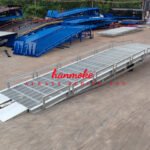
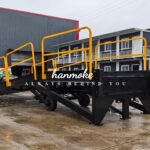
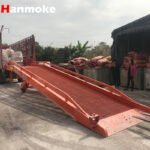
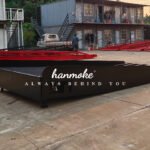
The deck is the only part of a yard ramp a forklift actually touches, and it is the part buyers specify last. Most purchase orders say “10 ton, 2,200 mm wide, 10,300 mm long” and stop there, as though the walking surface were a cosmetic choice. It is not: the deck decides whether a loaded forklift stops on a wet February morning, whether the ramp still looks straight after four years of steel wheels, and whether the repair in year six is a weld or a whole new deck. Here is how the three surfaces actually behave, with the numbers behind the claims.
What the Three Surfaces Actually Are
Steel bar grating is a grid: load-bearing bars running the length of the ramp, joined by cross bars. In North America it is specified against ANSI/NAAMM MBG 531, the Metal Bar Grating Manual, which carries the load tables; the base steel is normally ASTM A36 and the finish hot-dip galvanised to ASTM A123. A designation like 19-W-4 reads as 19/16 in bearing bar pitch, welded construction, 4 in cross bar pitch. In metric markets the same product is written 30 × 100 mm or 40 × 100 mm with a 25 × 5 mm bar. Serrated bars carry a rolled sawtooth 1.0–1.5 mm deep, three to five teeth per 25 mm.
Checkered plate — diamond plate, tread plate — is a solid rolled floor plate to ASTM A786/A786M, with a raised pattern rolled into the surface rather than cut into it. On a yard ramp it is usually 5 mm (0.2 in) or 6 mm (0.24 in) thick, and often specified with a raised diamond mesh overlay for extra grip. It is the cheapest way to build a deck and the easiest to repair in the field.
Timber matting is hardwood plank, 25–40 mm thick, bolted or clamped over a steel frame. You will find it on rental fleets, on used ramps imported from Europe, and on low-cost portable units. It is quiet under wheel, kind to non-marking tyres, and the shortest-lived of the three by a wide margin.
| Property | Serrated steel grating | Checkered plate (5 mm) | Timber matting (40 mm) |
|---|---|---|---|
| Governing standard | ANSI/NAAMM MBG 531; ASTM A36; ASTM A123 | ASTM A786 / A786M | No product standard; mill cert only |
| Typical mass | 27–35 kg/m² depending on pitch | 39 kg/m² | 22–30 kg/m² (dry) |
| Open area | 70–80% | 0% | 0% |
| Drainage | Through the deck | Across the surface only | None; absorbs |
| Field repair | Swap a panel | Weld a patch | Replace planks |
| Typical service life, heavy use | 10–15 years | 5–8 years | 3–6 years |
Traction: What the Numbers Say, and What They Don’t
Every supplier quotes a friction coefficient. Almost none of them tell you the test method, and the method dominates the number. A published comparison run at the University of Michigan (Redfern) on bare steel grating found 0.37 dry and 0.35 wet for plain bars, and 0.41 dry against 0.32 wet for serrated bars. Read that again: on that test, serration bought four hundredths when dry and lost three hundredths when wet. It is one study, on one surface condition, commissioned by a coated-flooring manufacturer — but it makes the point that marketing tables deserve suspicion.
The engineering conclusion is more useful than any single coefficient. Serration exists to bite into boot soles and to break the water film under a tyre at low speed. It does not create grip out of nothing, and the teeth are 1.0–1.5 mm deep — they wear flat long before the bar does. What actually keeps a ramp safe is drainage, and that is a geometry question, not a texture question.
| Condition | Serrated grating | Checkered plate, pattern intact | Checkered plate, pattern worn |
|---|---|---|---|
| Dry, clean | Good | Good | Fair |
| Wet, free water | Good — water falls through | Poor — water sheets downhill | Poor |
| Frost, black ice | Fair — ice bridges the openings at fine pitch | Poor | Very poor |
| Oil or hydraulic spill | Fair | Poor | Very poor |
| Sawdust, grain dust, sand | Good — falls through | Fair — packs into the pattern | Poor |
There is a compliance hook here worth knowing. OSHA 29 CFR 1910.22(a)(3) lists snow and ice among the hazards that must be cleared from walking-working surfaces, and (a)(2) requires surfaces to be kept clean and, to the extent feasible, dry. ANSI/ASSP A1264.2 uses 0.50 as its reference friction threshold for walking surfaces under its stated test conditions. Neither is a ramp-specific rule, and neither will be measured on your ramp — but if an incident is investigated, “the surface could not drain” is a hard sentence to defend.
Point Loading: Where a Deck Actually Fails
Nominal tonnage tells you very little about a deck. What matters is the wheel load and the contact patch. A 3-tonne forklift carrying 1.5 tonnes puts roughly 85% of that 4,500 kg on the front axle — call it 1,900 kg per wheel, sitting on a patch about 200 × 150 mm. On grating, that wheel sits across three or four bearing bars at 30 mm pitch. On plate, it sits on a 5 mm sheet spanning between cross members.
That is why the cross-member spacing, not the plate thickness, is the number that decides whether a plate deck survives. Weld a 5 mm plate to cross members at 600 mm centres and it will oil-can under a laden forklift from the first week: the plate deflects, the paint cracks at the weld toe, water gets in, and the deck rusts from the inside where you cannot see it. At 300 mm centres the same plate is stiff and the welds are in compression rather than peel. The plates we build for 10-tonne ramps are 5 mm with a raised 5 mm diamond mesh, on 300 mm cross-member spacing — and that spacing is in the drawing, not in the brochure.
| Deck build | Governing limit | Failure you will actually see |
|---|---|---|
| Grating, 25 × 5 bar at 30 mm pitch | Bearing bar bending between cross bars; NAAMM load table deflection | Bent bars from dropped loads; cross-bar weld cracks at the wheel path |
| Grating, 25 × 5 bar at 40 mm pitch | Same, but 35 mm clear opening | As above, plus small wheels dropping into the gap |
| Plate, 5 mm on 300 mm centres | Plate bending stress; weld toe fatigue | Pattern wear first, then weld-toe cracking, then internal corrosion |
| Plate, 5 mm on 600 mm centres | Deflection, not stress | Oil-canning, cracked welds, water ingress within 18 months |
| Timber, 40 mm on 400 mm bearers | Bearing and fastener pull-out | End rot where water sits, longitudinal splits, loose planks |
Water, Frost and Wash-Down
Water is the difference between a deck that lasts eight years and one that lasts fifteen, and it is the argument grating wins outright. Rain, meltwater and wash-down pass straight through a 70–80% open deck. On plate, water sheets downhill and pools wherever the frame is not perfectly drained — which, on a ramp parked outdoors, is every low point at the lip.
Frost changes the calculation. Open grating lets cold air circulate underneath, so meltwater does not refreeze into a glaze on the surface; but at a fine 30 mm pitch, ice can bridge the openings and turn the deck into a solid, slick sheet anyway. This is why the honest recommendation for a cold-climate yard is not “grating” but “grating plus a written ice-clearing routine”, and why the ramp should never be parked where the discharge from a roof drain lands on it. A ramp that ices up at the bottom third is a ramp someone will drive down too fast.
Small Wheels and Grating Openings
This is the failure nobody specifies for, and it is the reason a hybrid deck exists. Grating is sold as universal, but its clear opening — pitch minus bar thickness — is what a wheel has to cross. At 30 mm pitch with a 5 mm bar, the gap is 25 mm; at 40 mm pitch it is 35 mm. A 300 mm pneumatic forklift tyre crosses a 35 mm gap without noticing. An 80 mm nylon pallet-truck wheel drops into it, and a 50 mm castor on a powered pallet truck jams.
The rule we give customers is simple: keep the clear opening at or below one third of the smallest wheel diameter in the fleet. For an 80 mm wheel that means 25 mm clear, which means 30 mm pitch. For a mixed fleet running three-wheel forklifts and hand pallet trucks, we build the deck as grating with a solid checkered walking strip down the centre of the wheel path — drainage where the water runs, solid steel where the small wheels actually go. It is a heavier, more expensive deck than plain grating and it is the only one that works for that fleet.
The Ten-Year Cost of Each Surface
Deck cost is not the purchase price. On a 10-tonne, 2,200 × 10,300 mm ramp the deck is about 22.7 m², and what you spend over ten years depends on how often you replace it, how often you weld it, and what a day of downtime costs at your dock.
| Deck (10 t ramp, 22.7 m²) | Replacement cost, indicative EXW | Expected replacements in 10 years | What else you pay for |
|---|---|---|---|
| 5 mm checkered plate + mesh | USD 900–1,400 | 1, sometimes 2 | Weld repairs at 3–4 years; pattern wear reduces grip |
| Serrated galvanised grating | USD 1,600–2,400 | 0–1 | Panel swaps only; no painting, no internal corrosion |
| Timber matting, 40 mm hardwood | USD 700–1,100 | 2–3 | Labour each time; fastener replacement; slip risk when wet |
Prices are guidance for budgeting only, EXW Foshan, and not a quotation — deck cost moves with steel and with galvanising, and a custom width changes the number. The comparison that matters is the middle column plus the third: the cheapest deck is rarely the cheapest ten years.
Matching Surface to Application
| Application | Recommendation | Reason |
|---|---|---|
| Outdoor yard, rain and snow, multi-shift | Serrated galvanised grating, 30 mm pitch | Drainage, no repainting, panel-level repair |
| Covered dock, dry loads, pneumatic tyres | 5 mm checkered plate | Lowest cost, smooth rolling, easy field repair |
| Hand pallet trucks and 3-wheel forklifts | Grating with solid centre strip, or plate | Clear opening must stay under a third of wheel diameter |
| Food, beverage, wash-down | Grating, galvanised or stainless | Hose-down drainage; no standing water in joints |
| Freezer and cold store | Plate | Ice bridges fine-pitch grating; plate is easier to clear |
| Rental fleet, low capital budget | Plate | Cheapest, weldable anywhere, acceptable to a renter |
| Paper, board, non-marking tyres | Timber or plate | Bare steel marks product; timber is quiet but short-lived |
What to Write in the Purchase Order
Most deck complaints trace back to a purchase order that specified a tonnage and nothing else. Four lines fix that:
- Wheel data, not just tonnage. “Maximum wheel load 1,900 kg per wheel, smallest wheel diameter 80 mm.” Those two numbers let the factory size the deck correctly; “10 ton” does not.
- Deck build in full. “Bearing bars 25 × 5 mm at 30 mm pitch, serrated, hot-dip galvanised to ASTM A123, minimum 70 µm; cross bars 6 mm at 100 mm; panels welded to the frame.”
- Support spacing. For plate decks, state the maximum cross-member spacing — 300 mm for a 5 mm plate under a 10-tonne ramp — and require the perimeter to be seal-welded so water cannot enter between plate and frame.
- The rating basis. Ask whether the rated capacity assumes a uniformly distributed load or a specified wheel load. Both are legitimate; only one tells you what happens under a laden forklift on one wheel.
Questions We Get Asked
Is serrated grating worth the extra cost over plain?
Yes on ramps, for boots more than for tyres. Serration adds a small percentage to the deck price and gives a measurable edge at walking pace. Do not expect it to compensate for a deck that cannot drain.
Can I replace a plate deck with grating later?
Usually yes, if the frame and cross members are sound and the side rails are deep enough to take the grating. Check the overall height: 40 mm grating sits lower than a plate on a 300 mm frame, so lip height and approach ramp geometry may need adjusting.
How thick should a checkered plate deck be for a 10-ton ramp?
5 mm (0.2 in) on 300 mm cross-member spacing is the practical minimum for a 10-tonne ramp; 6 mm (0.24 in) is worth it above 15 tonnes or where the ramp is moved daily and the deck takes impact.
Does galvanising matter as much on the deck as on the frame?
More. The deck is where water sits, where the pattern wears through the coating first, and where you cannot repaint once it is assembled. Hot-dip galvanised grating at 70 µm or more is the difference between a fifteen-year deck and an eight-year one.
Tell us the wheel load, the smallest wheel diameter in your fleet and where the ramp will sit, and we will specify the deck rather than guess it. Send those three numbers through our contact page and we will return a drawing with the deck build written on it. For reference builds, the heavy-duty hydraulic yard ramp runs a grating deck and the standard hydraulic yard ramp runs checkered plate — same frame family, different duty. Galvanised variants are grouped under galvanised forklift ramps, and the full range sits in mobile yard ramps.