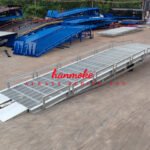
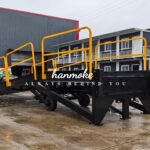
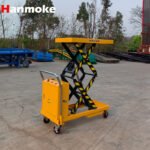
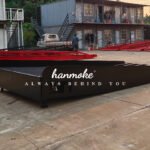
Two machines show up in almost every inquiry that starts with the words “we have no loading dock”: the mobile yard ramp and the stationary scissor lift table. They look like substitutes and they are not. One climbs a grade to reach a trailer bed; the other lifts a pallet vertically in place. Buying the wrong one is an expensive way to learn the difference — a scissor table that cannot reach a trailer bed is a workshop asset, not a dock, and a yard ramp used as a stationary lift wastes half its capability. This article compares the two the way our engineers actually size them: by job geometry, slope physics, capacity, cost and duty cycle.
Two Different Jobs: Vertical Lift vs Ground-to-Trailer Grade
A scissor lift table does one thing well: it raises and lowers a load vertically at a fixed point. Typical stationary units carry 0.5–10 t (1,100–22,000 lb) with platform sizes from about 1.2 × 1.0 m up to 3.6 × 2.0 m, lifting between 1 and 6 m. They are superb at dock leveling, mezzanine feeding, machine tending and work positioning — anywhere the load arrives at the platform and stays there.
A mobile yard ramp solves a different geometry problem: connecting ground level to a trailer bed that is 1.1–1.6 m (43–63 in) high, and doing it at whichever truck happens to be parked in the yard. It is a bridge, not a lift. The forklift provides the vertical movement by driving up the grade; the ramp just has to make that grade safe and climbable. Everything that follows — length, width, capacity, cost — flows from that distinction.
Spec-by-Spec Comparison
The table below lines up the two machines as we quote them for export orders. Prices are guidance ranges for typical Chinese factory EXW terms, not quotations — capacity, platform size and options move each number.
| Specification | Stationary scissor lift table | Mobile yard ramp |
|---|---|---|
| Typical capacity | 0.5–10 t (1,100–22,000 lb) | 6–20 t (13,200–44,000 lb) |
| Platform / deck size | 1.2×1.0 m to 3.6×2.0 m (47×39 to 142×79 in) | 10,300×2,200 mm typical (33’10″×87 in) |
| Working height | 1–6 m (39–236 in) lift travel | 1,100–1,600 mm trailer bed range (43–63 in) |
| Installation | Free-standing or pit-mounted; fixed position | None — tow it into place, connect lip |
| Power | 380V/415V 3-phase, 1.5–3 kW | Manual hydraulic standard; electro-hydraulic optional |
| Moves between trucks | No | Yes — repositioned in minutes by one forklift |
| Indicative EXW price | USD 2,000–14,000 | USD 9,000–20,000 |
The price gap surprises buyers. Chinese domestic market price lists for stationary scissor tables in 2025 run from about RMB 9,000–13,000 for a 1 t / 1.8 m unit up to RMB 45,000–70,000 for a 10 t / 4 m heavy model — roughly USD 1,800–10,000 at current exchange rates before export packaging. Even allowing for export-spec components, a scissor table rarely exceeds USD 14,000 EXW. A 10-ton hydraulic yard ramp starts around USD 11,000–12,500 EXW. So the real decision is not “which is cheaper” but “which geometry fits the job.”
The Slope Problem: Why Trailers Force a Ramp Design
Here is the calculation that decides the purchase more often than anything else. To reach a trailer bed, any ground-level bridge becomes an inclined plane. The slope is height divided by length, and forklifts have hard limits on it. OSHA 29 CFR 1910.178(n)(7)(i) requires that when any part of a powered industrial truck, other than the wheels, is on a ramp with a grade exceeding 10%, the load must face upgrade — a clear signal that grades above 10% are hazardous territory for loaded forklifts.
Work the numbers for a 1.5 m (59 in) trailer bed. A ramp that keeps the grade at or below 10% must be at least 15 m long. That is why full-size yard ramps run 10.3–12 m (33’10″–39’4″) overall: at 10,300 mm for a 1.4 m bed the grade is about 13.6%, and shorter beds bring it under 10%. A scissor lift table has a platform measured in meters, not tens of meters. Put a 2 m platform against a trailer bed and you would need a 75% grade — physically unusable for any forklift carrying a real pallet load. This is the single fact that disqualifies scissor tables from trailer work, and it is non-negotiable because it comes from geometry, not from product marketing.
There is a corollary worth knowing: the longer the ramp, the gentler the grade. If your trailer fleet runs tall — refrigerated trailers at 1.5–1.6 m (59–63 in) — check the ramp’s rated height range before ordering. A ramp rated 1,100–1,450 mm will be steep and uncomfortable at a 1.6 m bed.
Capacity and Load Path: The Differences Nobody Quotes
The second big difference is how each machine carries load. A scissor table’s rating is a static-ish rating at the platform center; the load sits still. A yard ramp’s rating is a dynamic rating — a loaded forklift driving up it, which multiplies effective load through the wheels and creates point loads where the tires cross the deck support spacing. A 3-ton forklift carrying 3 tons of pallet puts more than 6 tons (13,200 lb) of rolling load on the deck, concentrated on two front tires. This is why yard ramps are built heavier per ton of rating: 5 mm (0.2 in) checkered plate over closely spaced cross members, Q345B main beams, and solid tyres on the tow axle rated for the whole frame.
It also explains the capacity mismatch in the table. Scissor tables are commonly bought at 1–3 t for pallet handling; yard ramps are bought at 10 t and up because the machine must carry forklift plus load plus its own climbing dynamics. If your heaviest combination is a 2-ton forklift with a 1.5-ton pallet, a 10-ton ramp is the normal choice, not an upsell.
What Each Machine Actually Costs Over Five Years
Beyond the purchase price, the cost picture splits along fixed vs mobile lines. A scissor table in a pit has civil works — excavation, formwork, drainage — that typically adds USD 1,500–4,000 per position. A free-standing table needs guarding rails and may obstruct floor traffic. Its maintenance is modest: annual hydraulic oil change, seal checks. A yard ramp has no installation cost at all, needs the same hydraulic service, plus periodic greasing of lip hinge pins and a hand-pump oil top-up. The table below summarizes a five-year view for a single loading position.
| Cost item (5-year) | Scissor lift table (pit-mounted, 2 t) | Mobile yard ramp (10 t) |
|---|---|---|
| Equipment EXW | USD 4,000–7,000 | USD 11,000–12,500 |
| Civil works / installation | USD 1,500–4,000 | None |
| Maintenance (5 yr) | USD 300–800 | USD 600–1,200 |
| Relocation flexibility | None once pitted | Full — moves site to site |
| Indicative 5-yr total | USD 5,800–11,800 | USD 11,600–13,700 |
Read that table honestly: a fixed scissor table is cheaper if, and only if, its fixed position is actually where your loading happens. If trucks berth in different spots, or you load outside in the yard, the scissor table’s advantage evaporates — you would need one per berth, and the totals invert quickly at three positions or more.
When a Scissor Lift Table Is the Right Answer
Buy a scissor table when the job is vertical, not sloped: feeding a mezzanine or packing line, work positioning at a fixed machine, bridging a mezzanine floor level to ground inside the building, or acting as a fixed dock-level substitute at one berth with consistent truck heights. In those jobs it beats a ramp decisively — precise height control, small footprint, no grade for the forklift to climb, and cycle counts in the tens of thousands. We supply both machines, and we would rather sell a customer a USD 5,000 table that fits than a USD 12,000 ramp that does not.
When a Mobile Yard Ramp Wins
Buy a yard ramp when the destination is a trailer bed or a container, when trucks park in more than one spot, or when the facility has no dock and may never build one. Renters and 3PLs favor ramps precisely because they leave with the operation; a pitted scissor table does not. Container work tips the decision further — a yard ramp’s lip connects directly to a container floor at roughly ground level plus 150–200 mm, and ramp widths of 2,200 mm (87 in) let a forklift circle inside a 40’HC. Ground-level container loading without a dock is the classic ramp job, and no scissor table does it.
The Hybrid Setup We Ship Most Often
Plenty of plants end up needing both. A common configuration: one mobile yard ramp for yard trucks and containers, plus a small 1–2 t stationary scissor table at the production line for work positioning. The two rarely compete for budget because they serve different flows. If you can only buy one, size it by answering three questions: Do trucks berth at one fixed point? Is the destination a trailer bed or a machine? Will the operation move within five years? One “no” to the first or a “yes” to the third points to the ramp.
Frequently Asked Questions
Can I use a scissor lift table to load trailers?
No, not directly. Even a large table platform is far too short to reach a trailer bed at a walkable grade, so it cannot bridge the gap. Scissor tables serve fixed vertical-lift positions; trailer access needs a ramp of 10 m or more to keep the slope near or below 10%.
What slope is safe for a forklift on a yard ramp?
Keep the grade at or below 10% wherever possible; OSHA 1910.178(n)(7)(i) requires loads to face upgrade on grades above 10%. Full-size yard ramps achieve roughly 8–14% depending on trailer height, which is why deck length matters more than deck width when comparing quotes.
How much does a scissor lift table cost compared with a yard ramp?
Chinese EXW guidance: stationary scissor tables run about USD 2,000–14,000 depending on capacity and lift, while a 10-ton mobile yard ramp starts around USD 11,000–12,500. But cost per position, not unit price, is the fair comparison once installation and flexibility are counted.
Can a scissor table and a yard ramp work together?
Yes, and it is a common combination: the ramp handles yard trucks and containers, the table handles fixed in-plant lifting. They serve different geometry, so they complement rather than replace each other.
Still deciding? Tell us your trailer heights, forklift fleet and berth count, and our engineers will size the right machine — ramp, table or both. Browse the mobile yard ramp category, compare our 10-ton standard hydraulic yard ramp and 15-ton heavy-duty model, or see the lighter HRPL lightweight platform for smaller lifts. Contact us for drawings and a quote — replies within 24 hours, prices EXW Foshan with container loading included.