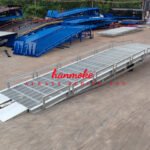
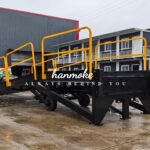
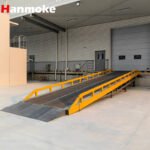
On a warehouse yard with a concrete apron, ground conditions are a non-issue: any yard ramp stands on its legs and works. On a construction site, a borrow pit, a temporary yard on compacted fill, or a quarry access road, the ground itself becomes part of the design — and it is the part most likely to fail quietly. A ramp leg that sinks 50 mm does not break anything dramatic; it just leaves the deck slightly out of level, the lip slightly off the trailer bed, and an operator who will not sign off on the setup. This article works through the load paths that push a ramp into soft ground, the soil values worth comparing against, and how to size mats without a structural engineer on standby.
Why Ramps End Up on Ground That Cannot Carry Them
Construction sites have an attractive logic: the ramp arrives with the site office, gets positioned wherever trucks approach, and stays for the project duration. But the ground under a temporary yard is usually compacted fill or native soil, not the 200–400 kPa bearing a structural slab provides. And unlike a crane or an excavator, a yard ramp looks small enough that nobody thinks of it as a foundation problem.
The physics disagree. A 10-ton hydraulic yard ramp typically weighs 2.5–4 tonnes in steel — comparable market units run 2,450 kg (HC Lifting) to 4,050 kg (Ramp Factory TRP-YR10-2) — and it carries that weight on four support legs with base plates measured in hundreds of millimeters, not on the hundreds of square meters a crane mat uses. Concentrate a few tonnes onto a small plate on fill that was rolled to support a 6-ton truck wheel, and settlement is a question of when, not whether.
Load Path One: Support Legs, the Quiet Killer
The support legs are the primary worry. On our standard hydraulic ramps the legs are rated at 28 t static capacity each — that is the leg, not the ground. When the ramp stands empty, self-weight splits roughly evenly across four legs; take a 3.5-tonne unit as a middle example and each leg carries about 875 kg. With a 400 × 400 mm base plate (0.16 m²), that is roughly 54 kPa of contact pressure. On dense or compact sand or gravel that is comfortable. On soft clay it is already over the limit.
The loaded picture is worse and uneven. When a forklift sits mid-deck, load distribution shifts toward the legs nearest the wheel, and a reasonable conservative check is that one leg sees 30–40% of the total live load. Put numbers on it: a 10-ton capacity ramp will commonly carry a 2.5–3 ton forklift with a matched load. Say 4 tonnes of live load lands transiently on the ramp frame; if one leg takes 35% of it plus its share of self-weight, that leg sees roughly 2,275 kg. On the same 400 mm plate that is 140 kPa — at the dense-gravel limit and far past soft clay.
| Condition | Load on one leg | 400×400 mm plate pressure | Verdict on soft clay (40–50 kPa) |
|---|---|---|---|
| Ramp empty, 3.5 t self-weight | 875 kg | ≈54 kPa | Over limit |
| Forklift + load on deck, worst leg | ≈2,275 kg | ≈140 kPa | Severely over |
| Same, on 2 × 2 m mat | ≈2,275 kg | ≈5.7 kPa spread area 4 m² | Comfortable |
The fix is arithmetic, not heroics: double the mat side length and the pressure drops to one quarter. That is why a pair of 2 × 2 m timber mats or steel spreading plates under the two most-loaded legs solves most site setups for the price of an afternoon.
Load Path Two: Rolling Wheel Loads
Legs stand still; wheels travel — and a fully loaded forklift climbing a ramp concentrates enormous force on four small contact patches. A 2.5-ton electric forklift with a rated load on the forks puts about 5,390 kg on the front axle (Hangcha’s published specification for the lithium model), roughly 2,700 kg per front wheel. On a contact patch around 250 × 100 mm, that is over 1 MPa against the steel deck — harmless to the deck, because steel spreads it into the frame. What matters for the ground is where that load ends up: at the bottom of the ramp, each wheel lands on the ground itself, or on the transition plates.
This is why the bottom 3–4 m of a site ramp deserves more than compacted soil. Loose gravel that looks fine underfoot will rut under repeated wheel passes at 2.7 tonnes each. Our standard practice for site installations is a graded, compacted approach pad or a pair of steel road plates at the ramp foot — the wheels cross that strip at low speed, but dozens of times per shift, and rutting there also changes the ramp’s entry angle.
Angle is worth a sentence of its own: OSHA 29 CFR 1910.178(n)(7)(i) requires a loaded forklift to travel with the load upgrade on any grade steeper than 10%. A ramp at 9° is already a 15.8% grade, so the rule of the day is simple — loaded climbing, and keep speed to a walk. That is a safety rule, but it also protects the ground: a forklift that wheelspins on a loose approach digs it up fast.
Load Path Three: Everything at the Lip End
The third path is the one people forget: when the ramp’s lip rests on a trailer bed, the trailer carries the end of the ramp — until the truck leaves. A ramp left standing with its lip unsupported, or propped on the wrong height of blocking, turns its whole end load into a point force on two small feet. Site crews occasionally “borrow” timber cribbing to prop a ramp lip between trucks; make sure whatever props the lip carries load over an area, not on a 100 × 100 mm sleeper that will punch straight into fill.
Soil Values Worth Comparing Against
You do not need a geotechnical report to sanity-check a site — but you do need honest numbers. The table below comes from the Ontario Building Code, Table 9.4.4.1, which publishes prescriptive maximum allowable bearing pressures for shallow foundations. These are conservative, code-published values, and the right order of magnitude for preliminary ramp checks. For final design on questionable ground, get a real geotechnical opinion; the code table assumes a competent engineer confirms the classification.
| Soil type and condition | Max allowable bearing pressure | What it means for a ramp |
|---|---|---|
| Dense or compact sand or gravel | 150 kPa | Base plates alone OK for empty ramp; mats for loaded conditions |
| Loose sand or gravel | 50 kPa | Mats mandatory; watch wheel path ruts |
| Dense or compact silt | 100 kPa | Mats recommended; silt loses strength when wet |
| Stiff clay | 150 kPa | OK for empty ramp, mats for loaded leg checks |
| Firm clay | 75 kPa | Mats mandatory; re-check after rain |
| Soft clay | 40 kPa | Not suitable without engineered mats or pads |
| Till (mixed glacial) | 200 kPa | Base plates generally OK; verify fill is not loose |
| Sound rock | 500 kPa | No concern |
Two practical field tests, straight from the code’s own notes: sand or gravel is “dense or compact” if an average worker cannot push a 38 mm square picket more than 200 mm into it, and clay is “soft” if a thumb presses in easily, “firm” with moderate pressure, “stiff” only with difficulty. Five minutes with a picket and a thumb beats any guess.
Also flag the water table: the code halves allowable pressure on sands and gravels when groundwater sits within one footing width of the bearing surface. On site terms — if a shovel hits water at 400 mm, halve every number in that table.
Sizing Mats Without Overthinking It
Load spreads downward and outward from the base plate through a mat at roughly 60° to the horizontal — the same frustum rule the building code uses for footing design. For shallow spreads, a simpler conservative version works: treat the mat itself as the bearing area. Required mat area = leg load ÷ allowable ground pressure, then add margin.
Worked example: worst leg load 2,275 kg (≈22.3 kN) on firm clay at 75 kPa. Required area = 22,300 N ÷ 75 kN/m² ≈ 0.30 m². A 700 × 700 mm pad covers it with margin, but only if the pad itself does not bend — timber mats work because they bridge, and a pad that flexes concentrates load back at the center. In practice we specify 2 × 2 m hardwood mats or steel spreading plates for site work, because the extra area absorbs the “load lands slightly off-center” reality. Doubling side length to 2 m quarters the pressure again, which buys the difference between “worked on paper” and “still fine after a week of rain.”
Layering matters more than material. A 38 mm hardwood mat directly on clay will flex under 2 tonnes; the same mat on a 150 mm compacted gravel layer behaves far better because the gravel participates in the spread. The cheapest ground improvement on any site is compaction: a plate compactor pass over the leg positions is worth more than a second mat.
A Site Checklist We Send With Every Ramp
When a ramp ships to a construction project rather than a warehouse, our delivery pack includes a one-page ground check. The essentials: confirm the setup positions are on fill that has actually been compacted, not just backfilled — ask the site engineer which areas were rolled and to what standard. Mark leg positions at least 300 mm clear of slab edges, trenches and previous excavations; disturbed ground beside a trench can carry half the pressure of undisturbed ground. Place mats or plates under all four legs whenever allowable pressure is below 150 kPa. Level the four leg positions to each other — a ramp adjusted to compensate for a settled leg runs its cylinders crooked for weeks. And re-walk the setup after the first heavy rain, because clay and silt sites lose strength in exactly the weather that makes the site busiest.
When Ground Is Really Bad: Change the Product
Some sites cannot be fixed with mats. Peat, soft organic silt, recently placed uncompacted fill — no amount of timber solves those, and the honest answer is to change the loading method instead. A modular ground-to-facility ramp bolted to a concrete pad, or a free-standing loading dock set on engineered fill, puts the load into a structure designed for it rather than onto whatever the site happens to offer. On a long-duration project, one concrete pad with a modular ramp often costs less than a season of re-compacting a muddy approach.
How much weight does a yard ramp leg actually carry?
Empty, a typical 10-ton unit spreads 2.5–4 tonnes of self-weight over four legs — roughly 875 kg per leg on a 3.5-tonne machine. With a loaded forklift on deck, transient loads on the most-loaded leg can reach 2–2.5 tonnes. The legs themselves are rated far higher (ours at 28 t static); the ground under them is the limiting factor.
Can a yard ramp sit on gravel without mats?
On dense, compacted gravel — a picket cannot be pushed in beyond 200 mm — the base plates alone are fine for an empty ramp and acceptable for light loaded conditions. Loose gravel at 50 kPa needs mats under every leg, and the wheel path at the ramp foot needs a compacted pad or road plates.
What size mat do I need for one leg?
Divide the worst-case leg load by the allowable ground pressure. A 2.3-tonne leg load on firm clay (75 kPa) needs about 0.30 m² of bearing on paper, but we specify 2 × 2 m hardwood mats or steel plates in practice to absorb off-center loading and rain-softened ground. Doubling the mat side length quarters the pressure.
Does rain change anything?
Yes, materially. Silt and clay lose allowable bearing strength when saturated, and the code halves sand and gravel values when the water table is within one footing width of the surface. Re-inspect leg positions and mats after heavy rain, and expect to re-compact any approach pad that has rutted.
If you are planning loading on unprepared ground — construction sites, quarries, temporary yards, event logistics — send us the site soil description and forklift sizes, and we will return a mat sizing and ramp specification proposal. Contact Hanmoke for drawings and a quotation, or start with our mobile yard ramp range to see which units suit site work.