Ask three suppliers what a loading dock costs and you get three numbers that cannot be compared: one quotes the concrete, one quotes the steelwork, one quotes a leveler. The only figure that matters to a capital budget is the cost of one working loading position — everything from the approach apron to the last wheel chock, installed, permitted and able to take a truck tomorrow morning.
There are three ways to buy that position in 2026: cast-in-place concrete, a welded steel free-standing dock, or a bolt-together modular platform. They are not priced on the same curve, and the cheapest first invoice is rarely the cheapest position.
What One Loading Position Actually Contains
A position is not a hole in a wall. In a conventional concrete dock it is roughly a dozen cost lines, and leaving three of them out of the comparison is how budgets go wrong:
| Element | What it covers | Who usually forgets it |
|---|---|---|
| Approach apron | 25–40 m of paved, level truck standing area | Everyone comparing equipment prices |
| Earthworks and retaining | Fill, compaction, retaining wall if the site slopes | Quotes based on a flat drawing |
| Dock structure | Pit walls, slab, thickened edges, rebar or steel frame | Budget estimates |
| Dock equipment | Leveler or lip, bumpers, restraint, door, seal | Civil contractors |
| Services | Power to the position, lighting, drainage, interlocks | Almost everybody |
| Permit and inspection | Building permit, structural sign-off, fire access review | Fast-track projects |
Route A: Cast-in-Place Concrete
Concrete is the default in North America and northern Europe, and the published 2026 numbers are wide. A specialist contractor in Ventura County, California puts concrete work for a single standard dock bay — excavation, forming, reinforcement, placement, finishing — at USD 35,000 to 65,000. Dock equipment for that bay adds a further USD 20,000 to 35,000. That is 55,000 to 100,000 dollars for one position before anyone mentions the apron.
| Concrete cost line, one standard bay (US, 2026) | Low | High |
|---|---|---|
| Excavation and grading | $4,000 | $8,000 |
| Subgrade preparation and aggregate base | $3,000 | $5,000 |
| Formwork: walls, pit, apron | $8,000 | $14,000 |
| Reinforcement and accessories | $5,000 | $9,000 |
| Concrete and pumping | $6,000 | $10,000 |
| Placement and finishing labour | $7,000 | $12,000 |
| Curing, protection, cleanup | $2,000 | $4,000 |
| Concrete work per bay | $35,000 | $65,000 |
Two things move that band. Poor soil adds roughly USD 5,000 to 15,000 per bay for over-excavation and imported fill; high groundwater adds 3,000 to 8,000 for dewatering; a sloping site can add 5,000 to 20,000 in retaining work. Multi-bay jobs do get cheaper — a four-bay project prices at roughly 120,000 to 200,000 dollars of concrete work instead of four times the single-bay rate, because mobilisation, forming and concrete delivery are shared.
What concrete buys is life. Thirty to fifty years, no coating to renew, and a dock that is part of the building rather than an asset sitting next to it. What it costs is time: 12 to 24 weeks from permit to first truck is normal, and the concrete has to cure before the leveler goes in.
Route B: A Welded Steel Free-Standing Dock
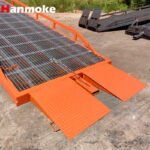
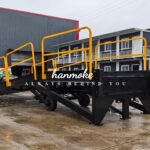
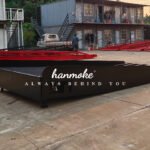
A steel dock is a structure you can load onto a ship. Ours (the HRFA range) is a welded frame with its own ramp, deck platform and guard rails, rated 6 to 60 t depending on configuration, with height and length set to the trailer fleet rather than to a building drawing.
Indicative EXW pricing for a single-position 10 t unit with a 10 m ramp is USD 9,500 to 16,000. Freight, duty and installation then do most of the damage to the budget — more on that below. The structural advantage is that the deck height is a design variable. If your trailers run 1,200 to 1,400 mm beds, the platform is set at 1,350 mm and the ramp length is calculated from the grade you are willing to accept, not from what the building already has.
The trade is permanence and weather. A welded steel dock needs its coating maintained — repaint every 6 to 10 years inland, more often on a coast unless it is hot-dip galvanised. Anchoring matters: it is a free-standing structure, but it still wants a designed foundation or a properly reinforced slab under each support, and a wind or seismic review in exposed locations.
Where it wins is speed and reversibility. Eight to twelve weeks from order to working position, most of it ocean freight. If you lease the building, or expect to move in three years, that reversibility has a price of its own.
Route C: A Bolt-Together Modular Platform
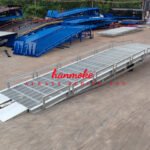
The third route is the newest and the one most often mispriced, because buyers compare it to a ramp instead of to a building. A modular platform (our HRFD) ships as prefabricated panels — deck, legs, guard rails, stairs — rated 6 to 30 t per square metre and assembled with standard tools, no heavy lifting equipment.
It sits between the other two on capital cost and ahead of both on flexibility. Positions can be added one at a time as volume grows, the deck can be extended in bays rather than rebuilt, and the whole structure can be unbolted and moved. Indicative EXW for a 20 t single-position platform is USD 18,000 to 35,000, depending on deck area, height and whether a ramp or leveler is integrated.
The design constraint is ground bearing. A platform concentrates load at its leg positions, so a slab or pad under each leg is not optional, and a yard that drains badly will need the platform set higher than you first planned.
| All-in cost, one loading position (2026 planning bands) | Concrete, cast in place | Steel free-standing dock | Modular platform |
|---|---|---|---|
| Structure | $35,000–65,000 | $9,500–16,000 EXW | $18,000–35,000 EXW |
| Dock equipment | $20,000–35,000 | $3,000–7,000 | $3,000–7,000 |
| Freight and duty to US | — | $4,800–8,000 | $9,000–17,500 |
| Site work and install | included above | $2,500–5,000 | $3,000–6,000 |
| All-in per position | $55,000–100,000 | $20,000–36,000 | $33,000–65,000 |
| Time to first truck | 12–24 weeks | 8–12 weeks | 6–9 weeks |
| Design life | 30–50 years | 20–30 years | 15–25 years |
| Relocatable | No | Crane and truck | Yes, unbolts |
Landed Cost: What Duty Does to the Steel Routes
This is where most 2026 comparisons are still wrong. The IEEPA reciprocal and fentanyl tariffs were struck down by the US Supreme Court on 20 February 2026, but a Section 301 forced-labour duty took effect on 24 July 2026 and it stacks on top of the original Section 301 lists. For machinery under HS 8428.90 from China the base rate is free, and the two Section 301 layers give 37.5%.
| Single-position steel dock, 10 t, FOB $13,000 | US (Los Angeles) | EU (Rotterdam) |
|---|---|---|
| FOB Foshan | $13,000 | $13,000 |
| Ocean freight, share of a 40 ft high-cube | $1,500 | $1,150 |
| Marine insurance, about 0.4% of CIF | $30 | $25 |
| Import duty | $4,875 (37.5%) | $0 (HS 8428.90) |
| MPF 0.3464% and HMF 0.125% | $60 | — |
| Terminal handling, documents, broker | $480 | $430 |
| Inland trucking, 320 km / 200 mi | $520 | $470 |
| Landed | ≈ $20,465 | ≈ $15,075 plus VAT |
Two practical notes. First, duty is assessed on the customs value, not the invoice including freight, so a cheaper FOB helps twice. Second, tariff lines and exclusions change — 2026 has already rewritten the US schedule three times. Have your broker confirm the 10-digit code before you sign a purchase order, and do not build a business case on a rate you read on a supplier’s website.
The Costs That Never Appear in a Quote
Downtime. A concrete dock takes a loading position out of service for three to six months. If that position handles 20 trucks a day at a 30-minute cycle, the lost throughput dwarfs the difference between routes.
Bridge capacity. During construction, most sites rent or borrow a mobile ramp to keep the bay alive. Add 1,500 to 3,000 dollars to the concrete route for a realistic project.
Permit treatment. In many jurisdictions a bolted steel platform is treated as equipment, not a structure, which shortens approvals. In others it needs a foundation design and a structural sign-off. Ask the local authority before you assume either answer.
Accounting treatment. Equipment is depreciated over 5 to 10 years and can often be financed or leased; a building improvement is depreciated over 27.5 to 39 years in the US and stays with the property. On a three-year lease, that difference matters more than the purchase price.
Ten Years, and Which Route Wins
Run all three out ten years and the ranking does not change, but the gap narrows, because steel needs coating maintenance and concrete needs almost none:
| 10-year view per position | Concrete | Steel dock | Modular |
|---|---|---|---|
| All-in capital | $55,000–100,000 | $20,000–36,000 | $33,000–65,000 |
| Maintenance and coating, 10 years | $3,000–8,000 | $2,500–5,000 | $2,500–5,000 |
| Residual at year 10 | Property value only | 30–40% | 50–60% |
| Net 10-year cost | $58,000–108,000 | $18,000–31,000 | $20,000–35,000 |
The rule we give customers is blunt. Own the building, load heavy all day for twenty years, and have the site to dig: concrete, and stop optimising. Lease the building, need the position inside a quarter, or expect the volume to change: steel, either welded or bolted. Grow one position at a time out of a yard that already has a slab: modular, and add bays as the trucks arrive.
What you should not do is compare an installed concrete price with an FOB steel price. Put both on a landed, installed, ten-year basis and the argument usually settles itself in one meeting.
Questions We Get Asked About Dock Cost per Position
Is a steel dock cheaper than concrete in every market?
No. In the US the 37.5% duty on Chinese steel structures widens the gap in concrete’s favour, and in markets with cheap labour and expensive imported steel the two can land within 20% of each other. Always price landed and installed.
Does a modular platform need a building permit?
It depends on the jurisdiction. Some treat a bolted, free-standing platform as equipment; others require a foundation design and structural sign-off. Ask before ordering — the approval path, not the steel, is usually what sets the schedule.
Can a steel dock be moved later?
A welded free-standing dock can be craned onto a truck and reinstalled elsewhere. A bolted modular platform unbolts into panels and goes back into a container. Neither is as cheap to move as it is to install the first time, but both retain resale value that concrete does not.
What maintenance should I budget per position?
Plan USD 300 to 800 per position per year for a conventional dock position — inspection, bumpers, restraint test, leveler service. Steel structures add coating renewal every 6 to 10 years, or hot-dip galvanising at the outset to push that past 20 years.
If you are comparing routes for a specific site, send us the trailer bed range, the forklift weights, the ground conditions and the number of positions. We will come back with a drawing, an EXW price and a landed estimate for your port — contact us here. For the steel options, start with the free-standing loading docks and modular loading dock platform categories, or the HRFD 20-tonne platform page and the HRFA custom dock page.