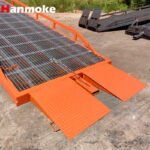
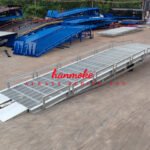
Nobody buys a mobile yard ramp to admire it, so storage sounds like an afterthought – until the ramp that cost five figures comes back from three months parked against a fence with a seized pump, a flat tyre, and a corroded lip hinge. We build these ramps in Foshan and we get the warranty calls, and the pattern is consistent: ramps that live in a planned spot with a ten-minute housekeeping routine outlast neglected ones by years. This guide covers where a ramp should live between shifts, what the ground under it needs to do, and the checklists that keep a 10-ton machine ready to roll.
Why Storage Decisions Shorten or Extend Ramp Life
A yard ramp is a welded steel structure wearing three vulnerable subsystems: the hydraulic power pack, the tyres, and the lip mechanism. Leave it standing in standing water and the pump housing and cylinder rods rust first. Park it on soft ground and the frame twists, which shows up later as a lip that will not seat flush on the trailer. Let it drift around the yard with the tow bar loose and it becomes the thing a forklift clips on a dark shift.
The repair bill tells the story. A replacement hand pump or power pack runs $400-900; a cylinder reseal with labour, $300-700; a new solid tyre, $150-350. None of these are covered under warranty when the cause is standing water or impact damage. Compare that with the cost of a marked parking bay with decent drainage: a few cans of paint and one afternoon.
The Four Storage Options Compared
Most sites use one of four arrangements. Each has trade-offs, and the right answer depends on how often the ramp actually moves.
| Option | Best for | Watch out for |
|---|---|---|
| Dock-side bay, outdoors, on hardened ground | Daily use, dedicated yard | Needs drainage and wheel chocks; exposure shortens paint and hose life slightly |
| Indoor bay near the door | Multi-shift warehouses, theft-prone areas | Consumes floor area; check door width – a 2,200 mm (7 ft 3 in) wide ramp needs a 2.5 m (8 ft 2 in) opening minimum |
| Folded / two-part parked position | Shared yards, tight sites, transport between sites | Two-part models fold to roughly half length (a 10 t HRNX-type deck drops from about 11,400 mm / 37 ft 5 in to about 5,700 mm / 18 ft 8 in); folding adds a hinge line to inspect |
| Long-term layup (seasonal or project gap) | Rental fleets, seasonal operations | Requires the full winterisation routine below, not just parking |
If your ramp only moves a few metres a week, a dock-side bay is right. If it travels between buildings or you share the yard with other traffic, the folded position on a marked bay earns its keep – the shorter footprint is far harder for a stray forklift to hit.
Choosing the Ground: Surface, Slope and Drainage
The ground does more work than people expect. A 10-ton ramp plus a loaded forklift concentrates serious point loads onto four to six small contact patches, and the bay must be designed for that, not just for the parked weight.
- Surface: sound concrete of at least 150 mm (5.9 in) thickness is the benchmark. Good-quality interlocking block works if it is laid on a compacted base and the blocks are bedded tight; the ramp’s weight will find any loose block. Avoid parking on asphalt in summer – a 10 t ramp can indent soft binder, and those depressions become puddles.
- Slope: keep the parking surface level to within about 2% (2 cm per metre, roughly 0.25 in per foot). On a steeper apron the ramp’s levelling feet run out of travel, the deck sits out of square, and the tow bar pulls to one side when repositioning. Never leave a ramp parked on a slope steeper than about 3% without both chocks set – and remember that under OSHA 1910.178(n)(7)(i), a loaded forklift travels any grade over 10% with the load upgrade, which is a reminder of how quickly grades matter once wheels are rolling.
- Drainage: the bay should shed water away from the ramp, never toward it. A ramp parked in a shallow dish keeps its cylinder rods wet for days. If the yard only offers a hollow, a cheap concrete plinth or two parking pads lifts the wheels clear of standing water.
- Clearance: mark the footprint plus 500 mm (20 in) on all sides, and keep the tow-bar end facing the direction of travel. Painted hatching is the cheapest collision protection you can buy.
Daily and Weekly Housekeeping Checklist
The routine below takes one operator about ten minutes a week. It is deliberately boring – boring is what prevents the $700 cylinder reseal.
| Frequency | Task | What good looks like |
|---|---|---|
| Each shift end | Park on marked bay, deck fully lowered, chocks set | Ramp square in the bay, lip resting on its support, no load left on deck |
| Each shift end | Wipe hydraulic cylinder rods if soiled | Bright rod surface, no film of grit or product residue |
| Weekly | Walk-around: hoses, fittings, pump housing | No weeps or fresh oil film; hoses not chafed or flattened by tyres |
| Weekly | Clear deck grating and lip hinge line | No strapping, stretch wrap, gravel or ice packed in the grating or hinge |
| Weekly | Check tyre pressure / solid tyre condition | Pneumatic tyres at spec; solid tyres free of deep chunks and flat spots |
| Weekly | Test full raise-lower cycle before first use Monday | Smooth travel, no drifting down under load, relief valve not constantly lifting |
| Monthly | Torque-check tow bar, hitch and fasteners; grease points per manual | No play in the hitch; grease present at lip and axle points |
Housekeeping obligations do not end at the ramp. OSHA’s walking-working surfaces rule at 29 CFR 1910.22 requires surfaces to be kept clean and, to the extent feasible, dry – a parked ramp that sheds mud and shrink-wrap across the yard is exactly the kind of housekeeping an inspector notices. And under 1910.178(n)(11), a ramp or dockplate must be properly secured before it is driven over; a ramp that has drifted off its chocks overnight fails that test before anyone has started work.
Hydraulics, Pump and Cylinders: Off-Shift Care
The hydraulic side punishes neglect faster than anything else on the machine. Three habits cover most of it. First, keep the deck fully lowered when parked – a deck left raised holds the cylinders extended, which exposes maximum rod area to weather and leaves the load on the pump relief. Second, keep the power pack dry: on manual-pump ramps the pump sits low at the frame end, and it is the first component to fill with water if the bay floods. A breathable equipment cover is worth more than its price here – a fully sealed tarp that traps condensation is worse than nothing. Third, cycle the hydraulics at least weekly even if the ramp is idle. Seals that sit dry for months tend to leak at the first real duty cycle; a weekly full-stroke cycle keeps the seals wet and shows up a slow drift-down while it is still cheap.
Hydraulic oil itself has a service life of roughly 12 months or 2,000 working hours, whichever comes first – shorter on dusty sites or where the ramp is washed down regularly. Log the oil change like any other service item; an oil sample is cheaper than a rebuilt pump.
Security: Ramps Are Theft and Vandalism Targets
A mobile ramp is a five-figure asset that rolls, and sites learn this the hard way. Basic measures: park inside the fence line, in camera view, with the tow bar locked or removed and stored. On shared estates, a wheel clamp or a simple ground anchor and chain costs under $150 and removes the opportunism. Mark the frame with the unit number and keep the serial record with your CE file – recovery and insurance both go smoother when ownership is provable. For rental fleets we build in a frame-mounted data plate for exactly this reason.
Winter and Long-Term Storage Prep
Before a seasonal shutdown or any layup longer than a month, run this short list:
- Wash the deck and underside, paying off salt and mud – winter road salt is the fastest corrosion path into the hinge line
- Grease all points per the manual; a film of grease on exposed cylinder rods before layup is cheap insurance
- Top the hydraulic reservoir to the correct level with the deck fully lowered
- Chock both axles, release any parked hydraulic pressure per the manual
- Cover the power pack with a breathable cover; do not wrap the whole machine in plastic
- For pneumatic tyres, over-inflate slightly (about 10%) to offset slow bleed; for long layups, move the ramp a metre every month to avoid flat-spotting
Site conditions matter in winter too. Under 29 CFR 1910.22(a)(3), snow and ice are explicitly named walking-working surface hazards, so a ramp left iced over is not just a corrosion problem – it is a citation waiting for its moment. Clear the approach, not just the deck.
Common Mistakes We See on Site Visits
| Mistake | Consequence | Fix |
|---|---|---|
| Parked in a drainage hollow | Rusted pump housing, pitted cylinder rods | Move to a shed bay or add parking pads |
| Deck left raised overnight | Exposed rods, seal drying, drift-down by morning | Full-lower before leaving the machine |
| Shared bay, no markings | Impact damage to handrails and tow bar | Paint footprint + 500 mm (20 in) hatching |
| Plastic tarp over whole ramp | Trapped condensation, worse corrosion than open air | Breathable cover on power pack only |
| Hydraulics untouched for months | Seal failure and leak at first use | Weekly full-stroke cycle on the calendar |
None of these fixes costs more than a modest service visit, which is the whole point: ramp storage is the cheapest maintenance you will ever do.
Can I leave a mobile yard ramp outside all year?
Yes, provided the bay is drained, the machine is cycled weekly, and the power pack is covered. Painted frames benefit from touch-up of chips; galvanised frames such as our HRHG series shrug off weather far longer. Standing water is the enemy, not rain.
How much space does a stored ramp actually need?
Plan for the full parked footprint plus about 500 mm (20 in) clearance each side for the tow bar and inspections. A typical 10 t ramp is around 11,400 mm (37 ft 5 in) long and 2,200 mm (7 ft 3 in) wide; two-part folding models halve the length for tight yards.
Should the deck be up or down when parked?
Fully down, always. It protects the cylinder rods, unloads the pump, lowers the centre of gravity, and makes the ramp harder to tip or tamper with.
What is the single most neglected item?
The lip hinge line. Strapping, gravel and ice pack into it, the lip stops seating flush, and then someone forces it. Thirty seconds with a brush each week prevents the whole chain of damage.
Want a ramp that is easy to live with? Browse the mobile yard ramps range, compare the standard 10-ton hydraulic model with the mechanical lift version, or see the hydraulic 2-part folding ramp for tight yards – then contact Hanmoke for specifications and pricing.