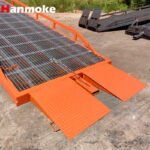
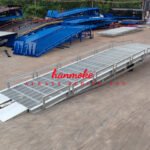
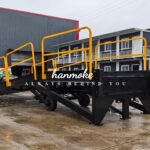
Steel coil yards are the hardest customers to answer straight. The load is brutal, the loading point moves, and every square metre of yard has to earn its keep. In January 2026 a steel service centre about 40 km north of Houston asked us to quote a 20-ton mobile yard ramp. After two site calls we told them not to buy one. They needed a fixed deck, not a slope.
Here is what we built instead, what it cost against the cast-in-place dock they priced in 2025, and what we would change next time.
Why a Yard Ramp Was the Wrong Tool Here
Three reasons decided it. First, gradient: a 10-ton ramp runs at roughly 8–9%, and a forklift carrying an 18-tonne coil on a boom has that mass hanging ahead of the mast, so traction on a wet steel deck becomes the limiting factor, not hydraulic capacity. Second, coverage: they load from three faces of a 40 m × 25 m yard depending on where the coil is stored, and a ramp serves one position. Third, cycle time: a ramp forces a straight-in, straight-out move, and with 12 m flatbeds and a three-stage mast the operator was reversing 25 m for every coil.
The decisive number was point load. An 18-tonne coil sits on about 1.2 m of timber saddle, so the deck sees close to 15 t per metre of line load rather than a polite 5 t/m² pallet pattern. A portable ramp will carry that if the operator crawls, but the plate pits within two seasons.
What We Specified
| Item | Specification |
|---|---|
| Platform modules | 4 × 3,000 × 3,000 mm (9’10” × 9’10”) |
| Assembled deck | 12,000 × 3,000 mm (39’4″ × 9’10”), 36 m² |
| Deck height | 1,200 mm (3’11”) above finished grade |
| Rated capacity | 20 t/m² (4,100 lb/ft²) uniform; 18 t coil on saddle verified by test |
| Deck plate | 8 mm checkered plate in the coil landing zone, 6 mm in the traffic zone |
| Cross members | 200 × 100 × 6 mm rectangular tube at 400 mm centres (coil zone) / 500 mm (traffic zone) |
| Legs | 150 × 150 × 6 mm SHS, 12 mm base plates, M16 chemical anchors |
| Guardrail | 1,100 mm (43 in) with 100 mm toe board |
| Approach ramp | 10,300 × 3,000 mm, 1:8.5, rated 20 t |
| Finish | Two-coat alkyd over shot-blasted Sa 2.5 steel |
| Assembly | Bolted only — no site welding, no crane above 8 t |
The one non-standard choice was thickening the deck in the coil zone to 8 mm over 400 mm cross-member centres. That is the difference between a platform rated 20 t/m² on paper and one that survives a coil being set down 60 times a day. We also kept the guardrail at 1,100 mm so it clears the 1,067 mm (42 in) height that US general-industry guardrail rules use as the reference.
Foundation Work Took Longer Than the Platform
The yard drains toward the gate at 2.1% — good for water, bad for a level deck. We specified a 150 mm slab at 25 MPa, 12 m × 3.6 m, level to within 3 mm over the full length, with a 1% fall away from the platform edge so runoff never sits under the legs. It cured seven days before anchoring. Cast-in-place concrete would have needed 28 days of cure plus a permit cycle, and the yard could not lose the apron that long.
Two Days to Assemble
Four people, one 8-tonne telehandler, two days. Day one: set out the slab, fix the base frames and legs, land modules one and two, torque the module joints to 180 N·m in three passes. Day two: modules three and four, deck panels, approach ramp and guardrail. No site welding, and the first flatbed was at the ramp on day two.
Load Test and Handover
We tested at 125% of rated capacity: two 12.5-tonne coils, one centred on module three and one straddling a module joint, which is the worst case for a bolted deck. Measured deflection at mid-span was 4.1 mm against an allowable L/300 of 10 mm for a 3,000 mm span. Photographs, deflection readings and the anchor torque log went into a signed handover sheet; their insurer had asked for exactly that.
What It Cost
| Line item | Modular platform (this project) | Cast-in-place dock |
|---|---|---|
| Structure | USD 52,000–64,000 EXW (platform, ramp, guardrail) | USD 70,000–110,000 |
| Freight | USD 3,000–4,500 (one 40′ HC, Foshan to Houston) | — |
| Site works | USD 6,000–9,000 (slab, anchors, local crew) | Included above |
| Engineering and permits | Drawing package included | USD 4,000–8,000 |
| Time to first load | 25 days production + 34 days sea + 3 days site | 12–16 weeks |
| Relocatable | Yes — unbolts and moves with the lease | No |
Those figures are indicative EXW ranges for a 12 m × 3 m, 20 t/m² platform in 2026, not a quotation. On this project the modular route landed roughly 30% below the concrete quote once permits, engineering and four lost production weeks were counted.
Three Things We Would Change
Galvanise it. Two-coat alkyd holds up in Houston for maybe five years. Hot-dip galvanising adds 8–10% and buys 20 years in a coastal humidity band — cheap insurance on a 20-ton platform.
Order the fifth module now. They added one four months later, which meant a second 40′ container and a second freight bill for one 3 × 3 m bay. Buy the extra bay at the start.
Widen the approach ramp. At 3,000 mm it is fine for a counterbalance truck, tight for a three-stage mast with a coil boom. Next time we would go 3,600 mm (11’10”).
Frequently Asked Questions
Can a modular dock platform take a 20-ton coil point load?
Yes, if the deck is specified for it. Uniform 20 t/m² is not the governing case — the governing case is a coil on a 1.2 m saddle, so we thicken the plate and tighten cross-member spacing in the landing zone, then verify with a 125% static test.
Does it need a concrete foundation?
A 150 mm reinforced slab is enough for a 12 m platform on firm ground. You do not need a pit, a dock wall or a building tie-in, which is why the platform can be dismantled and moved to another lease.
How long from order to first load?
Production is about 25 days, sea freight Foshan to US Gulf ports 30–38 days, and site assembly 2–3 days. Customs and slab cure usually add a week each.
Can it be extended later?
Yes. Modules bolt together in any rectangular layout, and a 3 × 3 m bay can be added on any free side. Plan the slab for the final footprint, though.
Need a Loading Position That Does Not Exist Yet?
Send us a site plan, the heaviest load you handle and where it lands. We will come back with a module layout, deck specification and a load-test plan — usually within two working days. See the modular loading dock platform range, the 20-ton HRFD platform, or the modular ground-to-facility ramps for the approach span. If your site can take a slope instead of a deck, a mobile yard ramp will cost a third as much and install in an hour. Either way, start with the contact form and tell us what the coil weighs.