Momentum Works put 2025 Southeast Asia platform GMV at $157.6 billion in its April report, up 22.8% from $128.4 billion in 2024. Add roughly $27.8 billion moving through social, chat and brand channels and the region lands near $185.5 billion.
Every one of those dollars still crosses a dock edge. In this region that edge is where money leaks — not from carelessness, but because the interface between a 40-foot container and a forklift was designed for a different climate, fleet and property market.
What the Growth Numbers Actually Say
The headline is reallocation, not uniform growth. Indonesia remains the largest market at $57.7 billion but grew only 2.2%, a direct result of Bukalapak leaving physical goods and Tokopedia being rationalised after the TikTok Shop acquisition. Thailand and Malaysia are where volume is moving.
| Market | 2025 platform GMV | 2024 platform GMV | Growth |
|---|---|---|---|
| Indonesia | $57.7B | $56.5B | +2.2% |
| Thailand | $35.5B | $23.4B | +51.8% |
| Malaysia | $17.0B | $11.5B | +47.6% |
| Philippines / Vietnam / Singapore / others | ≈$47.4B (derived) | ≈$37.0B (derived) | +21% to +32% |
| Platform total | $157.6B | $128.4B | +22.8% |
| Non-platform (social, chat, brand sites) | ≈$27.8B | — | — |
| All-in regional e-commerce | ≈$185.5B | — | — |
Two facts sit behind that table. Shopee, TikTok Shop and Lazada now hold 98.8% of platform GMV, and content commerce accounts for about 32% of it — the least forecastable demand pattern in the industry, where one live session can push a week of volume into a six-hour window. Meanwhile supply is tightening: Colliers puts Greater Jakarta modern warehouse stock at roughly 3.0 million m² as of Q1 2026 and forecasts additions slowing from about 270,000 m² per year (2019–2025) to 186,000 m² per year through 2029.
Translate that into behaviour. A tenant who cannot get into a new high-spec building takes an older shed with no dock, or one dock instead of four. Loading equipment then decides whether that tenant can serve the account at all.
Three Problems Nobody Budgets For
Ground-level destuffing is the default. In a rented shed without a raised dock, a 40-foot container sits on the slab with its floor 150–200 mm (6–8 in) above grade. A local six-wheel truck bed runs 1.10–1.30 m (3’7″–4’3″). That is a 1.0–1.2 m step with no concrete in between. The cheap answer is two steel plates and two men with pallet jacks; the cost shows up as crushed cartons, a four-hour unload instead of 90 minutes, and operators who refuse the job.
The fleet is mixed and nobody wrote it down. A site receiving containers on chassis, six-wheel lorries, ten-wheel lorries and the occasional reefer faces bed heights from 1.00 m to 1.50 m (3’3″–4’11”). No single fixed ramp serves that spread at a workable grade. This is a specification failure, not an equipment failure — and it is why ramps get bought twice.
Water is the real maintenance cost. Monsoon rain on thin-coated painted mild steel produces rust at the welds within 18–24 months. A hot-dip galvanised deck at 85 µm (AS/NZS 4680, steel over 6 mm) is a different asset class here, and the factory price gap is far smaller than the gap at year five.
Five Bottlenecks, and What Actually Fixes Them
| Bottleneck | What you see on site | Equipment that fixes it | Indicative EXW range (USD) |
|---|---|---|---|
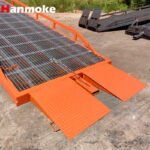
| No dock; containers on the ground | Plates and pallet jacks, 3–5 hours per 40 ft | Container ramp, 6–10 t, with side pockets | $1,100–2,600 |
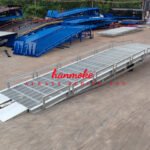
| Dock edge but steep approach | Loads stalled on the incline, tyres spinning | Mobile yard ramp, 10–15 t, 10.3 m (33’10”) long | $6,000–15,000 |
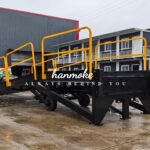
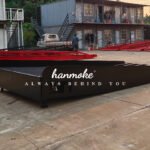
| One door, four vehicle heights | Queue at 08:00, idle dock at 15:00 | Dock ramp platform with adjustable height, or free-standing dock | $4,500–9,000 |
| Coastal or open-yard site | Rust streaks at welds in year two | Galvanised yard ramp, 600 g/m² zinc | +12–20% over painted |
| Peak-season overflow | Rented ramps at short notice, wrong capacity | Foldable or 2-part folding ramp, truck-mountable | $5,500–11,000 |
Those are indicative factory-gate figures for planning only. Freight to Jakarta, Laem Chabang or Port Klang plus 5–15% import duty will move the number materially. They are not a quotation.
What to Specify Before You Order
Grade, not length. Forklift-safe grade is 10% for a battery truck, up to 15% for LPG. Take your worst height difference and divide by the grade: a 1.20 m step at 12% needs 10.0 m (32’10”) of running length. A supplier quoting 6 m for that step is selling a 20% grade and a future incident.
Capacity as a dynamic figure. Rated capacity means forklift plus load plus operator, moving. A 3.0 t truck carrying 1.5 t is a 4.5 t crossing before margin. Specify 25–30% headroom above the heaviest realistic combination; braking and turning on a wet deck spike load more than buyers assume.
Deck surface matched to wheels. Checkered plate suits pneumatic tyres. Small hard wheels concentrate load into two contact patches and will polish a smooth deck into a slide hazard during the wet season. Grating, or plate plus grating, is the safer choice if electric pallet trucks go up the ramp.
Corrosion system in writing. Ask for zinc thickness in µm and the test standard, not the word “galvanised”. For coastal sites: 85 µm minimum, 600 g/m² coating mass.
Frequently Asked Questions
Is a container ramp enough for e-commerce fulfillment?
For inbound destuffing at a ground-level shed, yes — a 6–10 t container ramp with forklift pockets covers most 20 ft and 40 ft work. It does not replace a yard ramp when outbound trucks also load at height.
What grade can a forklift climb safely on a mobile ramp?
10% for battery counterbalance trucks, up to 15% for LPG or diesel, 7% or less for electric pallet trucks. Above 10%, OSHA 29 CFR 1910.178(n)(7)(i) requires loaded trucks to travel with the load uphill, which changes your traffic flow.
How many ramps does a 20,000 m² fulfillment centre need?
Roughly one ramp per 8–12 vehicle movements per shift, plus a spare where campaign peaks are part of the model. Content-driven demand is bursty; the spare is not a luxury.
Can one ramp serve both containers and local lorries?
Only if hydraulic travel covers the height range. Check the working range against your actual fleet list — typically 1.00 m to 1.50 m bed height — before accepting a standard model.
Get the Grade and Capacity Right the First Time
Hanmoke has built loading equipment in Foshan for 30 years. Send your vehicle list — bed heights, forklift model, heaviest load — and we will return a ramp length calculation, a recommended model and a dimensioned drawing within two working days, at no charge. Start with the HRCN container ramp for ground-level destuffing, or browse mobile yard ramps and free-standing loading docks if you need height at the door. Coastal sites should look at the galvanised range. Send site details through our contact page for a quote and drawings.