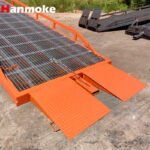
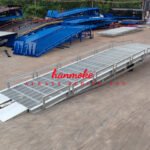
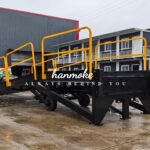
Every winter we get the same call from a customer in Minnesota or Hokkaido or Poland: the ramp worked fine in October, and now the forklift will not climb it. Nothing has changed except the weather and, in the same week, the effective grip under the tyres. A mobile yard ramp is a slope before it is anything else, and slopes are where winter finds you.
What Actually Fails First
In our experience the order of failure is predictable, and it is not the order most maintenance plans address.
Traction goes first. A wet deck is a nuisance; a deck with a film of ice is a different machine. The ramp geometry has not changed, but the friction available to the tyres has dropped below what that geometry demands.
Hydraulic response goes second. Cold oil is thick oil. Manual pumps feel stiff, electric units run slow, and the deck may creep down rather than hold. Nothing is broken, but the operator who does not expect it will force something.
Then the hardware starts to suffer. Grease channels thicken, cables stiffen, hinge pins pick up grit, lip plates freeze to the trailer sill, and every dent from a slipped tyre becomes a stress point that salt can reach.
And last, people adapt badly. They take the ramp faster to build momentum, they stop adjusting height, they skip the walk-around because it is cold. That is when the accident happens, not during the first ice of the year but in the fourth week of it.
The Slope Math That Decides Whether Today Is Safe
There is one number worth memorising: on a slope, the minimum friction coefficient you need equals the tangent of the ramp angle, which for small angles is simply the grade as a decimal. A 10% ramp needs μ ≥ 0.10. A 12.5% ramp needs μ ≥ 0.125. There is no interpretation involved; it is geometry, and you can check it with a spirit level and a tape measure.
| Ramp grade | Angle | Friction coefficient required | Winter reality |
|---|---|---|---|
| 5% | 2.9° | 0.050 | Usually holds with light snow, if the deck is cleared |
| 8% | 4.6° | 0.080 | Marginal on packed snow; needs grit and a slow approach |
| 10% | 5.7° | 0.100 | Ice film is enough to break traction on a laden forklift |
| 12.5% | 7.1° | 0.125 | Not workable on ice; a 10,300 mm ramp at 1,300 mm bed sits here |
| 15% | 8.5° | 0.150 | Stop. Re-position the trailer or use a different dock |
The 12.5% row is the one to notice. A standard 10,300 mm ramp reaching a 1,300 mm trailer bed averages close to that grade before you count the transition curve at the head end, which is steeper. That is fine in July and unforgiving in January. EN 1398 uses ±12.5% as the working limit for dock levelers, which is a different device, but the number is a useful reminder that these ramps are already near the practical edge of what a tyre can hold when the surface is clean and dry.
Two rules come with the math. First, OSHA 29 CFR 1910.178(n)(7)(i): on grades above 10%, a loaded forklift travels with the load uphill — up the ramp forwards, down the ramp in reverse, load leading. Second, 29 CFR 1910.22(a)(3) lists snow and ice by name as hazards that walking-working surfaces must be kept free of, and 1910.22(d)(2) requires the hazard be corrected before the surface is used again. The ramp deck is a walking-working surface when your crew walks on it to hook a chain or set a lip. It is not a grey area.
Deck Surface Is a Winter Decision You Make at Order Time
You cannot fix a solid-plate deck in February. You can only sweep it. This is why deck specification matters more in cold climates than in warm ones, and why we ask about winter in the first email.
| Deck type | Snow and ice shedding | Pallet truck casters | Winter verdict |
|---|---|---|---|
| Open steel grating | Falls through; deck self-clears under traffic | Catch in the bar openings | Best for forklift-only yards that stay outdoors |
| Diamond safety mesh | Holds water in low spots; ice bonds to the pattern | Smooth, no snagging | Good indoors, needs brushing every shift outdoors |
| Checkered plate | Worst of the three — flat surface, water sits | Smooth | Only if the ramp never sees frost |
| Timber matting on deck | Insulates and holds grit, but soaks and rots | Fair | Temporary fix for a cold snap, not a season |
| Loose grit or washed sand | Applied by hand each shift | Fine | Works, and costs almost nothing |
One warning on de-icing. Rock salt melts ice beautifully and then sits in the hinge line, between the deck and the frame, and inside every weld crevice, eating the coating from the inside where you cannot see it. If you must use salt on the apron, wash the ramp down the same week. On the deck itself, washed sand or a coarse grit does the job without the corrosion bill, and it does not leave a brine film for the next freeze to turn into black ice.
Cold Starts: Hydraulics, Batteries and the Temptation to Force It
A hydraulic yard ramp is specified around an oil grade, usually in the ISO VG 46 range, and that grade assumes an ambient temperature band. Below that band the oil thickens, pressure drop through the lines rises, and the pump has to work harder for the same lift. The system is not damaged by cold oil. It is damaged by an operator who decides the slow lift means a problem and holds the valve open to push it.
What to do instead, in order:
- Cycle the ramp empty, twice, full stroke. This moves cold oil through the circuit and warms the cylinder barrel. Two empty cycles turn a sluggish ramp into a normal one.
- Check the reservoir level cold. Oil that read full in summer can read low in winter in a system that weeps at the rod seal.
- Look for weep at the cylinder rod and the hose crimps. Cold makes aged seals hard; a seep in October becomes a drip in January.
- Keep the battery warm if the unit is DC electric. A lead-acid battery gives up a noticeable share of its usable capacity at −18 °C (0 °F), which shows up as a pump that runs but will not lift a loaded deck.
Manual pump units have their own winter habit: the handle gets stiff and operators pump in short jabs, which aerates the oil. Long, full strokes. If the deck will not hold height, the problem is the check valve or a seal, not the cold, and no amount of pumping fixes it.
Salt, Chlorides and What They Do to the Frame
Road salt is the second-largest cause of premature ramp retirement after impact damage, and it works quietly. Chlorides attack zinc before they attack steel, so a galvanized ramp is not immune — it is simply slower, and the protection depends on coating thickness, not on the word “galvanized” on the invoice.
Under AS/NZS 4680, hot-dip galvanizing on steel thicker than 6 mm must reach a minimum average coating of 85 µm, roughly 600 g/m². That is the baseline for a ramp frame. Durability then depends on the corrosivity category of the site: AS 4312 and AS/NZS 2312.2 put HDG600 at roughly 20–40 years in C4 (industrial and coastal-inland), 10–20 years in C5 (coastal), and 3–10 years in CX (offshore or heavy salt exposure). A ramp at a Great Lakes freight terminal that gets salted every week is living in C5 whether or not anyone wrote it down.
Practical consequences: touch up coating damage before winter, not after; keep the hinge line and the lip mechanism clear of packed salt-and-grit — the same care applies to a dock plate or dock board; and wash the underside of the deck, which nobody ever does, because that is where brine sits.
A Winter Shift Routine That Holds Up
This is the sequence we recommend to customers running ramps outdoors through a cold season. It takes about six minutes a shift and replaces a lot of improvisation.
Before the first trailer: clear the deck with a stiff broom, not a hose — water refreezes. Check the approach apron and the wheel area for ice. Look at the lip and the hinge for frozen grit. Cycle the lift empty twice. Walk the guard rails and look for cracks at the welds, because cold steel does not forgive a crack the way warm steel does.
During the shift: grit the deck at the start and again after any freezing rain. Keep the ramp at working height between trailers instead of dropping it to the ground, so the deck stays clear of slush. No turning on the deck, no side entry, no second person riding. Approach slowly and straight; momentum is what people use instead of grip, and it is what puts a forklift through a guard rail.
At the end of the shift: sweep the deck, drop it to the ground if the site is secure, and park it where meltwater drains away rather than pooling under the frame. Never drop a loaded deck the last 100 mm onto frozen ground — that shock load is not in the rating, and it is how frames get bent at the head end.
When to Stop Loading
Some conditions are not manageable with grit and patience, and a ramp that is out of service for four hours costs less than one incident report.
- Visible ice film on the deck that grit does not break up.
- Freezing rain falling, or a forecast that puts it inside your loading window.
- Lip plate frozen to the trailer sill and no safe way to free it.
- Wind strong enough to move an empty forklift on the deck, or to swing a trailer door.
- Any doubt about the deck’s condition after an impact — park it and inspect before the next trailer.
Questions We Get Every Winter
Can I put salt on the ramp deck?
You can, and it will melt the ice. It will also sit in the hinge line and under the deck, and chlorides shorten the life of the coating. Use washed sand or coarse grit on the deck and keep salt for the apron, then wash the ramp down the same week.
Why is my ramp so slow in cold weather?
Cold hydraulic oil is thicker, so the pump moves less volume per stroke. Cycle the deck empty, twice, full stroke before loading. If it is still slow with warm oil, check the filter and the relief setting.
Does a galvanized ramp survive salted yards?
Better than painted steel, but the coating thickness decides how much better. Specify at least 85 µm per AS/NZS 4680 on frame steel over 6 mm, touch up damage before winter, and expect a C5 coastal or heavily salted site to halve the coating life compared with a C4 inland site.
Is it safe to leave a ramp outdoors all winter?
Yes, if it stands on a drained hard surface, the deck is grating rather than solid plate, and someone sweeps it before each shift. The failure mode is not the cold — it is meltwater refreezing in the hinge and under the frame.
If your yard runs through a real winter, tell us the lowest expected temperature and whether the site is salted when you enquire — deck type, oil grade and coating specification all change with that answer, and the difference at order stage is far cheaper than a retrofit in February. Start from the mobile yard ramps category, look at the HRYS 10-ton hydraulic ramp for a typical specification, compare the galvanized ramp range if salt is part of your winter, and send your site conditions through the contact page for a specification and an EXW price.