A tea exporter we worked with last season had a problem that has nothing to do with tea and everything to do with concrete. During the peak plucking-to-shipment window, eight to ten full containers arrived at their packing station in a single day, and the yard had no loading dock at all. Every container was destuffed — unloaded, inspected and re-palletised — by hand-carrying sacks down a temporary plank. The plank moved, the sacks tore, and the trucks waited. Here is how eight container ramps solved it, and the capacity maths behind the choice.
Why Ground-Level Destuffing Was the Bottleneck
Bulk tea travels in FCL shipments: a 20 ft container typically carries 9 to 11 tonnes of orthodox leaf tea in 3–5-ply kraft paper sacks with PE liners, while denser CTC grades push a 20 ft toward 20 tonnes and a 40 ft high cube to 20–22 tonnes. Tea is hygroscopic — it absorbs moisture and odours — so sacks cannot be dragged, dropped or stacked wet. Hand-destuffing from a plank on the ground failed all three tests, and the export season is exactly when monsoon humidity makes it worst.
The second problem was dwell time. A truck that waits four hours at the gate is a truck the shipping line charges detention on. The yard needed to push a 20 ft container through destuffing in under an hour, in the same footprint where the containers were parked.
The Eight-Ramp Layout We Shipped
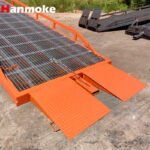
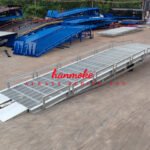
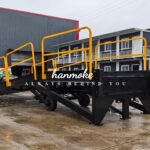
The client runs 3-tonne diesel forklifts with ~1 tonne pallet loads, so the ramp itself must carry the full laden forklift plus a safety margin as it climbs into the container. We supplied six HRCN-A container ramps rated at 6 tonnes for the two standard destuffing lines, and two HRCN-C galvanized container ramps rated at 10 tonnes for the open yard section, where monsoon rain and wash-down rules out painted steel.
| Model | Qty | Rated capacity | Role in the yard |
|---|---|---|---|
| HRCN-A container ramp | 6 | 6 t | Two destuffing lines under the shed roof |
| HRCN-C galvanized container ramp | 2 | 10 t | Open-yard duty, rain and wash-down exposure |
Both models work the same way: the ramp’s lip rests on the container floor edge, the deck adjusts to the container height, and the forklift drives straight in. For cargo moving between ground and raised trailer beds, a container loading board is the lighter companion piece.
The Cycle Maths Behind a 6-Ton Rating
Purchasing managers sometimes see “6 t” and assume it refers to cargo. It refers to the moving weight on the ramp: the forklift and its load together. A typical 3 t counterbalance forklift weighs about 4.3–4.5 t; with a 1 t pallet of tea it puts roughly 5.5 t on the deck, concentrated on the front axle as it climbs. That is why a 6 t ramp is the sensible floor for a 3 t truck.
| Container | Payload (orthodox tea) | 1 t pallets | Forklift trips in/out |
|---|---|---|---|
| 20 ft dry | 9–11 t | 9–11 | ≈20–24 |
| 40 ft high cube | 20–22 t | 20–22 | ≈44–48 |
At a steady 40 seconds per loaded trip and 30 seconds back, a 20 ft clears in about 25 minutes of pure travel; the rest of the hour goes to sack inspection and re-palletising — the work a packing station should be spending time on.
Slope: The Rule Most Yards Miss
Two rules from OSHA 29 CFR 1910.178 govern this work. Section (n)(7)(i) requires that on any grade above 10%, a loaded forklift travels with the load pointing upgrade — so on a container ramp, the laden trip is always the climb into the container, which the layout above already guarantees. Section (n)(11) requires the ramp to be properly secured before it is driven over, and never exceeded against its rated capacity. In practice that means chocking the ramp, checking the lip sits fully on the container floor, and parking the container itself on level ground so the ramp grade stays in single digits. Our container ramp page covers the adjustment range and securing points.
What Changed After the First Season
The numbers the client reported back match what we see on similar installations: destuffing time for a 20 ft dropped from roughly three hours of manual handling to under one hour with the ramps, truck dwell time at the gate fell by about half, and sack damage — previously a recurring claims item — effectively stopped because sacks now travel on pallets the whole way. The two galvanized units in the open yard went through a full monsoon with only cosmetic white rust, which is the coating doing its job. For buyers weighing corrosion protection for exposed yards, our galvanized container ramp page explains the coating system.
Frequently Asked Questions
Can a container ramp be used on a container still on the trailer chassis?
It can, but the grade steepens as the deck must climb to roughly 1.35–1.5 m instead of the container-on-ground height. For regular destuffing, drop the container to level ground to keep the climb low-gradient.
What capacity do I need for a 3-tonne forklift?
Count the truck, not the cargo. A 3 t diesel forklift with a full pallet weighs about 5.5 t, so a 6 t ramp is the practical minimum, and 10 t gives room for heavier electric trucks with battery counterweights.
How many ramps does a yard with eight containers a day need?
Two lines clear eight 20 ft containers in a normal shift; eight units let the client run four lines in parallel during the compressed peak weeks when vessels cut booking windows short. Your number depends on how lumpy your season is, not just your annual volume.
How are the ramps shipped and installed?
Each unit ships fully welded and assembled, is offloaded with the customer’s own forklift or a mobile crane, and works within an hour of placement. No foundation, anchors or wiring — ground-level equipment moves when your yard layout does.
If your yard destuffs containers without a dock, send us your container mix, forklift model and daily volumes — we will size the ramps, confirm the grade and quote with lead time and packing details. Contact Hanmoke for a drawing and a firm quotation, or browse the full mobile yard ramp range to compare options.