For two years US warehouse operators had a buyer’s market: spec buildings kept landing, vacancy climbed, docks had spare capacity. That has turned. Q3 2026 put national industrial vacancy at 6.8%, the lowest since end-2024, with absorption ahead of completions for a second straight quarter. The consequence lands at the dock, not in the leasing office.
The Q3 Numbers, Without the Brokerage Spin
Cushman & Wakefield reports 76.6 million sq ft of net absorption in Q3, the strongest quarter since Q1 2023. CBRE’s cut is 104.6 million sq ft, its best since Q4 2022; the gap is methodology — renewals, owner-user moves, sublease treatment. Both have vacancy falling.
| Indicator | Cushman & Wakefield | CBRE |
|---|---|---|
| Q3 net absorption | 76.6 m sq ft | 104.6 m sq ft |
| National vacancy | 6.8% (−20 bps vs late-2025 peak) | 6.4% (−20 bps YoY) |
| Availability | not published | 8.9% (−30 bps) |
| YTD completions | ~185 m sq ft (−13% YoY) | 182.7 m sq ft (−17% YoY) |
| Under construction | ~324 m sq ft (+23% YoY) | 278 m sq ft (+9.3% YoY) |
| Asking rents | +4.0% YoY | $11.16 / sq ft (+3.6% YoY) |
| Build-to-suit share of pipeline | ~35% | not published |
Read the completions line twice. 185 million sq ft delivered in nine months sounds like a flood until you set it against 203 million absorbed. The pipeline grew 6% to 324 million sq ft, but a third is build-to-suit — spoken for before the slab is poured. Speculative space is not coming back quickly.
The Empty Space Is in the Wrong Buildings
The national average hides a split. In the 14 largest North American port markets, vacancy reached a record 7.7% through July — up 0.2 points from the end of 2025 while the rest of the country fell by the same amount. Inland markets took 83% of first-half demand, their highest share since 2010. Imports from China fell 23%; the freight moved inland and the sheds near the water did not follow.
| Port market | Vacancy | Asking rent, YoY |
|---|---|---|
| Inland Empire | 8.0% | −9.9% |
| New Jersey | 8.1% | −4.0% (to $16.12 / sq ft) |
| Savannah | 10.0% | +4.4% (5.1 m sq ft still building) |
| Los Angeles | 6.7% | below national average |
For loading equipment, the more useful half of the story is the old stock. Buildings delivered between 2000 and 2019 shed roughly 78 million sq ft of occupancy across 2024 and 2025. In 2026 that segment stopped bleeding and started signing again, as tenants priced out of new space took what was left. Facilities of 500,000 sq ft or more are down 280 basis points year on year to 7.4%.
Put a face on it. A 2005-vintage distribution centre: 1,200 mm (47 in) dock height, three doors where the new tenant’s flow needs five, a pit leveler fifteen years into a fifteen-year life, and an apron graded before anybody worried about trailer approach angles. It is leasable again. Nobody is knocking it down.
Three Things That Change for Equipment Buyers
1. Retrofit beats waiting for a building
A tenant signing five years on a 2005 shed cannot dig a pit and cannot wait eighteen months for a build-to-suit. That pushes demand toward equipment needing no civil work: free-standing docks, exterior levelers, mobile ramps, edge-of-dock units bolted to the existing face. On rented concrete the question is which one comes out in 2031 without leaving a hole in the slab.
2. Fewer doors, carrying more volume each
Modern big-box design trades door count for door size. When 76.6 million sq ft is absorbed in a quarter, the overflow goes into older buildings with two or three doors, not six. Volume concentrates, and downtime stops being an inconvenience and becomes a queue at the gate. That is why repositioning time, not tonnage, is the spec we are asked about most.
3. The 10% slope rule is not theoretical
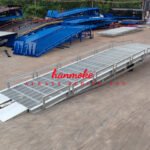
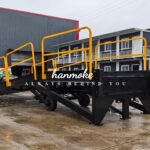
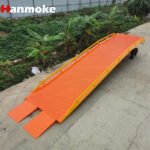
OSHA 29 CFR 1910.178(n)(7)(i) requires a loaded forklift to travel with the load uphill on grades steeper than 10%. Run the geometry and the rule stops being academic: 1,200 mm of rise over 10,300 mm of ramp is 11.7%, or 6.7°. Nearly every 10-tonne ramp sold into a 1.2 m dock is already past the trigger, which makes the operator’s approach direction a design decision. To stay under 10% at that height you need 12,000 mm of ramp — 1.7 m more steel than most budgets allow for.
What We See on the Order Desk
Two enquiries dominate this quarter, and neither is new construction. The first is retrofit: a tenant with eighteen months left on a lease asking what can be installed without a permit. The second is capacity: a 3PL that won a contract and needs a fourth door working in eight weeks. On the factory side the constraint is ordinary — a standard 10-tonne hydraulic ramp runs 25–30 days from drawing approval, a custom deck width or galvanised finish pushes it to 45–60, and ocean freight adds four to six weeks to the US. The equipment is rarely the bottleneck. The decision is.
Questions Buyers Are Asking
Does falling vacancy make dock equipment more expensive?
Not directly. Ramp pricing tracks steel, galvanising and ocean freight, not real estate. What tight vacancy does change is lead time: more retrofit projects land in the same quarter and the factory queue lengthens.
Mobile ramp or pit leveler for a leased building?
Lease term decides it. Under seven years, or any building you do not own, a free-standing or mobile solution wins on exit cost alone. A pit leveler is cheaper per cycle over twenty years and the wrong answer for a five-year lease.
Is 6.8% actually tight?
By the standards of 2021–22, no. It is a mid-single-digit market working off a 2024–25 overshoot, and the slack is unevenly spread — port markets at 7.7% against much tighter inland infill. Treat the national figure as a direction, not a local reading.
What does vacancy data tell me about my own dock?
Nothing directly. It tells you what your competitors face: if they cannot find modern space, they will take older space and load it harder.
If you are fitting out a leased building or adding a door to an older dock, send us the door height, the apron depth and the forklift model. We will come back with a drawing and a slope calculation at your actual dock height — which is where most retrofit projects go wrong — rather than a brochure. Start with the mobile yard ramp range, the free-standing loading docks that need no pit, or the exterior dock leveler for buildings that already have a face to bolt to. Bolt-on units are in the edge-of-dock range. Or contact our engineering team with your dimensions.