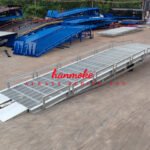
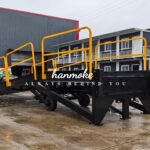
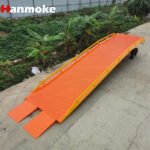
The first thing I look at on a used yard ramp is the plate. Not the deck, not the welds — the plate. If it is missing, painted over, or stamped with nothing but a number and a year, the ramp has no history and no legal identity, and whatever it is worth as steel is what it is worth.
Buyers spend weeks comparing deck thickness and cylinder bore, then accept a ramp whose only capacity claim lives in an email. That is backwards. The plate is the one document that stays with the machine for fifteen years, in the rain, after everyone who sold it has changed jobs.
What a Data Plate Is Actually For
A plate does three jobs, and none of them is marketing. It identifies the machine so a failure can be traced to a batch. It declares the load limit in terms a forklift driver can apply at seven in the morning. And it warns about the conditions under which that limit stops being true — gradient, wheel type, surface.
The test is simple: can a person standing at the bottom of the ramp, with a loaded forklift waiting, decide go or no-go without phoning anyone? If the plate says “10T” and nothing else, the answer is no. Ten tonnes of what, measured how, at what slope?
The Minimum Content, by Market
Europe is the strictest and the clearest. Under Regulation (EU) 2023/1230, identification data sits in Article 10(5)–(6): model, series or type, year of construction, batch or serial number, plus the manufacturer’s name, registered trade mark, postal address and a website or email. The physical marking duty is Annex III 1.7.3, and the CE mark follows Article 24.
Note the numbering change, because most supplier checklists still get it wrong. In the old Machinery Directive 2006/42/EC, “marking of machinery” was Annex I 1.7.4. In the new Regulation, 1.7.4 is instructions for use, and marking has moved to 1.7.3. A tender document citing 1.7.4 for the plate in 2027 is citing the wrong clause.
| Market | Instrument | What the plate must carry |
|---|---|---|
| EU | Reg. (EU) 2023/1230, Art. 10(5)–(6), Annex III 1.7.3, Art. 24 | Model/type, year of construction, serial number, manufacturer name and address with digital contact, CE mark (5 mm minimum vertical height, per the long-standing rule) |
| UK | Supply of Machinery Regulations; CE marking continues to be accepted in Great Britain | Same identification set; UKCA is an option, not a replacement obligation |
| US | ANSI MH30.1 / MH30.2 practice; OSHA 29 CFR 1910.26(a) design-load duty | Manufacturer, model, serial, rated capacity in lb, deck size, and the load definition used |
One more EU point that gets skipped: Annex III 1.7.3 requires the mass to be marked legibly where a part is handled by lifting equipment during use. On a mobile yard ramp that means the unit weight belongs on the plate, not only in the manual — a crane lift or a forklift recovery goes wrong when nobody knows whether the ramp is 2.6 or 3.4 tonnes.
Capacity: Three Different Numbers Wear the Same Word
EN 1398:2009 defines three loads, and the difference is not academic. The rated load is the weight of the greatest moving load — goods, persons and transport equipment together. The axle load is taken as acting over two rectangular contact areas 1 m apart, with each footprint derived from wheel load divided by 2 N/mm² and a width-to-length ratio of 3:2. The dynamic load is that rated load in motion, braking and turning on the deck.
The European materials handling federation, FEM, published a warning about exactly this in its guidance note 11.004: capacities were being displayed on dock levellers and in sales literature that were misleading, letting one supplier appear stronger than another. The capacity marked on the machine, FEM states, is the total load that can be applied whether moving, braking or stationary — the test safety factor is a test condition, not a licence to quote a bigger number.
| Term | What it means in the yard | Question to ask the supplier |
|---|---|---|
| Rated load | Forklift + cargo + driver, added together | “Is this figure the total moving load, and is it stated in kg or lb?” |
| Axle load | What one axle puts through two contact patches 1 m apart | “What footprint did you test to — 2 N/mm², 3:2 ratio?” |
| Dynamic load | The same load while driving, braking, turning | “Does the plate rating include dynamic, or is it static only?” |
| CIR (US) | Comparative Industry Rating in pounds, tied to lip thickness | “Which lip thickness pairs with this rating?” |
A 10 t ramp is not a ramp that carries a 10 t forklift. It carries a 10 t total: a 7 t forklift with a 2.8 t load is over the line before the driver climbs in. This is the single most common misreading we see in incoming enquiries.
Reading a Load Chart Properly
A load chart exists because capacity is not one number — it is allowable axle load plotted against where that axle sits. The lip end and the rear hinge are the two positions that govern, and they fail for different reasons: the lip end in bending and local deck deformation, the hinge in weld fatigue.
Work an example. A 3.5 t electric forklift carrying a 1.5 t pallet is 5,000 kg, plus a 100 kg driver. Laden, roughly 80% of that sits on the front axle: about 4,100 kg over two wheels, so 2,050 kg per wheel. Using the EN 1398 footprint rule, 2,050 kg is 20,110 N, divided by 2 N/mm² gives 10,055 mm², and at a 3:2 ratio that is a patch of roughly 123 × 82 mm. That patch is what punches into the deck plate every time the truck crosses the lip.
| Load case | Where it hurts | Plate figure that governs |
|---|---|---|
| Laden forklift crossing the lip | Lip hinge, lip-to-deck weld, deck leading edge | Rated load and lip thickness |
| Forklift braking on the slope | Deck plate, cross-members, hinge pin | Dynamic load |
| Pallet truck with hard nylon wheels | Local deck dishing, weld cracking | Wheel-type note or derating rule |
| Ramp parked on soft asphalt in summer | Support legs punching through the surface | Unit mass and leg footprint |
Row three is the one no plate ever explains, and FEM says it plainly: a 6,000 kg leveller used for years with a 6,000 kg forklift on rubber tyres will still suffer localised deck damage if it is also used by a 2,000 kg pallet truck on small hard wheels, because contact pressure is far higher. A plate that gives only a tonnage is silent on the failure mode that actually costs you a deck.
Slope Limits Belong on the Plate Too
EN 1398 caps the working range at ±12.5%, about 7°, and permits more only where the operator has eliminated the risk of slipping — dry, clean, gritted. That is a machine limit. The vehicle limit is usually lower, and it varies by equipment type.
| Equipment | Maximum gradient in service |
|---|---|
| Roll cage / cage trolley | 3% |
| Hand pallet truck | 3% |
| Electric pallet truck | 7% |
| Battery forklift | 10% |
| Gas or diesel forklift | 15% |
Those figures are the ones European leveller makers publish for selection, and they line up with US practice: OSHA 29 CFR 1910.178(n)(7)(i) requires a loaded forklift on a grade steeper than 10% to travel with the load uphill, which is a roundabout way of saying the operator should not be on that grade at all with the load downhill. If your ramp sits at 12% because the trailer is a step-deck, the plate’s 10 t rating no longer describes your operation. Write the actual working gradient on the plate, or on a decal next to it.
Dimensions, Mass and Ground Pressure
Four numbers belong beside the capacity, and they are the four buyers forget. Overall length versus usable deck length — the approach plate and the lip are not deck. Overall width versus clear width between guard rails, which on a 2,200 mm ramp is nearer 2,000 mm once 60 mm posts and edge plates are counted. Unit mass, for crane lifts and for ground pressure. And the support-leg footprint, because a ramp plus a loaded forklift concentrates a surprising share of its weight on two small pads, which is fine on 200 mm of concrete and marginal on fresh asphalt in August.
Eight Things a Cheap Plate Leaves Off
Compare two plates side by side and the price difference usually explains itself.
- Serial number. Without it there is no batch traceability, and a warranty claim becomes a conversation about photographs.
- Year of construction. Required in the EU, and the first thing a resale buyer checks.
- Manufacturer address and a contact that still works. Name alone is not enough under 2023/1230, which asks for a postal address plus website, email or other digital contact.
- A defined capacity. “10T” without “rated load, including forklift and driver” is a number, not a limit.
- Maximum working gradient. The failure mode most often ignored in the field.
- Deck and clear dimensions, plus unit mass. Needed for door widths, container loading and crane lifts.
- Lip size and hinge pin diameter. The parts you will actually reorder.
- Warning decals in the operator’s language. English-only decals on a ramp bound for Jeddah or Veracruz get ignored, and the warning was the point.
Material matters as much as content. A printed vinyl sticker on an outdoor ramp is unreadable in eighteen months. Laser-etched stainless, or anodised aluminium with stamped characters, survives a decade of washdown. On galvanized ramps we mount the plate on a bracket rather than directly to the zinc, so it can be replaced without grinding into the coating.
Put the Plate in Your Specification
You do not have to accept whatever arrives. Three clauses solve most of it. First, require a plate drawing for approval before production, listing every field in the order above. Second, require a photograph of the actual plate, with the serial number legible, in the pre-shipment inspection report. Third, put the serial number on the packing list and the commercial invoice, so the plate, the paperwork and the asset register all agree.
Then photograph the plate on day one and file it with the purchase order. When the ramp is sold in year eight, that photograph is the difference between a used ramp with a history and a lump of steel with a story.
FAQ
Is a data plate legally required on a mobile yard ramp?
In the EU and UK, yes — marking is a condition of placing machinery on the market, and the plate is the visible evidence of it. In the US there is no federal plate rule specific to ramps, but ANSI MH30.2 practice plus OSHA 1910.26(a)’s design-load duty mean the capacity has to be established and communicated either way.
What does “10 ton capacity” mean on a yard ramp?
It should mean the total moving load: forklift, cargo and driver together. If the supplier cannot tell you whether the figure is rated, axle or static, treat it as unverified and ask for the test basis in writing.
Can I replace a lost data plate myself?
Only the manufacturer should reissue one, against the serial number in their records. Never stamp a higher capacity onto an existing plate: it voids the CE declaration, defeats the traceability the plate exists for, and puts the next operator outside the load the structure was tested to.
Where should the plate be mounted?
Where a driver standing at the foot of the ramp can read it without climbing — normally the approach-end side plate at eye level. Not under the deck, not on a guard rail that gets removed for transport, and not where a fork pocket or a sling will scrape it off.
If you are specifying ramps for a tender, or replacing a plate that has gone missing, send us the serial number and a photograph of the machine and we will tell you what it was built to. Our export team can supply plate drawings before production, and the mobile yard ramp and dock leveler ranges are both built with EN 1398 load definitions on the nameplate. For ground-level container work the HRYS standard hydraulic ramp is the usual starting point, and every unit ships with a stamped plate, a load chart and a spare-parts list keyed to the same serial number.