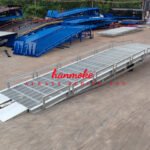
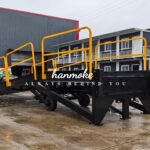
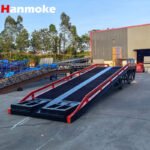
The most dangerous twenty minutes in a mobile yard ramp’s life are not the ones it spends under a forklift. They are the ones it spends hooked to the back of a pickup, being dragged across a yard at 15 km/h by someone who has done it before and got away with it.
Moving a ramp is not difficult, but it is unforgiving. The machine is long, heavy, top-heavy when the deck is up, and has no brakes, no lights and no suspension. This is the method we give to customers who run ramps across two or three sites — the arithmetic first, then the three ways to do it, then the checklist.
Start with what the ramp actually weighs
Nobody guesses this correctly, because the tonnage on the data plate is capacity, not weight. A “10 ton” ramp is a machine that carries 10 t; what it weighs itself depends on how much steel the builder put into the frame:
| 10 t class mobile yard ramp | Published unit weight |
|---|---|
| Light-frame import (HC Lifting class) | 2,450 kg / 5,400 lb |
| Mid-frame (Chase Titan 10s) | 2,880 kg / 6,350 lb |
| Heavy-frame (Ramp Factory TRP-YR10-2) | 4,050 kg / 8,930 lb |
| Our own 10 t hydraulic frame | 11,400 mm long × 2,200 mm wide (37 ft 5 in × 7 ft 3 in) |
So the same nominal capacity can differ by 1.6 tonnes between suppliers. Get the weight off the data plate or the shipping documents before you book anything — a trailer rated for 3.5 t and a 4,050 kg ramp is an overload, and a forklift chosen for 2,450 kg will not lift the other one.
Three ways to move it, and what decides which
Every move comes down to one of three methods. The site decides, not the preference:
| Method | Best for | Fails when |
|---|---|---|
| Towed behind a forklift or tractor | Paved yard moves under 500 m, same site | Public road, gravel, slopes over 5%, or a ramp without a tow bar |
| Lifted on forklift forks | Loading onto a trailer, short lifts, tight corners | Forklift capacity at 1.2 m load centre is less than half its rating |
| Flatbed or step-deck transport | Anything over 5 km, any public road | Securement is improvised with two straps and hope |
Towing: five things that go wrong
Our own data plate rates the ramp for yard moves at walking pace — 5 km/h (3 mph) — on hard standing, and nothing faster. Five failures account for almost every towing incident we hear about.
Speed. At 15 km/h a 3 t ramp on two small wheels starts to yaw, and the tow bar becomes a lever. There is no brake on the ramp and no weight on the drawbar, so the tail will swing past the tow vehicle on any turn taken quickly.
Tyres. Solid tyres flat-spot if the ramp is left standing on them for months, and then the ramp hops instead of rolling. Lower the support legs whenever the ramp is parked so the wheels carry nothing.
The tow bar. Bolt-on bars exist for a reason. A chain wrapped around the chassis rails pulls on a weld that was designed for a static load, and it will crack at the rail-to-cross-member joint, usually out of sight behind the deck.
Ground. A 3,000 kg ramp on two wheels puts roughly 1,500 kg through each contact patch — on a solid tyre that is around 3.5 MPa of pressure on the asphalt. On a 35 °C day that is a rut, and on a slight cross-fall it is a rut that pulls the ramp sideways.
The deck. Travel with the deck in its lowest position, pressure released. A ramp towed with the platform up is a 2.2 m wide sail with a high centre of gravity.
Lifting with a forklift: the load centre is the whole argument
Forklift capacity is quoted at a 500 mm (20 in) load centre. A yard ramp’s centre of gravity sits far further out than that, because the deck runs 11 m back from the fork pockets. Use the proportional estimate to see the size of the problem:
| Load centre | 3.0 t forklift, proportional estimate | Real plate curve |
|---|---|---|
| 500 mm / 20 in | 3,000 kg | 3,000 kg |
| 800 mm / 31 in | 1,875 kg | 1,700–1,800 kg |
| 1,200 mm / 47 in | 1,250 kg | 1,100–1,200 kg |
| 1,600 mm / 63 in | 940 kg | 800–900 kg |
The proportional column is just rated capacity × 500 ÷ actual centre. The real curve is lower, because the mast and carriage weight does not change while the capacity does. Which means: to lift a 3,000 kg ramp with its centre of gravity 1,200 mm out, you need a nominal 7.2 t forklift on the proportional rule and something larger in practice. This is why people book a 3 t truck for a 3 t ramp and then watch the steer axle come off the ground.
Two rules that matter more than the arithmetic. Lift only on the designated lifting points or through the fork pockets — never under the guard rails, never on the deck edge plate, and never with a sling over the handrail. And keep the deck down: a ramp lifted with the platform raised has its centre of gravity about 1.5 m higher, and the whole load swings.
Securing it on a flatbed: the 50% rule and the 10-foot rule
In the United States, 49 CFR 393.106(d) requires the aggregate working load limit of your tiedowns to be at least half the weight of the article. 49 CFR 393.110(c) adds a second, separate requirement: one tiedown for every 3.04 m (10 ft) of article length, or fraction thereof. Both apply, and whichever gives the larger number wins.
| Ramp | 50% rule | 10-ft rule | Tiedowns needed |
|---|---|---|---|
| 3,000 kg, 11.4 m long | Aggregate WLL ≥ 1,500 kg | 11.4 ÷ 3.04 = 3.75 → 4 | 4 (at 2,500 kg WLL each) |
| 4,050 kg, 11.4 m long | Aggregate WLL ≥ 2,025 kg | 4 | 4 (at 2,500 kg WLL each) |
| 2,450 kg, 5.7 m folded | Aggregate WLL ≥ 1,225 kg | 5.7 ÷ 3.04 = 1.9 → 2 | 2 (at 2,500 kg WLL each) |
Watch the counting rule when you do this on paper. A strap that runs from a trailer anchor, over the ramp, to an anchor on the other side counts its full WLL. A strap that runs from the trailer anchor to a lifting point on the ramp itself counts only half, and one that runs anchor-to-anchor on the same side counts half as well. Four straps at 2,500 kg WLL straight over the deck give you 10,000 kg of aggregate — comfortable. The same four straps hooked to the ramp’s own lugs give you 5,000 kg, which is still legal for a 4 t ramp but leaves nothing for a chafed strap.
Two more things that are not optional. Chock or cradle the wheels, because 393.106(c)(1) treats anything likely to roll as needing restraint that cannot come loose in transit. And use edge protection wherever a strap crosses the deck plate edge, since a 16 mm lip will cut a polyester strap in one trip.
What folding actually saves you
If the move is going to be regular, buy for it. A 2-part folding ramp halves its transport length: our HRNX 2-part folding ramp travels at 5,700 mm (18 ft 8 in) instead of 11,400 mm, which drops the 10-ft rule from four tiedowns to two and turns a step-deck booking into a flatbed one. It does not reduce width — you are still at 2,200 mm (7 ft 3 in), and that is the number that decides whether it fits through the gate.
If the ramp is going overseas rather than down the road, the rules change again: the 40 ft HC door opening is 2,340 mm (7 ft 8 in), so a 2,200 mm ramp has 70 mm (2.8 in) each side. We cover that in the packing and container loading guide, including how the deck is blocked to stop it sliding on a 10-day sea passage.
The pre-move checklist
Print this and keep it in the cab. It takes eight minutes and it has never failed us:
- Weight confirmed from the data plate, not from the model name.
- Trailer or forklift rated for that weight at the actual load centre.
- Deck fully lowered, hydraulic pressure released, transport lock engaged if fitted.
- Support legs raised and pinned; nothing left to drag.
- Wheels free, tyre pressures equal, no flat spots.
- Tow bar or lifting points inspected for cracks at the weld, not just at the pin.
- Route walked: gate widths, overhead lines, drain covers, cross-falls, soft asphalt.
- Machine chocked or cradled before any strap goes on.
- Four straps minimum on an 11 m ramp, edge protection at every deck edge.
- Straps re-tensioned after the first 5 km, because everything settles.
- Towing speed agreed and briefed — walking pace, and no reversing with the ramp attached.
- Ramp re-inspected on arrival: deck flat, lip square, welds sound, no hydraulic leak.
Questions we get from fleet managers
Can I tow a yard ramp behind a pickup on a public road?
No. A mobile yard ramp has no brakes, no lights, no suspension and no registration category. It goes on a trailer for any public road, full stop. Towing is a yard manoeuvre only.
What happens if I lift the ramp by its guard rails?
The rails are 200 mm handrails on 60 mm posts, sized for a person leaning on them, not for 3 t of deck. They bend first and the ramp drops second. Use the fork pockets or the lifting lugs, and if the ramp has neither, ask the builder before you move it.
Do I need to drain the hydraulic oil before transport?
No, but close the valve and release residual pressure so the deck cannot creep. If the ramp is going by sea, tell the builder — we ship with the cylinder retracted and the reservoir at the correct level for the voyage.
How often should a ramp that moves weekly be inspected?
Every move gets the visual check on the checklist; a full inspection with weld and pin checks every quarter. A ramp that travels is a ramp that fatigues, and the welds at the wheel legs are where it shows first.
If you are moving ramps between sites as a routine, tell us the route, the gate widths and the trailer bed heights, and we will quote a mobile yard ramp with the right tow bar and lifting points rather than the cheapest frame — the heavy-duty hydraulic series carries the extra steel where a weekly move punishes it. Send the details through our contact page and you will get a drawing with the lifting points marked, usually inside a working day.