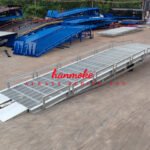
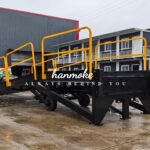
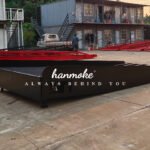
Most buyers compare ramps on load rating, deck width and price, and then stop thinking about the product until the container doors open at their yard. That is a mistake. A mobile yard ramp spends roughly five weeks in production and four to six weeks in a steel box crossing the ocean, and the way it is packed inside that box decides whether you receive a finished machine or a list of warranty claims. We have shipped ramps in every export market from Los Angeles to Melbourne for years, and this article explains exactly how the packing and container-loading process works, what it costs, and what you should check when the doors swing open.
What Actually Leaves the Factory: Weights and Configurations
The first number that governs packing is weight. A ramp is dense cargo: steel frame, deck grating, hydraulic cylinder and counterweight all concentrated in a long, narrow footprint. Typical shipping figures for our own families, with options removed where noted, look like this:
| Model family | Rated load | Overall length | Overall width | Typical shipping weight |
|---|---|---|---|---|
| Standard hydraulic yard ramp (HRYS) | 10 t / 22,000 lb | 11,400 mm / 37’5″ | 2,200 mm / 7’3″ | ≈6 t / 13,200 lb |
| Heavy-duty hydraulic ramp (HRHS) | 15 t / 33,000 lb | 10,300 mm / 33’10” | 2,200 mm / 7’3″ | ≈7–8 t / 15,400–17,600 lb |
| 2-part folding ramp (HRNX) | 10 t / 22,000 lb | ≈5,700 mm folded / 18’8″ | 2,200 mm / 7’3″ | ≈5 t / 11,000 lb |
| 3-section folding ramp (HRFJ) | 10 t / 22,000 lb | ≈3,430 mm folded / 11’3″ | 2,200 mm / 7’3″ | ≈4.5 t / 9,900 lb |
| Container ramp (HRCN-A) | 6 t / 13,200 lb | ≈4,300 mm / 14’1″ | 2,000 mm / 6’7″ | ≈2.5 t / 5,500 lb |
These weights matter for two reasons. First, they sit well inside the payload of a 40 ft high-cube container, which on most series is in the 26–28 t class — even two folding ramps plus a container ramp add up to barely half a box’s payload. Second, weight drives the lashing plan: a 6-tonne deck sliding 50 mm / 2 in in a heavy swell can tear a guardrail off its bolts, so the securing design starts from the ramp’s mass, not its value.
Why Ramps Don’t Ship Assembled
A ramp as delivered to your yard is at its worst geometry for shipping. Overall width of 2,200 mm is fine, but the guardrails stick out, the support legs project downward past the frame line, and the tow bar sticks out front. Three changes fix that, and none of them costs you anything on arrival:
- Guardrails unbolted and packed inside the frame. The rails bolt on with the same fasteners you will re-tighten at assembly; we pack them in a steel hardware bag lashed to the deck so they cannot wander.
- Support legs raised and locked. The legs fold or screw up above the frame line, so the deck rests flat on its packing saddles instead of on four cantilevered points.
- Lip secured in the closed position. A hydraulic lip that floats during transit will slam against its stop for five straight weeks. We pin or strap the lip closed for every export unit.
On folding models the folding joints are the additional risk point. The hinge pins are retained with their standard keepers, but each joint is also braced with a steel prop so that road vibration on the first and last 500 km of the journey cannot work the deck open.
The Packing Process, Step by Step
Our standard export packing sequence for a straight-deck 10-ton ramp takes a loading team of three about four hours and follows the logic of the IMO/ILO/UNECE CTU Code — the international code of practice for packing cargo transport units. The code is not a law you can be fined under, but it is what insurers and marine surveyors will measure a claim against, and its core requirements are simple: distribute heavy cargo over the floor area, never concentrate it on small zones, block and lash so nothing can slide or tip in any direction, and fill or control void spaces.
- Saddles first. Two welded steel saddles, each with a timber or polymer bearing pad, are set on the container floor at the ramp’s frame bearing points. The ramp is forklifted onto them, weight spread lengthwise, never point-loaded on the lip.
- Shoe it in. The ramp is entered nose-first at walking pace, with the lip end trailing. The deck centerline stays within a few millimeters of the container centerline; on a 2,200 mm / 7’3″ deck inside a 2,352 mm / 7’8″ internal width, that leaves roughly 76 mm / 3 in of clearance per side — enough for lashings, not enough for improvisation.
- Lash down. Four lashing points, welded to the frame, take heavy-duty web or chain lashings angled down and out to the container’s lashing bars. Angle matters: flat lashings do nothing against vertical acceleration, which is the force that lifts a saddle.
- Block it. Timber wedges at the wheel-bearing points stop any fore-and-aft creep, and where the schedule calls for it, steel props brace the frame against the container wall.
- Wrap it. The hydraulic power pack, cylinder rods and any machined surface get a corrosion-inhibiting wrap; the whole unit gets a woven poly cover, tied down, to keep sea spray and condensation off the deck grating.
- Verify and document. We record the gross mass on the packing declaration, photograph the secured load inside the open doors before closing, and include the assembly hardware list in the document pouch. The CTU Code’s closing checklist — correct gross mass, seal number on the documents, packing certificate where required — is exactly what we do, because on the rare occasion a claim gets disputed, those photographs and that mass statement are what settle it.
Fitting a Ramp Into a 40 ft High Cube: The Geometry
Container fit is pure arithmetic, and it is worth doing before you order, because the answer changes your freight bill by hundreds of dollars per unit. The interior of a 40 ft high cube is about 11,978 mm / 39’3″ long, 2,352 mm / 7’8″ wide, with a door opening of roughly 2,340 mm / 7’8″ — figures that also explain why a 2,200 mm deck is the industry’s default width. Now compare ramp lengths against that box:
| Ramp type | Shipping length | Units per 40 ft HC | Freight implication |
|---|---|---|---|
| Straight-deck ramp (HRYS/HRHS) | 10.3–11.4 m / 33’10″–37’5″ | 1 | Full container per unit; the 11.4 m deck clears the 11.98 m interior with about 0.5 m to spare |
| 2-part folding (HRNX/HRYN) | ≈5.7 m / 18’8″ folded | 2 end-to-end | Two units share one box — roughly half the ocean freight per ramp |
| 3-section folding (HRFJ) | ≈3.4 m / 11’3″ folded | 2 plus a container ramp | Best freight efficiency; folding adds hinge weight, not freight |
This is the quiet argument for folding designs if you buy more than one ramp. At recent container rates — Drewry’s World Container Index was around USD 4,429 per 40 ft in late October 2026 — a straight-deck ramp to the US West Coast carries roughly USD 3,700 more freight per unit than a two-per-box folding ramp on the same lane. If your fleet plan calls for three or more ramps, ask the supplier to quote both configurations; the folding premium on the machine side rarely eats the freight saving.
Lashing Standards in Plain Language
You do not need to become a lashing engineer, but you should know the three tests any packing plan must survive. At sea, a container on deck sees accelerations that can approach 1 g sideways in a severe roll. The CTU Code’s method is to assume a friction coefficient, calculate the forces on the cargo, and size blocking and lashings so that sliding and tipping are prevented in every direction. Three practical consequences for ramps:
- Friction is not a securing method. A steel saddle on a plywood container floor feels immovable; wet and dry friction figures say otherwise once the deck is rolling. Lashings do the work, friction just reduces it.
- Web lashings must not be knotted — the code states this explicitly because a knot can cut the working load limit by half or worse. If a lashing runs out of length, the answer is a different lashing, not a knot.
- Heavy cargo stays low and spread out. A ramp is inherently low-center-of-gravity cargo, which is a gift; the mistake to avoid is stacking spare parts or loose pallets on top of it inside the box.
| Packing item | What it does | Why it earns its place |
|---|---|---|
| Welded steel saddles | Carry the frame off the container floor | Spreads 5–8 t of steel over bearing points instead of edge-loading the lip or deck plate |
| 400×400 mm timber pads | Bearing surface under saddles | Keeps saddle edges from concentrating load on corrugated floor panels |
| Heavy-duty web/chain lashings | Down-and-out restraint at 4 frame points | Handles vertical and lateral acceleration that friction alone cannot |
| Timber wedges and steel props | Blocking in all horizontal directions | First line of defense against creep before any lashing stretch is used up |
| VCI wrap on rods and machined faces | Inhibits condensation corrosion | Thirty days inside a sealed box can spot-rust an exposed cylinder rod |
| Woven poly cover, tied down | Keeps spray and dust off the unit | Protects the deck grating finish and keeps the box inspection clean |
| Hardware bag lashed to deck | Guardrail bolts, pins, tools | Nobody arrives at a yard hunting for M20 bolts at 7 a.m. |
What Damage Claims Actually Teach Shippers
In more than a decade of export shipping we have had to deal with two categories of transit damage more than any other, and neither is exotic. The first is contact damage: a forklift tine at a transshipment terminal, a guardrail corner scuffed by a lashing hook. The second is cosmetic corrosion: surface rust bloom on an unprotected deck that spent a wet monsoon season in a poorly ventilated box. Both are cheap to prevent and expensive to argue about — which is why every unit leaves here photographed, wrapped and mass-declared. When a surveyor opens the container, the evidence chain matters more than the story.
The practical takeaway for you as a buyer is that packing quality is a supplier-selection criterion, not a detail. Ask any prospective supplier how the ramp is secured inside the container, whether the gross mass is declared on the documents, and whether they photograph each loaded box. A factory that cannot answer those three questions quickly is a factory whose warranty department is about to become your pen pal.
Receiving Checklist at Your Dock
When the container arrives, spend thirty minutes on this sequence before signing anything free of exceptions:
- Check the seal number against the bill of lading before breaking it; a mismatch goes on the delivery receipt immediately.
- Open both doors and photograph the load before anyone touches it. If lashings have slackened or a saddle has shifted, the photos decide the claim.
- Count the hardware bag contents against the assembly list while everything is still inside the box.
- Inspect the lip and cylinder rod first — they are the two parts where transit damage shows up as a functional problem, not just a cosmetic one.
- Assemble with a torque wrench, not an impact gun, on the guardrail bolts; overtightened anchors distort the rail sockets and make later rail removal genuinely difficult.
None of this is complicated, and a good supplier hands you the checklist without being asked. We include a printed receiving sheet in every document pouch, and the same document is available in advance if you want your yard team briefed before the container lands.
Can one 40 ft container really take two 10-ton ramps?
Yes, if they are 2-part folding models: each folds to roughly 5.7 m / 18’8″, so two fit end-to-end in the 11.98 m interior with lashing space, and their combined weight of about 10 t is far below the container’s payload. Straight-deck ramps of 10.3–11.4 m ship one per box.
What packing standard applies to ramp shipments?
The IMO/ILO/UNECE CTU Code is the recognized international reference for packing cargo transport units. It is non-mandatory guidance, but insurers and surveyors use it as the benchmark when a claim is disputed, so we pack and document every export unit to its requirements.
Do I need to grease or prepare anything before assembly?
Check the hydraulic oil level and inspect the cylinder rod for transit scuffs before first use; the VCI wrap comes off at assembly. Otherwise the ramp ships ready to work — guardrail bolts, support legs and tow bar are the only assembly items.
How much does export packing add to the price?
For a single 10-ton ramp, saddles, timber, lashings and wrapping add roughly USD 250–450 to the invoice. Folding configurations pack in pairs, which spreads that cost across two machines and is part of why folding ramps are cheaper to land per unit.
If you want a packing plan for a specific order — or a quote that shows straight-deck and folding freight costs side by side — contact our export team with your ramp type and destination port. We will return the container-fit calculation and packing specification with the offer, so there are no surprises when the box opens. To compare machine families first, start with the mobile yard ramps category, the folding loading ramps category, or go straight to the standard 10-ton hydraulic yard ramp.