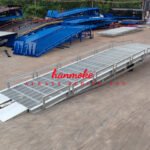
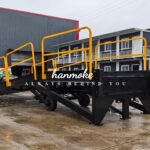
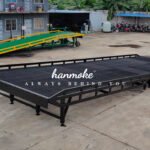
Most buyers who ask me to compare a container ramp with a yard ramp are not comparing like for like, and the quotation stage is where it shows. They ask for “a ramp to load containers”, get two prices that differ by a factor of six, and assume the cheap one is a smaller version of the expensive one. It is not. One of these products bridges a gap. The other manufactures a height difference. Confusing the two is how facilities end up with a 1.25 m plate under a 2.5 t forklift, or a 10 m ramp they did not have the yard space to turn around.
This is the comparison I would give a maintenance or procurement manager before they sign anything — the physical difference, the grade numbers that decide who can drive on it, the three different meanings of capacity, and the site conditions that eliminate one option before price ever comes up.
One Bridges a Gap, the Other Builds the Height
Set the two units side by side and the difference is not styling. Our HRCN-A container loading board is 1,250 mm (4 ft 1 in) long and 2,100 mm (6 ft 11 in) wide, rated 6 t, in checkered plate with forklift pockets at the front. Our HRYS standard yard ramp is 10,200 mm (33 ft 6 in) long overall — a 7,570 mm slope plus a 2,630 mm platform — 2,200 mm (7 ft 3 in) wide, rated 10 t dynamic, lifting from 1,200 mm to 1,680 mm.
Read those two sentences again. The container board is 1.25 m long. It cannot climb 1.3 m, because that would require a 104% grade, which is a wall, not a ramp. What it does is span a step: from a dock face onto a container sill, from a raised concrete apron onto a container floor, or from the platform of a yard ramp into the box. It is a bridge plate with a container-specific width, and our catalogue files it under dock plate and dock boards for that reason.
The yard ramp does the opposite job. It takes a container or trailer floor that is 1.2 to 1.7 m above grade and creates the entire approach itself — slope, platform, guard rails, support legs, hydraulic lift. You drive up it from flat ground. That is a different piece of engineering, and the six-fold price difference is mostly steel and hydraulics, not margin.
What the Numbers Actually Say
The table below is the comparison I use on the phone, because it settles most arguments in thirty seconds. Note the column that matters most: what the unit is designed to sit against.
| Attribute | Container loading board (HRCN-A) | Standard yard ramp (HRYS) | Heavy-duty yard ramp (HRHS / HRES) |
|---|---|---|---|
| Rated capacity (dynamic) | 6 t (13,228 lb) | 10 t (22,046 lb) | 20–30 t (44,092–66,139 lb) |
| Overall length | 1,250 mm (4 ft 1 in) | 10,200 mm (33 ft 6 in) | 10,300 mm (33 ft 9 in) |
| Overall width | 2,100 mm (6 ft 11 in) | 2,200 mm (7 ft 3 in) | 2,200 mm (7 ft 3 in) |
| Height it creates | None — it spans an existing step | 1,200–1,680 mm (3 ft 11 in – 5 ft 6 in) | 1,200–1,800 mm (3 ft 11 in – 5 ft 11 in) |
| Deck | Checkered plate | 5 mm diamond mesh, grating optional | Grating or checkered plate, 5–6 mm |
| Lifting | None, set by forklift | Manual hydraulic pump, twin cylinders | Manual or 380 V electro-hydraulic |
| Sits against | Dock face, apron, container sill, ramp platform | Open yard with 3 m run-up | Open yard, high-cycle docks |
| Indicative EXW price | Quoted by size and capacity | USD 6,800–9,200 | Quoted per drawing |
Those price figures are EXW Foshan, indicative ranges for planning only, and not a quotation — freight, duty, deck upgrades and custom widths all move them. The useful comparison is the ratio, not the number: the yard ramp costs several times what the board costs because it contains several times the steel, plus a hydraulic system with cylinders, seals and a pump that has to hold 10 t at height for years.
Grade Decides Who Can Drive On It
This is where most wrong purchases are made. Take the HRYS geometry: 1,200 mm of rise over a 7,570 mm slope is a 15.9% grade, about 9°. At full height, 1,680 mm over the same run, it is 22.2%, about 12.5°. Both numbers are normal for a mobile yard ramp, and both are above the 10% threshold in OSHA 29 CFR 1910.178(n)(7)(i), which requires a loaded forklift to travel with the load uphill on grades steeper than 10%. That is an operating rule, not a defect: it means your drivers descend in reverse with a load, and you train for it or you get a tip-over.
| Rise required | Run available | Grade | Angle | Verdict |
|---|---|---|---|---|
| 150 mm (6 in) step at a dock face | 1,250 mm board | 12% | 6.8° | Container board is correct |
| 300 mm (12 in) step | 1,250 mm board | 24% | 13.5° | Board works for pallet trucks, marginal for forklifts |
| 1,200 mm (3 ft 11 in) to trailer bed | 7,570 mm slope | 15.9% | 9.0° | Yard ramp, load uphill rule applies |
| 1,680 mm (5 ft 6 in) to high-cube floor | 7,570 mm slope | 22.2% | 12.5° | Yard ramp at full extension, check gradability |
| 1,300 mm container floor on the ground | 1,250 mm board | 104% | 46° | Impossible — you need a yard ramp |
Forklift manufacturers typically publish 15% to 20% gradability for a loaded counterbalance truck on concrete, and it drops on wet steel. So a yard ramp at full height is at the edge of what a loaded truck will climb, which is why the platform exists: the truck levels out before it enters the trailer, and the transition is a designed knuckle rather than a kink. A container board placed on a 300 mm step has no such transition, which is why it is a pallet-truck tool first and a forklift tool second.
Capacity Has Three Meanings
When a buyer says “I need a 5-ton ramp”, I have to ask which 5 tons. Three numbers get mixed up constantly, and the gap between them is where failures come from.
Static capacity is what the unit holds standing still. It is the largest number and the least useful. Dynamic capacity is what it carries in motion, with the load bouncing and the forklift’s axles transferring weight — this is the number on the plate, and it is what our 10 t rating on the HRYS refers to. Per-axle load is what actually cracks decks: a 3 t forklift with a 1.5 t load does not present 4.5 t, because the front axle takes most of it and the impact factor multiplies it.
| Load case | What to compare | Typical sizing rule | Where it goes wrong |
|---|---|---|---|
| Container board, pallet truck | Wheel load, not total mass | Board rating ≥ 2× laden pallet truck | Nylon wheels point-load a 6 t plate |
| Yard ramp, counterbalance forklift | Dynamic rating vs forklift + load | Combined weight × 2.5 (standard duty) | Buying on forklift capacity alone |
| Yard ramp, high-cycle or heavy cargo | Dynamic rating with impact | Combined weight × 3 to 4 | Under-buying to save 15% of price |
| Any unit, over time | Weld and lip condition | Annual inspection, lip wear limit | No inspection until a weld lets go |
The 2.5 and 3-to-4 multipliers are industry practice rather than a legal requirement, but they exist because impact loading is real. A ramp rated exactly at the forklift’s combined weight will survive the first month and crack at the lip weld in the second. If you want the formal language, ANSI MH30.2 covers portable dock levelling devices and OSHA 1910.178(n)(11) requires a dockboard or bridgeplate to be secured before it is driven over and never loaded beyond its rated capacity — the phrase “never exceeded” is doing a lot of work in that sentence.
Site Conditions That Rule One Out
Before price, look at the ground and the turning circle. A 10.2 m ramp needs roughly 3 m of flat run-up behind the approach and a turning area a counterbalance truck can use loaded. If your yard is a 12 m wide strip between two sheds, the yard ramp physically will not deploy, and no amount of specification fixes that. That is when facilities go the other way: a low fixed dock plus a container board, or a ground-level operation with a shorter ramp and a pallet truck.
Surface matters just as much. Yard ramps want a hard, level approach — asphalt, concrete, or compacted hardcore at minimum. Support legs sink into soft ground and the ramp settles out of level, which twists the frame. A container board on a dock face needs a sound concrete edge; spalled concrete under a 6 t plate is how the plate walks off the edge with a truck on it.
And count the cycle. Two or three height changes a shift suits a manual hydraulic pump, which takes 2 to 4 minutes including setting the legs. Forty trailer changes a shift does not — that is electro-hydraulic territory at under a minute, and it is worth the extra cost because the alternative is drivers leaving the ramp at the wrong height and bridging the gap with a plate they should not be using.
The Cost of Getting It Wrong
The failure mode I see most is not buying the wrong ramp; it is buying a ramp for the wrong half of the job. A facility loads containers on the ground at the back of the yard and also receives at a 1.3 m dock. One HRYS handles the yard; one HRCN-A handles the dock face. Buy only the ramp and the dock work still gets done by hand. Buy only the board and the yard work cannot be done at all.
The second failure is over-specifying the board. A 6 t board is not a 6 t ramp, and a buyer who reads “6 ton” and assumes it will take their 3 t forklift up a 400 mm step is going to be disappointed — the grade, not the capacity, is the limiting factor. Ask for the grade at your actual step height before you order, and get it in writing.
A Decision Sequence That Works
Four questions, in this order, resolve almost every case:
1. What is the height difference? Under 300 mm and the approach is already at container floor level: a container board. Over 600 mm with grade-level approach: a yard ramp. Between the two, measure the actual step before deciding.
2. What is driving on it? Pallet truck and hand cart: board territory. Counterbalance forklift: yard ramp, sized on combined weight times 2.5.
3. How much run-up and turning space exists? Less than 3 m behind the approach or a narrow yard: the 10.2 m ramp is out, and you are looking at a fixed solution or a shorter ground-to-dock ramp.
4. How many cycles per shift? Under five: manual pump is fine. Above twenty: pay for electro-hydraulic and never think about it again.
Frequently Asked Questions
Can I use a container ramp to load a container sitting on the ground?
No, not on its own. A container floor on the ground sits about 1,300 mm up, and a 1,250 mm board would need a 104% grade. You need a yard ramp to create the incline, and the board is then used to bridge from the ramp platform into the box if the gap demands it.
Is a 6 t container board enough for a 2.5 t forklift?
Usually marginal. A 2.5 t counterbalance truck with a load puts most of its weight through the front axle, and the impact factor on a short board is unforgiving. Check the per-axle figure with the supplier, and expect a board to be a pallet-truck tool in practice.
What grade is too steep for a yard ramp?
Above 15% a loaded counterbalance truck is working near its published gradability, and above 10% OSHA requires travelling with the load uphill. Our standard ramp runs 15.9% at low height and 22.2% at full height, which is why the platform and the load-uphill rule both matter.
How long is delivery and how do they ship?
Yard ramps run 20 to 30 days after deposit and drawing approval; boards are faster because there is no hydraulic assembly. Two nested yard ramps fit a 40 ft high-cube, so confirm the loading plan with your forwarder before booking.
If you send us the height difference, the forklift model with its loaded weight, the available run-up and a photo of the approach, we will tell you which of the two you need — including when the answer is the cheaper board. Send your site details for a quote, or start with the mobile yard ramp range and the HRCN-A container ramp.