A loading dock is a 10 m² hole in a wall that opens forty times a day. Everything else in the building — insulation, roof, glazing — is designed to a U-value, and then the dock door is asked to perform with a rubber pad and a strip of vinyl. That is why seals and shelters pay for themselves faster than almost any other upgrade in a warehouse, and also why so many of them are specified badly and replaced every third year.
This guide is the version I give to facility managers who ask which one to buy: what the two families actually do, how to size them so the trailer touches the pad and not the frame, and how to work out in ten minutes whether the purchase makes sense at your dock hours and your climate.
What a Seal and a Shelter Actually Do
A dock seal is a compression device: foam blocks wrapped in coated vinyl, fixed around the door opening, that the trailer body presses into when it backs in. It seals because the trailer crushes it. A dock shelter is an enclosure: a rigid frame with fabric curtains on the top and sides that drape over the trailer without being compressed. It seals because the curtains overlap the trailer, not because they are squeezed by it.
That single mechanical difference drives every other decision. A seal gives the tighter joint — usually the tightest you can buy — but only at one trailer width and within a limited height band. A shelter gives up some tightness and gains tolerance: it will accept a 2.4 m van, a 2.6 m reefer and a slightly out-of-square trailer in the same afternoon without anyone adjusting anything.
| Type | Projection | Trailer width it handles | Indicative cost per position (EXW) | Best for | Weak point |
|---|---|---|---|---|---|
| Foam compression seal | 457 mm (18 in) | 2,400–2,550 mm (94–100 in) | USD 700–1,300 | Single-fleet DCs, cold storage, food plants | Oversized or damaged trailers crush the pads |
| Inflatable seal | 457–610 mm (18–24 in) | 2,300–2,600 mm (91–102 in) | USD 4,000–7,000 | Freezers, pharma, docks with mixed but narrow fleets | Blower, pressure switch and air lines to maintain |
| Rigid-frame shelter | 610–915 mm (24–36 in) | 2,300–3,000 mm (91–118 in) | USD 1,600–3,200 | Mixed carrier fleets, dry climates, high wind sites | Leakier at the corners; curtains wear on sharp edges |
| Full-access shelter | 610 mm+ (24 in+) | 2,300–3,200 mm (91–126 in) | USD 3,000–6,000 | High-throughput docks, side-load access needed | Needs approach depth and a clear door surround |
Prices above are indicative 2026 ex-works ranges for a 2.4 m × 3.0 m opening. They are not a quotation: freight on a seal is often a third of the goods value because the pads ship at volume, not weight.
Sizing Rules That Prevent Comebacks
Most failed seals I have seen were the right product at the wrong projection. Three dimensions decide whether the trailer compresses the pad or misses it entirely.
Projection. Measure from the dock face to the face of the bumper, then add the depth you want the trailer to compress. For a standard dock with 100 mm bumpers, 457 mm (18 in) of projection gives roughly 100–125 mm of compression on a van — enough to seal, not enough to bottom the foam. Where the leveler lip extends beyond the bumpers, or the trailers have thick reefer walls, go to 610 mm (24 in).
Pad width and header drop. Side pads are normally 305 mm (12 in) wide; the header pad needs to reach the lowest trailer roof you actually receive. A 13’6″ (4,115 mm) van and a 13’0″ (3,962 mm) trailer differ by 150 mm, and a header set for the taller one will leave a slit of daylight on the shorter one. If your fleet is mixed by more than 200 mm, that is a shelter argument, not a seal argument.
Clearance around the leveler and bumpers. The lip folds out roughly 400 mm on a standard leveler and up to 750 mm on a telescopic lip. Bottom pads have to be cut back or the lip will plane them off in the first month. The same applies to lights, wheel guides and the vehicle restraint housing, all of which now sit inside the seal envelope on a modern dock.
The Energy Arithmetic, Worked Out
You do not need an energy model to size this decision. You need the leakage area, the pressure difference and your fuel price. Infiltration through an opening follows orifice flow: velocity rises with the square root of pressure, so a 10 Pa daytime condition and a 30 Pa windy afternoon differ by a factor of 1.7, not 3.
Take a 3,000 mm × 3,600 mm door (10.8 m²). A seal in good condition leaves maybe 0.15 m² of effective leakage — the perimeter joints, the gap above the lip, the corners. A seal in its fifth year with waterlogged foam and a torn bottom corner leaks around 0.4 m². A dock with no seal at all is a 1.2 m² opening once you count the space around the trailer body.
| Effective leakage area | Airflow at 10 Pa | Airflow at 30 Pa | Heat load at ΔT 40°F (22°C) | Heat load at ΔT 20°F (11°C) |
|---|---|---|---|---|
| 0.15 m² — seal in good condition | 840 CFM (1,430 m³/h) | 1,450 CFM (2,460 m³/h) | 36,300 BTU/h (10.6 kW) | 18,200 BTU/h (5.3 kW) |
| 0.40 m² — seal at year five | 2,250 CFM (3,820 m³/h) | 3,890 CFM (6,610 m³/h) | 97,200 BTU/h (28.5 kW) | 48,500 BTU/h (14.2 kW) |
| 1.20 m² — no seal | 6,750 CFM (11,470 m³/h) | 11,680 CFM (19,850 m³/h) | 291,600 BTU/h (85.4 kW) | 145,700 BTU/h (42.7 kW) |
Convert that to money with gas at USD 1.10 per therm and an 80% efficient unit heater: the year-five seal costs about USD 1.34 an hour to leak, the unsealed door about USD 4.00 an hour. At 1,200 dock hours a winter that is USD 1,600 versus USD 4,800 for one door — and a new seal costs USD 700–1,300. The payback is one heating season, which is why I am suspicious of any facility that has been “planning to replace the seals” for three years.
Cooling climates behave differently, because you pay twice: sensible heat and the latent load of humid air. In a 20°F (11°C) Miami summer with air at a COP of 3.2, a year-five seal costs roughly USD 0.72 per dock hour, or about USD 1,450 across 2,000 hours. In a freezer dock the same leak is far worse — 85°F across the wall, refrigeration at a COP near 2.0 — around USD 3.90 an hour, or USD 11,800 a year at 3,000 dock hours. That is the case where an inflatable seal stops being a luxury.
Where Seals Fail in Year Two
The failures are predictable, and they are almost never the vinyl. They are the bottom corners, torn by container twist locks and ICC bars that arrive a little high; the header, worn through by reefer units with ribbed roofs; and the foam itself, which waterlogs once the coating is punctured and then stops recovering its shape after compression. A waterlogged pad looks fine from the yard and seals nothing.
The maintenance routine that actually prevents this is short: walk the pads monthly for tears and daylight, check the fasteners and the frame-to-wall joint quarterly, and test the compression annually by watching where the trailer touches. On inflatables, add a monthly blower and pressure-switch check — an inflatable that never fully inflates is worse than a foam seal because it looks engaged. Expect 8–12 years from a well-maintained vinyl seal, 5–7 from foam in a wet climate, and 10–15 from an inflatable that gets serviced.
Cold Storage and Food Plants Play by Different Rules
Below about -18°C (0°F) the material matters more than the geometry. Standard vinyl stiffens and cracks; you need a coating rated for low-temperature flex, and you need the frame detailed so condensation does not run back into the wall. Freezer docks also tend to run inflatables or insulated shelters with heated frames, because a compression seal that cannot recover at -20°C stops sealing within a season.
Food and pharma plants add a second requirement that buyers forget: washdown. Seals in a washdown zone need removable pads or a design that lets the foam dry, otherwise you are growing something in the dock wall. Ask for the pad fixing detail before you order, not after.
When a Seal Is the Wrong Purchase
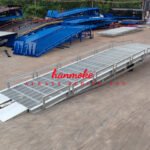
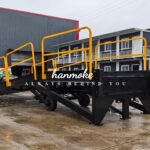
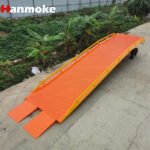
Seals only work against a trailer body with a flat vertical face at a known height. Flatbeds, flat-racks, container chassis loaded with a 20-foot box, and side-load trailers have nothing to compress against, so a seal at those doors is decoration. If most of your loading happens in the open yard with a mobile yard ramp, a seal is not your problem at all — rain protection becomes a canopy question and drainage becomes a deck question, which is where a galvanised or grated ramp earns its price.
The same logic applies to drive-through docks and any position that handles both vans and plant equipment. In those cases a full-access shelter with removable curtains will tolerate more abuse than a sealed envelope ever will.
Ten Questions Before You Order
- What is the door opening, measured, not read off a drawing?
- What is the distance from the dock face to the bumper face?
- What is the narrowest and widest trailer body in your fleet?
- What is the lowest and highest trailer roof?
- How far does the leveler lip extend past the dock face?
- Where do the lights, wheel guides and restraint sit?
- How many dock hours per year, and at what outside design temperature?
- Is the wall insulated, and is there a thermal break at the frame?
- Does the position see washdown, salt or ice?
- Who is going to inspect it, and how often?
Answer those ten and the choice between seal types is usually obvious. If two options survive, pick the one with the replaceable pads — you will replace them, and the labour is the expensive part.
Frequently Asked Questions
How long do dock seals last?
Eight to twelve years for a well-maintained vinyl compression seal, five to seven in a wet climate where the foam waterlogs, and ten to fifteen for an inflatable that gets its blower and pressure switch serviced. The vinyl usually outlives the foam.
Do dock seals work with every trailer type?
No. They need a flat vertical trailer face at a predictable height, so flatbeds, flat-racks and container chassis cannot be sealed. Those positions are better served by a shelter with removable curtains, or by loading in the open with a mobile ramp.
What projection do I need?
Measure from the dock face to the bumper face and add the compression you want — typically 457 mm (18 in) total for a standard dock with 100 mm bumpers. Go to 610 mm (24 in) when the leveler lip extends past the bumpers or the fleet runs thick-walled reefers.
How do I estimate the savings myself?
Estimate the leakage area, convert it to airflow at your design pressure, then use 1.08 × CFM × ΔT for the heat load in BTU per hour and divide by your fuel price and efficiency. If the annual figure is more than twice the cost of a new seal, replace it.
Ask for the Sizing Sheet, Not the Catalogue Page
Send us the door opening, the bumper-to-face distance and your fleet’s narrowest and widest trailer, and we will come back with the seal or shelter that fits — plus the mounting detail around your dock leveler, dock plate and bumper line. If the position handles flatbeds or containers, we will tell you straight that a seal will not work and point you at a mobile yard ramp or a dock ramp platform instead. Start here: contact our engineering team.