Every galvanized yard ramp quotation seems to come with a corrosion warranty these days — 10 years, 15 years, sometimes 25, printed in bold on the last page. Buyers sign it and move on. After 30 years of building and watching these machines rust (or not rust) in ports, seafood plants and mining yards, I will tell you plainly: the number on the warranty page tells you almost nothing. The coating thickness, the environment category and the exclusions tell you everything. This article walks through how to read a corrosion warranty the way a fabricator reads it.
What a Corrosion Warranty Actually Covers
A corrosion warranty on a hot-dip galvanized ramp is a promise about the coating, not about the steel. It typically commits the supplier to repair or replace if the coating fails prematurely — meaning flaking, peeling, or red rust appearing through the zinc well before the stated term. What it almost never covers is the damage that actually kills most ramps in the field: mechanical impact from forklift tines, scraping pallets, weld repairs made on site without re-protecting the bare steel, or cuts and drill holes where water sits. Those are usage issues, and no sensible supplier will underwrite them.
The honest framing is this: the warranty covers process failure, the way a car warranty covers engine failure but not a crash. That is still valuable — process failure is the expensive kind you cannot see coming — but only if the promised coating is specified precisely enough to be checked. “Galvanized finish, 10-year warranty” is not a specification. “Hot-dip galvanized after fabrication to ASTM A123, coating grade 100, mill certificate with magnetic gauge readings supplied” is.
The Coating Thickness That Has to Back the Promise
Zinc buys time in micrometres. The major standards set minimum average coating thickness by the thickness of the steel being coated, because thicker steel stays hotter in the zinc bath and grows a heavier alloy layer. For ramp main frames, beams and plate thicker than about 6 mm, the relevant minimums are:
| Standard | Scope | Steel thickness | Min. avg. coating |
|---|---|---|---|
| ASTM A123/A123M | Fabricated structural shapes and plate (US market) | ≥ 6.35 mm (1/4 in) | Grade 100 — 100 µm (3.9 mils, ≈705 g/m²) |
| ASTM A123/A123M | Same, lighter sections | 1.6–6.35 mm | Grade 75 — 75 µm (3.0 mils) |
| AS/NZS 4680 | After-fabrication HDG (Australia/NZ market) | > 6 mm | 85 µm (600 g/m²) |
| ISO 1461 | General HDG reference (international tenders) | > 6 mm | 85 µm (610 g/m²) |
Note that there are no maximum limits — reactive steels often come out of the kettle above minimum, which works in your favour. When you compare two “galvanized” quotes, the first question is not whose warranty is longer; it is which standard and grade is named on the drawing, and whether the supplier will attach the galvanizer’s certificate with actual thickness measurements. A supplier who cannot produce gauge readings is selling a word, not a coating.
How Fast Zinc Is Actually Consumed
The useful life of the coating is roughly the zinc thickness divided by the corrosion rate of zinc in your environment. ISO 9223 classifies atmospheres from C1 to CX and gives first-year corrosion rates for zinc; the rate slows over time as the patina stabilises, so dividing thickness by the first-year rate is a conservative estimate rather than an optimistic one. Here is what 85 µm and 100 µm coatings buy in each environment class:
| ISO 9223 class | Typical environment | Zinc loss (µm/yr) | Time to first maintenance, 85 µm | 100 µm |
|---|---|---|---|---|
| C2 — low | Rural inland, dry | 0.1–0.7 | 121–170 yr | 143–200 yr |
| C3 — medium | Urban, light industrial, mild coastal | 0.7–2.1 | 40–121 yr | 47–143 yr |
| C4 — high | Industrial areas, moderate marine | 2.1–4.2 | 20–40 yr | 24–47 yr |
| C5 — very high | Heavy industry, tropical marine | 4.2–8.4 | 10–20 yr | 12–24 yr |
| CX — extreme | Offshore, splash zone | 8.4–25 | 3–10 yr | 4–12 yr |
Most yards — including coastal ones that feel aggressively “marine” — sit in C3 or C4. That is the quiet headline of this table: in a C4 industrial yard, an 85 µm coating has a realistic 20–40 year life to first maintenance, which is longer than most ramps will stay in service, and a 100 µm coating stretches that further. A 10-year warranty on a properly coated ramp in C3 is not a bold promise; it is a floor so low it is nearly meaningless. When a supplier leads with the warranty years instead of the coating grade, they are usually compensating for a thinner kettle.
The Arithmetic a Warranty Must Beat
Run the numbers yourself before signing anything. Take a yard ramp working an industrial estate 40 km from the coast: call it C4, zinc loss 2.1–4.2 µm per year. An 85 µm AS/NZS 4680 coating gives 20–40 years; a 100 µm ASTM A123 Grade 100 coating gives 24–47. Compare that with a painted ramp: a typical two- or three-coat system (zinc-rich epoxy primer plus epoxy build plus polyurethane topcoat, around 240 µm dry film total) falls into ISO 12944 durability “high” — 15 to 25 years to first major maintenance — and unlike zinc, a paint system offers no galvanic protection at scratches and cut edges, so damage spreads instead of healing.
That is the structural reason a galvanized ramp holds value in the used-equipment market. The zinc still has reserve thickness after ten years of honest work; a ten-year-old painted ramp is usually a repainting project. The one environment where paint genuinely competes is CX — offshore platforms and splash zones — where even 100 µm of zinc is consumed in under a decade and duplex systems (galvanize plus paint) become the correct answer.
Five Red Flags in Corrosion Warranty Text
- No standard or grade named. If the warranty never mentions ASTM A123, ISO 1461 or AS/NZS 4680, there is no measurable commitment behind it — “galvanized” alone has no minimum thickness.
- “Zinc-coated” instead of “hot-dip galvanized after fabrication.” Pre-galvanized sheet or electro-plated components carry a fraction of the zinc mass and fail years earlier; some quotes quietly mix the two.
- Warranty years exceeding the coating’s physical life by a wide margin. A 25-year warranty on a Grade 75 coating in a declared C5 site is marketing arithmetic, not metallurgy.
- Proration buried in the exclusions. Many warranties degrade to 20% coverage by year ten. Read what percentage of repair cost is covered at each interval, not just the headline term.
- No certificate or inspection clause. If the supplier will not commit to delivering the galvanizer’s mill certificate with gauge readings per the standard’s sampling plan, you have no way to prove a claim — or even know the coating exists.
What to Demand Before You Sign
Good warranty language is short and checkable. The table below contrasts the wording we see on problem quotes with what a buyer should accept:
| Clause | Weak wording | What to accept |
|---|---|---|
| Coating spec | “Galvanized finish” | “HDG after fabrication per ASTM A123 Grade 100 / ISO 1461 (85 µm min avg for >6 mm steel)” |
| Evidence | None | Mill certificate with magnetic gauge readings per the standard’s sampling plan, supplied with shipping documents |
| Coverage trigger | “Premature failure” | “Red rust on base steel before year N, excluding mechanical damage and field welds not re-protected” |
| Repair method | “At supplier’s discretion” | Zinc-rich repair paint per ASTM A780 for damaged areas; replacement for coating process failure |
| Environment declared | Silent | Warranty states the assumed ISO 9223 class, so both parties know what site it covers |
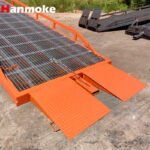
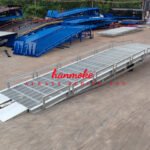
One practical note from our own production floor: the two galvanized ramp families we build for exposed yards are specified to exceed these minimums on the main frame, and every shipment leaves with the coating certificate in the document pack. If a competing quote cannot match that paperwork, the warranty years on its cover page are decoration.
Where Galvanized Ramps Win the Long Game
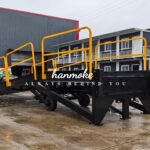
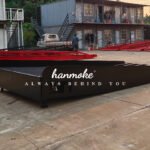
For buyers in coastal Australia, Gulf states, Southeast Asia or any site that washes equipment down, the galvanized yard loading ramps and galvanized dock ramps pages show the coating systems we apply by product family. For lighter duty around food processing or chemical plants, the galvanized forklift ramps follow the same logic at lower tonnage. The pattern across all of them: the coating, not the warranty, is the product.
The same logic applies at the port: a galvanized container ramp handles salt air and container wash-downs that eat painted steel in three or four years.
And in our service records, the ramps that outlive their warranty share two cheap habits: an annual walk-around — flag deep scratches, check lip hinges and drainage points — and prompt repair of bare steel with zinc-rich paint. Neither takes more than an hour a year, and both protect the warranty itself, because most claims are refused not on metallurgy but on neglect: a coating worn through by a dragging pallet is not process failure, and the supplier is right about that. Certificates filed, repairs logged — that paperwork is what turns a warranty from a page into leverage.
Frequently Asked Questions
Is a longer corrosion warranty automatically better?
No. A 10-year warranty backed by a Grade 100 coating and a mill certificate is worth more than a 25-year warranty on an unspecified finish with prorated coverage. Compare the coating standard, the evidence provided and the exclusions before comparing the years.
Does white rust mean the coating has failed?
Usually not. White rust is zinc hydroxide, a surface reaction from wet stacking or condensation during storage, and it does not meaningfully consume the coating. Heavy persistent white rust indicates poor storage, which is worth a claim; uniform grey patina is normal and protective.
Can a damaged coating be repaired in the field?
Yes, small areas are repaired with zinc-rich paint per ASTM A780, and the repaired zone is durable. Large mechanical damage or field welds should be cleaned and recoated the same way — the warranty excludes them precisely because the original kettle coating no longer exists there.
What corrosion class is my site?
Distance from the sea is the dominant factor: more than 1 km inland and away from industrial emissions usually means C3 or lower; industrial estates and moderate marine exposure are C4; heavy coastal industry is C5. Site-specific coupon testing per ISO 9226 gives certainty if the investment justifies it.
If you are comparing galvanized ramp quotations and want a second opinion on the coating specification, send us the quotes — we will read the warranty text and coating grades line by line and tell you where the gaps are. Contact Hanmoke for specifications, coating certificates and a firm quotation.