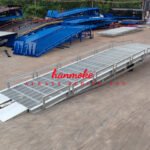
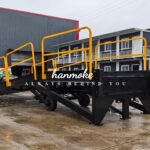
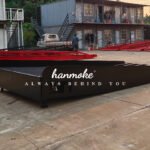
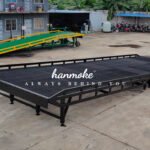
Six loading bays, one concrete apron, and an onshore wind that carries salt spray 400 m inland. That was the brief from a prawn and reef-fish processor on Queensland’s Wide Bay coast. Their previous ramps — painted mild steel, bought locally in 2023 — rusted through at the weld toes in fourteen months. Here is what we built, and what we would change.
The Site Problem: Salt, Chlorinated Wash-Down, Six Uneven Bays
The plant loads 20 to 26 trailers a day in season: 40 ft (12,192 mm) containers on skeletal trailers plus a few rigid pantechs. Forklifts are 2.5 t and 3.5 t electric, and every load crosses the ramp twice. Wash-down runs twice per shift at roughly 200 ppm free chlorine, and the apron falls away from the building at 1:60, so each ramp needed individual leg adjustment.
Paint never had a chance: a 200 µm system thins to 40 µm at every weld toe, sheared edge and bolt hole during application, and salt finds those points first.
What We Specified
Six hydraulic units, hot-dip galvanized after fabrication, 316 stainless fasteners throughout. Two 10 t units serve the pantech doors; four 15 t units handle container traffic where a loaded 3.5 t forklift plus a full pallet stack pushes the moving load past 8 t.
| Item | Qty | Rated capacity | Overall length | Width | Deck | Coating |
|---|---|---|---|---|---|---|
| HRYS-10 coastal spec | 2 | 10 t (22,046 lb) | 9,500 mm / 31’2″ | 2,200 mm / 7’3″ | 5 mm checkered plate | HDG600 |
| HRHS-15 coastal spec | 4 | 15 t (33,069 lb) | 10,300 mm / 33’10” | 2,200 mm / 7’3″ | 5 mm checkered plate + 4 mm wear strip at lip | HDG600 |
| Lip | 6 | — | 400 mm / 15.7 in fold-down | full width | 16 mm / 0.63 in plate | HDG600 |
| Side rail | 6 | — | — | 100 mm / 3.9 in toe board | — | HDG600 |
| Power | 6 | — | — | — | 24 V DC, IP65 control box | — |
Why Hot-Dip Galvanizing, Not Paint — the Numbers
A paint system looks cheaper per square metre on the quotation, and it is cheaper — for the first eight years. On this site it was not cheaper for the first two.
We specified HDG600 to AS/NZS 4680: for steel over 6 mm that is 600 g/m² minimum average, equivalent to 85 µm, with no local reading below 70 µm. AS/NZS 2312.2 turns that into expected life via the AS 4312 category — a plant 200 m to 1 km from a calm shoreline is C4; inside 200 m of surf beaches, C5.
| Coating system | Thickness | Life to first maintenance, C4 | Life to first maintenance, C5 | Relative capital cost |
|---|---|---|---|---|
| Paint: epoxy primer + polyurethane topcoat | 200–240 µm total | 8–12 years | 5–7 years | 100 (baseline) |
| HDG500 (steel 3–6 mm) | 70 µm | 16–33 years | 8–16 years | 112–118 |
| HDG600 (steel >6 mm) | 85 µm | 20–40 years | 10–20 years | 115–122 |
| Duplex: HDG600 + paint | 85 µm + 160 µm | 30–50 years | 18–28 years | 140–155 |
Two caveats we give every coastal customer. Galvanizing protects sacrificially, so a scratch does not propagate like a paint blister — but the zinc is still consumed, and an exposed plate edge will rust within a season without touch-up. And zinc does not survive concentrated acid or chlorine gas: keep the hypochlorite dosing point away from the ramp.
Geometry: Slope, Bed Heights and the 10% Rule
The trailer mix sets the height difference; the height difference sets the length. Container floors on a skeletal sat at 1,300 mm (4’3″), pantech beds at 1,150 mm (3’9″). We designed to the worst case and let the legs handle the rest — a ramp sized for the average is too short twice a day.
| Rise required | Grade | Ramp length needed | Practical comment |
|---|---|---|---|
| 1,150 mm / 3’9″ | 10% | 11,500 mm / 37’9″ | Comfortable for 3.5 t electric trucks |
| 1,150 mm / 3’9″ | 12.5% | 9,200 mm / 30’2″ | Upper limit for repeated loaded climbs |
| 1,300 mm / 4’3″ | 12.5% | 10,400 mm / 34’1″ | Matches our 10,300 mm deck at 12.6% |
| 1,300 mm / 4’3″ | 15% | 8,670 mm / 28’5″ | Only with traction surface and light loads |
Above 10% grade, OSHA 29 CFR 1910.178(n)(7)(i) requires a loaded forklift to travel with the load uphill. That changes operator behaviour more than any sign, and it is why we do not push 15% to save two metres of yard: a laden 3.5 t truck still grips at 12.5% in the wet, and does not on a wash-down deck at 15%.
Build, Ship, Install: Eleven Weeks
Production ran four weeks from drawing approval. Six units shipped in three 40 ft high-cube containers, one ramp per container with legs and lips crated alongside — at 10,300 mm long and 2,200 mm wide, two will not sit abreast inside a 2,352 mm container width. Sea freight to Brisbane took 24 days. Installation was three days with two technicians and a 12 t Franna crane, onto a 150 mm, 25 MPa pad poured a month earlier.
Three Things We Would Do Differently
1. Drain the deck from day one. The first two units went out with plain 5 mm plate and water pooled against the rear hinge. We added 10 mm drain holes on a 400 mm pitch with a 1:100 fall to the yard side. Grating self-drains better, but in a food plant it traps product and boots — for seafood we still specify plate, with drainage designed in.
2. Start with 316 stainless, not 304. The first fastener batch was 304. One month of chlorinated wash-down pitted the leg pins. Swapping 96 bolts cost less than the argument would have.
3. Light and signal the bays, not just the ramp. A night-shift near-miss — a driver pulling out while a forklift was still on the lip — led to LED dock arm lights and red/green restraint signals at all six doors. The ramp was never the problem. The interface was.
Questions Buyers Ask About This Kind of Job
Does hot-dip galvanizing survive daily chlorinated wash-down?
Yes, at HDG600 and with rinse-down after foam cleaning. Zinc is consumed slowly in neutral to alkaline water but attacked quickly by concentrated hypochlorite or acid sanitisers, so keep dosing points away from the ramp.
What capacity do I need for a 3.5 t forklift?
Add truck service weight to the heaviest load, then apply 1.25 to 1.5 as a dynamic factor. A 4.8 t truck carrying 1.5 t gives 6.3 t — a 10 t ramp with margin. Repeated container work with attachments is where 15 t earns its price.
Can the same ramp load a container sitting on the ground?
Not safely. A ramp built for a 1,300 mm trailer bed is too steep and too tall for a 2,591 mm container door at ground level. That job needs a dedicated container ramp with the correct approach angle.
What does a galvanized unit cost, and what is the lead time?
Indicative EXW Foshan pricing is USD 6,800–9,200 for a 10 t galvanized hydraulic ramp and USD 8,500–11,500 for 15 t, before freight. These are guidance ranges, not quotations. Standard lead time is 25–30 days ex-works.
Replacing ramps in a coastal or wash-down environment? Send the trailer bed heights, the forklift model and a photo of the apron, and we will come back with a drawing and a coating spec rather than a price alone — start here. Standard units are listed under galvanized forklift ramps and mobile yard ramps.