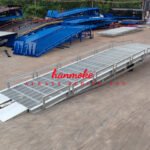
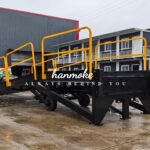
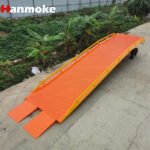
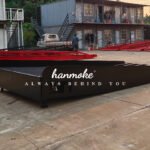
A dock bridge is the least glamorous piece of steel on a loading bay, and the one most often bought on guesswork. The HRBB is our 10-ton static bridge platform: a welded steel deck on legs, 4,872 mm long and 2,134 mm wide, with no hydraulics, no pit and no concrete. Below is the spec sheet we give customers who ask hard questions.
What the HRBB Physically Is
It is a rectangular steel platform on welded legs, with a checkered plate deck and formed transitions at each end. Nothing moves: no cylinder, no pump, no folding lip.
Two numbers decide whether it fits your building. The deck height of 755 mm (29.7 in) is fixed by the legs and cannot be shimmed out of a real mismatch. The usable length of 1,982 mm (78 in) is the flat run between the end transitions — what your load actually sits on.
| Parameter | Value | What it means on site |
|---|---|---|
| Model | HRBB | Static dock bridge, no power required |
| Rated capacity | 10 t / 20,000 lb | Dynamic rating for a loaded forklift crossing |
| Overall length | 4,872 mm / 191.8 in (15 ft 11.8 in) | Total footprint including end transitions |
| Platform width | 2,134 mm / 84 in (7 ft) | Fits a 2,340 mm container door with 100 mm each side |
| Usable length | 1,982 mm / 78 in | Flat run between transitions — the load-bearing centre |
| Deck height | 755 mm / 29.7 in | Fixed; the two faces it joins must match this |
| Deck surface | Anti-slip checkered steel plate | Rated for wet dock floors and condensation |
| Frame | Welded heavy structural steel | Rigid, no bounce under a 3 t forklift |
| Finish | Industrial powder coat | Galvanizing available for coastal sites |
The Three Jobs It Does Well
1. Bridging two adjacent dock faces
Two doors, one trailer in each, and a load that has to cross between bays without a second trip through the yard. A dock plate is too short and too light; a yard ramp blocks the apron. A 4,872 mm bridge laid across the opening gives a rigid full-width crossing that stays put under a turning forklift.
2. Extending an elevated platform to a loading face
Where a mezzanine or raised picking platform sits at roughly dock elevation, the HRBB closes the last 1.5–2 m with no fabricated structure or poured plinth. With no mechanism, it needs no annual service item either.
3. Covering a permanent opening
Removed conveyor runs, service trenches and knocked-through walls leave a hole in a traffic route. A static bridge restores the route in an afternoon and, unlike a loose plate, will not migrate when a pallet truck brakes on it.
Where the HRBB Is the Wrong Tool
- The two faces differ in height. The deck is fixed at 755 mm. If one side sits at 1,200 mm and the other at 1,300 mm, you need a leveller with working range.
- Trailer beds change height during the day. Air-ride trailers rise and fall as they load; a fixed bridge cannot follow. That is a dock leveler job.
- The bridge has to move between doors. Nobody repositions 4,872 mm of steel between shifts. For a ramp that follows the work, use a mobile yard ramp.
- Trucks load from open yard at 1.2–1.4 m bed height. There is no dock to bridge from — that is a ground-to-bed ramp.
Four Numbers to Put in the RFQ
- Clear span — the gap between the two supporting faces, measured at both ends, not the nominal door spacing.
- Height of both faces — to 5 mm, noting whether the floor is level or falls away.
- Load case — forklift weight plus heaviest pallet. Our rule is rated capacity ≥ (truck + load) × 1.3: a 3 t forklift with a 1.5 t pallet lands at 5.85 t, inside a 10 t rating.
- Width — widest load and narrowest door. A 2,134 mm deck through a 2,340 mm opening leaves 100 mm per side.
| Spec | HRBB (10 t) | HRBR (15 t) |
|---|---|---|
| Rated capacity | 10 t / 20,000 lb | 15 t / 30,000 lb |
| Overall length | 4,872 mm / 15 ft 11.8 in | 7,600 mm / 25 ft |
| Platform width | 2,134 mm / 84 in | 2,300 mm / 90.6 in |
| Deck surface | Checkered plate | Steel grating |
| Typical use | Dock-to-dock in tight bays | Longer spans, heavy handlers |
Over 5 m of span, or a fleet with 5 t forklifts, go to the HRBR 15-ton dock bridge — the extra 2.7 m keeps the transitions shallow enough for a loaded truck.
Price, Lead Time and Freight
Indicative EXW pricing for a standard HRBB sits in the USD 1,700–2,700 band. That is a planning figure, not a quotation: width, length, capacity and finish all move it, and freight is separate. Production runs 20–25 days after drawing approval; custom lengths add about a week.
Freight geometry works in your favour. Two units end to end occupy 9,744 mm of a 40 ft high-cube’s 12,032 mm internal length, and one across its 2,352 mm internal width — so a pair travels in one container. Ask for the packing-list weight rather than planning freight from this page. US buyers should also request a landed-cost breakdown: HS 8428.90 carries Section 301 duties above the MFN rate, and the exact stack depends on your broker’s classification.
Where you need a permanent platform rather than a bridge, the HRFA free-standing loading dock does the same job with its own approach ramp. The dock bridge category lists both models with drawings.
Frequently Asked Questions
Does the HRBB need to be bolted down?
In most dock-to-dock applications, no. Its own mass and the confinement of the opening hold it. Anchor it if traffic pushes laterally against it, wind gets under the deck outdoors, or local seismic rules require restraint.
Can the HRBB be used outdoors?
Yes. Powder coat and checkered plate handle rain and condensation. For coastal or de-icing-salt exposure, specify hot-dip galvanizing — powder coat on a welded frame chalks and creeps at the welds within a few years in a C4 environment.
What is the difference between a dock bridge and a dock plate?
A dock plate is a loose, short plate for wheeled pallet trucks over a narrow gap. A dock bridge is a structural platform with legs and a rated capacity for counterbalance forklifts. If a loaded forklift crosses it daily, you want the bridge.
Can I get a custom length or capacity?
Yes — length, width and capacity are built to order. We ask for your span and load case before quoting, and custom sizes add roughly a week to lead time.
Get a Drawing for Your Span
Send the clear span, the height of both faces and your heaviest forklift-and-load combination, and we will return a dimensioned drawing with a firm EXW price and a freight estimate to your port. Contact our engineering team to start — and if you are still deciding between a bridge, a leveller and a ramp, say so and we will tell you which one we would put in our own building.