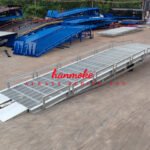
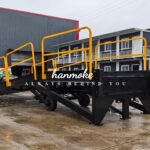
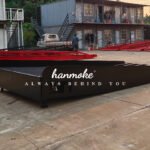
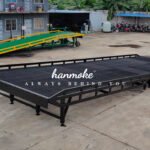
Most yards do not need a 20-ton ramp. What they need is a ramp that never becomes the reason a trailer sits at the dock for two hours. The HRES is our answer to that second problem: the reinforced I-beam frame of the heavy-duty HRHS, with an electro-hydraulic power pack in place of the hand pump. The operator presses a button, the deck rises or drops to trailer bed height, and the forklift keeps moving.
What the HRES Is, in Shop-Floor Terms
The HRES is not a new frame. It is the same large I-beam chassis we build for the 15-ton HRHS, engineered for the highest dynamic loads and the most intensive use cycles, then fitted with a reinforced electric-hydraulic system instead of a manual pump. Rated capacity is 20 t (44,092 lb). Standard decking is extra-heavy-duty steel grating; diamond safety mesh is an available upgrade. The guard rails stand 200 mm (7.9 in) above the deck.
| Specification | HRES | Imperial |
|---|---|---|
| Model | HRES | — |
| Rated load | 20 t | 44,092 lb |
| Overall length | 10,300 mm | 33 ft 9 in |
| Overall width | 2,200 mm | 7 ft 3 in |
| Guard rail height | 200 mm | 7.9 in |
| Main beams | Large I-beams (reinforced) | — |
| Lifting system | Electro-hydraulic, DC battery or AC mains | — |
| Deck | Heavy-duty steel grating (diamond mesh optional) | — |
| Best fit | Mega DCs, cross-dock hubs, high-cycle container yards | — |
Push Button Versus Hand Pump: Where the Minutes Actually Go
A hand-pump ramp is not slow because pumping is hard. It is slow because the person pumping is not doing anything else, and because operators quietly avoid adjusting height when adjusting costs effort. That second effect is the expensive one. When a height change takes minutes of physical work, drivers load at whatever deck angle they already have: cargo gets dragged, the forklift climbs a steeper slope than the site plan assumed, and the ramp’s own capacity margin gets eaten by bad posture on the deck.
As a working estimate rather than a laboratory figure, a manual pump costs roughly two to four minutes of operator time per height adjustment, including the walk to the pump. The electro-hydraulic HRES typically cuts a change to under a minute from the control position. Multiply that by the number of height changes your yard makes in a shift — every trailer with a different bed height is at least one — and the labour difference separates the two models within a season.
| Item | Hand-pump ramp (HRYS type) | HRES electro-hydraulic |
|---|---|---|
| Height change method | Manual pump lever, several dozen strokes | Push button, powered power pack |
| Time per change (estimate) | 2–4 minutes | Under 1 minute |
| Physical load on operator | Continuous | None |
| Power supply required | None | AC mains or DC battery pack |
| Where it makes sense | One or two changes per day, remote yards | High-cycle docks, single-operator sites |
DC Battery or AC Mains: Choose by Where the Ramp Sleeps
If the ramp parks at one bay and there is a socket within reach, take AC. Three-phase 380–415 V is the standard export build for Europe, the Middle East and most of Asia and Africa; 220–240 V single-phase builds are available where that is what the site actually supplies. Confirm the voltage and phase at order time, because a 380 V power pack bolted to a 208 V supply will not lift anything, and rewiring on site is a needless week.
If the ramp moves around a yard built before anyone thought about power outlets, take DC with a deep-cycle battery pack. The battery build costs more up front and adds a charging routine to the shift checklist, but it frees the ramp from the nearest cable run. The rule we give customers is blunt: if the ramp has to lift at more than one position per shift, buy DC.
What a 20-Ton Rating Does Not Cover
Three things worth saying plainly before you write a purchase order.
- Slope, not tonnage, is usually the binding constraint. A trailer bed at 1,400 mm (4 ft 7 in) needs a long ramp to stay inside a workable grade. A 20 t ramp that is too short for your trailer heights is still the wrong ramp at 20 t.
- The rating is dynamic, not static. Forklift plus load plus attachment has to sit inside 20 t with margin for off-centre travel. A 19 t combination that is always driven down one side of the deck is not inside the rating in any practical sense.
- The ramp does not fix the yard. Grade, drainage, turning radius and the approach apron decide whether a mobile ramp works as well as the numbers suggest.
Ordering Data: Lead Time, Container Loading and Budget
Indicative figures below are EXW Foshan ranges for guidance only, not a quotation. Freight, duty and site work are on top, and options move the number.
| Item | Indicative figure |
|---|---|
| Unit price, 20 t electro-hydraulic (EXW, indicative) | USD 12,500–16,500 |
| DC battery build versus AC mains | Battery pack adds roughly USD 400–900 |
| Diamond safety mesh deck upgrade | Adds roughly USD 300–600 |
| Unit weight, built | Approx. 7,000–8,000 kg (15,400–17,600 lb) |
| Production lead time | 25–35 days after deposit and drawing approval |
| Container loading | One unit per 40 ft HQ. At 10,300 mm (33 ft 9 in) long, a second unit will not fit the 40 ft HQ’s roughly 12 m of internal length |
One practical note from the dispatch desk: ask for the packing list weight before you book the forklift at the receiving end — a 7.5 t crate is not a two-person unload.
Does the HRES lift a 20-ton load with one cylinder?
No. A 20 t rated ramp on this frame uses robust cylinders working with a high-output power unit, sized so the deck lifts smoothly under load rather than in stages. The precise cylinder configuration is set per build and confirmed on the drawing.
Can I run the HRES on 220 V single phase?
In most cases yes, and 380–415 V three-phase is the more common export build. What matters is that the power pack matches your site supply, so confirm voltage and phase in writing before production.
How long does a height change take?
Typically under a minute from the control position, against two to four minutes for a manual pump including the walk. That difference is the whole commercial case for the electric model on a high-cycle dock.
Can the HRES load a container from ground level without a door sill?
Yes. That is the job it was specified for: the ramp climbs from the yard surface to the container or trailer floor so a forklift can drive straight in, with no dock, no pit and no door sill to bridge. Chock and secure the trailer before boarding, and keep the load inside the dynamic rating.
If you want the full specification sheet, the load test data or a quote with the power pack matched to your site supply, send us the trailer heights and the yard layout. We will come back with a drawing, a lead time and a delivered-cost estimate rather than a generic price list. You can compare the full range on the mobile yard ramps category page, or look at the HRES product page alongside its smaller 10-ton standard hydraulic and 15-ton heavy-duty hydraulic stablemates.