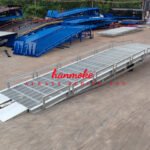
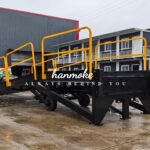
A 10-tonne hydraulic yard ramp leaves Foshan at about USD 11,500 EXW. Land the same unit in Los Angeles and you will have spent roughly USD 25,700 before a forklift touches it. Land it in Rotterdam, and the figure is nearer USD 17,000 — with most of that difference being a single line item that has nothing to do with the factory. This is the arithmetic we run with buyers who ask whether importing still makes sense in 2026, using rates we can point to rather than “it depends”.
The Five Layers Between EXW and Your Yard
Landed cost is not price plus freight. It is five stacked layers, and the fourth one is where budgets usually break.
| Layer | What it contains | Typical share of final cost |
|---|---|---|
| 1. Goods | EXW factory price, options, paint, deck type | 42–68% |
| 2. Origin handling | Export crate or skid, VCI wrap, inland haulage to Nansha or Yantian, export declaration, loading | 6–9% |
| 3. Main carriage | Ocean freight per 40 ft, marine insurance at about 1.2% of goods plus freight | 6–30% |
| 4. Border | Customs duty, trade-remedy duties, MPF/HMF or equivalent, VAT or GST | 0–20% |
| 5. Destination | Terminal handling, chassis or port fees, broker, drayage or delivery, unloading | 4–7% |
Two of those layers are volatile and one is not. The factory price moves with steel and with the exchange rate; the freight line moves weekly; the duty line moves with policy. Everything you can control sits in layers one and two — and mostly in how well the ramp packs.
Duty and Tax, Market by Market
The classification that matters for a mobile yard ramp is HS 8428.90 — other lifting, handling, loading or unloading machinery. What each market does with it differs sharply.
| Market | Import duty on Chinese origin | Consumption tax | Notes that change the number |
|---|---|---|---|
| United States | 37.5% (free MFN + 25% Section 301 List 1 + 12.5% forced-labour Section 301) | None federal | Plus MPF 0.3464% and HMF 0.125% on ocean cargo |
| European Union | 0.000% third-country duty (CN 8428 90 98, Reg. 2261/98) | VAT 19–27% by member state | VAT recoverable if you are registered; CE technical file required |
| United Kingdom | 0% (UK Global Tariff, 8428 90 90 80) | VAT 20% | CE marking accepted indefinitely in Great Britain for machinery |
| Australia | 5% general rate; 0% under ChAFTA or RCEP with a valid certificate of origin | GST 10% on value of taxable importation | Without a CoO you pay the 5% — that document is the whole margin |
Read that table once more, because it drives strategy more than any engineering decision. The same ramp, same crate, same container: duty-free into Rotterdam, 37.5% into Los Angeles. On an USD 11,500 unit that is a USD 4,312 difference before the tax line is even reached.
The Section 232 Wrinkle on 8428.90.03
One caution before you budget from the table. HTS 8428.90.03 is also named on the US Section 232 derivative-steel lists, which apply where the covered metal is at least 15% of an article’s weight — a welded steel ramp clears that threshold easily. Depending on the entry date and how the entry is reported, the Chapter 99 treatment can be a replacement rate rather than the 37.5% stack, and the tiers have been amended more than once in 2026. The honest position: budget 37.5% until your broker confirms the entry treatment in writing, and get a binding ruling if the order is large enough to matter. Anyone quoting you a precise all-in rate from a blog post — including this one — is guessing about your entry.
Ocean Freight Is the Line Nobody Budgets
Drewry’s World Container Index for 29 October 2026 put Shanghai to Los Angeles at USD 7,514 per 40 ft, Shanghai to New York at USD 9,631 and Shanghai to Rotterdam at USD 3,686. The transpacific number is roughly twice the Asia–Europe number, and that gap is what separates a US landed cost from an EU one.
The second half of the freight question is dimensional. A one-piece ramp at 11,400 mm uses almost the entire internal length of a 40 ft high-cube, so you pay a full container for one unit. A two-part folding ramp folds to about 5,700 mm and leaves half the box for spares, dock plates or a second order. On the LA lane, that geometry is worth up to USD 3,700 per unit — more than most buyers save by negotiating the ramp price. If your volume justifies it, look at the folding ramp range before you look at discounts. LCL is not a realistic option: an 11.4 m ramp cannot be handled as loose cargo without a flat rack or breakbulk booking, both of which cost more than the box.
Worked Example: One 10-Tonne Ramp to Los Angeles
Base unit: 10-tonne hydraulic mobile yard ramp, 2,200 mm wide, steel grating deck, manual pump. Prices in USD.
| Line | Amount (USD) | Basis |
|---|---|---|
| Ramp, EXW Foshan | 11,500 | Indicative mid-range for the class |
| Export skid, VCI wrap, inland to port | 900 | 550 packing + 350 haulage and docs |
| Ocean freight, 1 × 40 ft HC | 7,514 | WCI Shanghai–Los Angeles, 29 Oct 2026 |
| Marine insurance | 228 | 1.2% of goods plus freight |
| Section 301 duties, 37.5% | 4,312 | On the FOB customs value |
| MPF and HMF | 54 | 0.3464% + 0.125% |
| Terminal, chassis, broker, drayage | 1,200 | LA/Long Beach to a 50-mile yard |
| Landed, delivered | 25,708 | 2.24× the EXW price |
That multiplier is the number to carry into a business case. Not 1.3, not 1.4. On the US lane in late 2026, a Chinese ramp lands at roughly 2.2 times its factory price, and two thirds of the premium is duty and freight.
The Same Ramp Into Rotterdam, Felixstowe and Melbourne
Identical unit, identical crate. VAT and GST are shown gross and then net of recovery, because a registered importer gets them back and a cash-flow plan that ignores that is wrong in both directions.
| Market | Ocean (USD/40 ft) | Duty | VAT / GST | Landed, gross | Landed, net of recoverable tax | Multiple of EXW |
|---|---|---|---|---|---|---|
| Rotterdam (NL, 21% VAT) | 3,686 | 0 | 3,227 | 20,195 | 16,968 | 1.48× |
| Felixstowe (UK, 20% VAT) | 3,800* | 0 | 3,097 | 20,261 | 17,164 | 1.49× |
| Melbourne (AU, 10% GST) | 3,200* | 0 (with CoO) | 1,488 | 19,104 | 17,616 | 1.53× |
| Melbourne, no certificate of origin | 3,200* | 744 (5%) | 1,562 | 19,922 | 18,360 | 1.60× |
* Not a published index rate: the WCI does not quote these lanes, so these are planning assumptions from forwarder quotes on comparable cargo. Replace them with your own before you commit capital. Destination charges are included at USD 700 (Rotterdam), 780 (Felixstowe) and 1,840 (Melbourne, about A$2,800 including the A$152–200 import processing charge).
Five Years, Not One
Purchase cost is half the story. The other half is what the ramp demands after commissioning, and this is where the US and EU numbers converge again: spares and service cost the same everywhere, but the capital you tied up does not.
| Five-year item | USD | Assumption |
|---|---|---|
| Commissioning, electrical connection, operator briefing | 400 | One day, local contractor |
| Spares kit on the shelf | 600 | Seal kit, hose set, wheel set, lip pins |
| Planned maintenance | 3,500 | 700 per year: inspection, oil, hinge and lip work |
| Unplanned downtime | Not costed | Two days of a blocked bay is usually more than all of the above |
Add that USD 4,500 to each market and the ranking does not change, only the gap: about USD 30,200 for Los Angeles, USD 21,500 for Rotterdam, USD 21,700 for Felixstowe, USD 22,100 for Melbourne. Against those totals, a domestic ramp at USD 28,000 with local warranty and next-day parts is a rational purchase in the US and a poor one in the Netherlands — not because the equipment differs, but because the border does.
Where Importers Get Burned
Budgeting duty at the old rate. The forced-labour Section 301 layer took effect on 24 July 2026 and moved 8428.90.03 from 25% to 37.5% for Chinese origin. Quotes built on 2025 spreadsheets are still circulating.
Skipping the certificate of origin. On the Australian lane that single document is worth 5% of the goods value. It costs nothing to request at quotation stage and cannot be manufactured after arrival.
Ordering 380 V for a 415 V site. Voltage, plug type and control voltage are specification items, not accessories. Getting them wrong means a local electrician, a transformer or both — and it can void the CE file as supplied.
Treating CE as a sticker. Regulation (EU) 2023/1230 replaces the Machinery Directive on 20 January 2027, and the technical file requirements tighten. Equipment delivered after that date needs documentation built to the new regulation, which matters for an order placed this quarter with a 6–10 week build and 5 weeks of sailing.
Ignoring steel content questions. The EU’s CBAM definitive period started on 1 January 2026 for the goods listed in Annex I. Finished loading equipment under 8428.90 is not in that list today, but EU customers increasingly ask for mill certificates and heat numbers for their own reporting. Supplying them is a sales advantage; being unable to is a delay.
The Decision Rule
Import when the multiplier your market imposes still beats local price, and when you can absorb a 10-week pipeline and a 2–3% spares risk. In the US at 2.24×, that is a genuine calculation worth doing on paper — and it is why folding designs that halve freight per unit change the answer. In the EU, UK and Australia at roughly 1.5×, direct import remains heavily favourable against local dealer pricing for the same class of equipment.
Start from the unit that fits the arithmetic: the standard 10-tonne hydraulic yard ramp, or browse the wider mobile yard ramp range and the full product list. Send us your destination port and trailer heights and we will return an FOB price, a packing plan and the container loading diagram — the three documents your forwarder needs to give you a landed cost that is not a guess. Reach the factory through the contact page.
Questions Buyers Ask
Is 37.5% the real US duty on a Chinese yard ramp?
It is the stack most commonly reported for HTS 8428.90.03 in late 2026: 25% Section 301 List 1 plus 12.5% forced-labour Section 301, on a duty-free MFN base. Because the line also appears on Section 232 derivative-steel lists, confirm the entry treatment with your broker before you sign.
Why is the EU duty zero when the US duty is 37.5%?
Different instruments. The EU applies a 0.000% third-country rate to CN 8428 90 98 and collects VAT instead. The US applies a free MFN rate but loads Section 301 duties on top, so the border cost lands as duty rather than as recoverable tax.
Can I avoid the container by shipping LCL?
Rarely. An 11,400 mm ramp is longer than most LCL handling allows and needs a flat rack or breakbulk booking, which usually costs more than a 40 ft box. Folding designs that halve the length are the practical answer to freight cost.
Does a Chinese CE certificate work in the UK?
Yes. The UK recognises CE marking indefinitely for machinery in Great Britain, so a compliant EU declaration of conformity covers both markets. Northern Ireland follows EU rules. From 20 January 2027 the declaration must be built to Regulation (EU) 2023/1230.