Mexico’s industrial market spent three years building whatever it could and leasing it before completion. That phase is over. In Q3 2026 national inventory reached 115.1 million m², vacancy sat at 5.5%, and construction starts for January to September ran 35% below the same period of 2025, according to Solili. For anyone specifying loading equipment, the vacancy figure matters less than what moved: floor space is no longer scarce along the northern border. Doors are.
What the border markets are actually showing
The vacancy is concentrated where the freight is: Tijuana closed Q3 at 10.2%, Reynosa at 7.3%, Monterrey at 7.0% and Ciudad Juárez at 6.0%, against 5.5% nationally. In the previous quarter those four border markets held about 54% of all available industrial space in the country.
| Market | Vacancy, Q3 2026 | What it means for a dock plan |
|---|---|---|
| Tijuana | 10.2% | Most choice in the country, but much of the stock is older and has a fixed, low door count. Adding doors usually means an exterior ramp, not a new building. |
| Reynosa | 7.3% | Automotive and appliance parts. Loading peaks follow shift changes, so door count has to cover the peak hour, not the daily average. |
| Monterrey | 7.0% | Largest industrial market by inventory. New Class A space is often leased before completion, so the door count is frozen at design. |
| Ciudad Juárez | 6.0% | Electronics and medical devices. High trailer turns per door and tight appointment windows. |
| Saltillo | 2.3% | Effectively full. Expansion has to come from existing concrete, which means more turns per door. |
| Aguascalientes | 0.9% | Nothing to lease. Throughput gains are entirely an equipment question. |
| National | 5.5% | Asking rent averaged USD 7.67 per m² per month in Q3. |
Leasing never slowed: gross absorption reached 1.6 million m² in Q3, up 5% year on year, and 4.0 million m² across nine months, up 8%. Mexico City took 28%, Monterrey and Guadalajara 14% each. What changed is the mix. Logistics and warehousing now carry the demand manufacturers used to drive.
A leased shell is not a working dock
At 6% to 10% vacancy, tenants have leverage, and leverage gets spent on rent rather than doors. One tenant signs 8,000 m² in a park, then finds the building was designed for four doors and one 40 m apron shared with the next unit. At ten turns per door per day, four doors cap the site at roughly 40 trucks.
Do the arithmetic before signing: doors × turns per door × hours is the only capacity figure that matters. A palletized 40 ft container takes 45 to 90 minutes at the door with one forklift; a floor-loaded high cube takes three to six hours with a crew. Same door, six-fold difference.
Laredo is running past its design capacity
Port Laredo counted 255,129 northbound truck crossings in September 2026, up 4.9% year on year, and daily volume through its bridges runs above 16,000 trucks. The port carries 37% to 40% of Mexico–US overland trade. In May 2026 it moved USD 35.3 billion of goods, of which USD 30.7 billion, about 87%, went by truck.
The bridge is the visible constraint. The World Trade Bridge runs 14 lanes, and a programme of roughly 1.4 billion pesos takes it to 18; real relief is not expected before 2028. CBP’s published wait times show the gap meanwhile: on a July 2026 snapshot the standard lane ran 30 minutes and the FAST lane five. Six times faster, same bridge, same hour. A trailer that clears the bridge in 30 minutes and then waits 90 minutes at the receiving door never had a border problem.
Three ways to add door capacity without pouring concrete
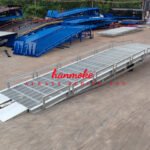
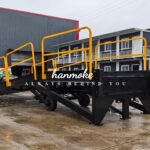
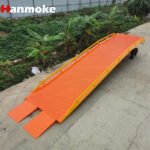
Convert a grade-level wall into a door. A mobile yard ramp against an existing opening gives a forklift access to a trailer deck at 1,200 to 1,500 mm without excavation. A 10,300 mm ramp reaches about 1,500 mm, which is a 14.6% grade. It is not a permanent answer, but it is a working door in a week rather than a construction season.
Add a bolted platform. Where the lease forbids pits, a free-standing steel platform with an integral ramp creates a raised loading position that can be removed and resold when the lease ends.
Buy turns, not area. A second ramp at an existing door usually recovers more capacity per dollar than another 500 m² of racking. Staging distance dominates: a forklift travelling 25 m to drop a pallet loses more time than one working a 10 m lane.
What to specify before the purchase order
Three numbers decide the equipment. Trailer deck height across the fleet: containers on chassis sit around 1,200 to 1,500 mm depending on tyre size, and a ramp sized for 1,350 mm will not reach a laden high cube at 1,550 mm. Laden weight actually moved, not the forklift rating: a 3 t forklift with a 1.5 t load needs about 5.9 t by the 1.3 dynamic factor, so 6 t is the floor and 10 t is sensible once side-shift is fitted. Grade you can live with: staying under 10% for a 1,500 mm deck needs about 15 m of ramp, so most border yards accept 12% to 16% and run laden forklifts with the load uphill, as OSHA 29 CFR 1910.178(n)(7)(i) requires above 10%.
Questions we get from border-market buyers
Is nearshoring still driving warehouse demand in Mexico?
Yes, but the driver changed. Manufacturing investment turned cautious while logistics absorption keeps rising: Q3 gross absorption was up 5% year on year and the first nine months were up 8%. Demand is real, less speculative than in 2023.
How many trucks can one dock door handle in a day?
Plan eight to twelve turns per door per shift for palletized freight, four to six for floor-loaded containers. Staging space and appointment discipline move those figures more than the equipment does.
Does a mobile yard ramp need a permit or a foundation?
No pit, no foundation, no building work; it is portable equipment. Check that the lease allows equipment on the apron and that the ramp does not block fire lanes or 16 m trailer turning circles.
What capacity do I need for a 3-ton forklift?
Rated dynamic capacity at least (forklift weight + maximum load) × 1.3. A 3.0 t forklift with a 1.5 t load comes to 5.85 t, so 6 t is the minimum and 10 t the usual choice once attachments are allowed for.
If you are fitting out a border-market building, send the trailer deck heights, the heaviest laden move and a photo of the apron, and you will get a ramp length, a capacity and a drawing rather than a brochure. Contact our engineering team, or start from the mobile yard ramp range, the dock ramp platforms used in lease-sensitive buildings, the free-standing loading docks for no-pit sites, or the dock leveller range if the concrete edge exists.