A pharmaceutical 3PL running a cold-chain warehouse near Tuas, Singapore contacted us in March with a familiar complaint: eight dock bays serving a 2-8 °C chilled block and a 15-25 °C CRT block were still being loaded with loose steel dock plates and wooden beavertail ramps. Every trailer change meant two workers manhandling a 90 kg plate, and every plate change left the dock door open for four to six minutes in a building that pays to keep air at 23 °C. The client is licensed by Singapore’s Health Sciences Authority as a therapeutic product wholesaler – every temperature excursion gets written up. They wanted dock levelers – but they did not want to cut pits.
Why They Refused to Cut Pits
The building was a two-year-old B2 industrial facility with a 200 mm reinforced slab on grade, and the chilled block sat directly above a membrane-limited foundation zone. Cutting eight pits 1,250 mm deep would have meant saw-cutting the slab, breaking out concrete, re-forming, rebar and a 28-day cure – roughly six weeks of dust and vibration inside an operating, GDP-mapped facility. Their quality team also refused any structural work inside the temperature-mapped zones during operating hours.
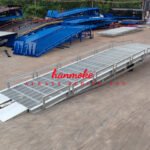
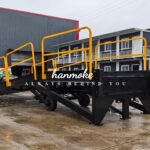
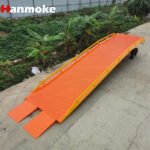
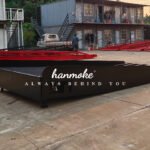
Pit-mounted levelers were out. The realistic options were face-mounted exterior dock levelers, or free-standing docks in the yard. Because the yard apron was already at a workable height and the bays had to come back fast, we specified the face-mounted route: our HLSH-EXT exterior dock leveler, 10-ton class, bolted to the outer face of the dock wall at each bay.
What We Shipped: The Hardware, Number by Number
Eight units, one per bay, shipped in two 40 ft containers from Foshan in April and installed over nine working days by the client’s own contractor under our remote supervision. The specification they received:
- Platform 2,280 mm long x 1,830 mm wide (7 ft 6 in x 6 ft 0 in), Q235B checkered steel plate.
- Working range -300 mm below dock to +450 mm above dock (-12 in / +18 in), covering both 40 ft containers on the yard and taller reefer trailer beds.
- Hydraulic lip and platform, 1.1 kW power pack, 380 V three-phase – the building already had three-phase at every bay.
- Full-width hinged lip with 100 mm of lip-to-trailer-bed overlap at the steepest working angle.
- Safety: maintenance strut, hinged toe guards, and a lip-keep pin for travel.
Because the chilled bays lose money every minute a door stands open, we paired each leveler with the client’s existing dock shelter upgrade and instructed their team on a simple rule: park, chock, dock, load – the leveler holds the interface so the door only opens behind a sealed opening. For bays where the wall had no structural backup behind the render, the contractor cast a 300 mm reinforced plinth at grade and we supplied the anchoring template. We had asked for photos of each bay before shipping, and two showed blockwork infill that changed the anchor plan.
The Numbers After Four Weeks
The client tracked three figures before and after, and shared them with us because they were pleased:
| Metric | Before (plates + beavertails) | After (HLSH-EXT x 8) |
|---|---|---|
| Trailer changeover per bay | 25-30 min, 2 workers | 12-15 min, 1 forklift driver |
| Door-open time per change | 4-6 min | 1-2 min |
| Temperature excursions logged per week | 3-5 | 0-1 |
| Plate-related near-miss reports | 2 per quarter | 0 |
The excursion figure is the one their quality manager cared about: fewer open-door minutes meant fewer mapping alarms.
What a Cold-Chain Retrofit Gets Wrong Without Planning
Three things we would flag for anyone planning a similar project:
- Condensation. A steel leveler bridging a 23 °C building and a 30 °C, 85 % RH yard will sweat on the underside. We specified a two-coat epoxy on the underside plates for this job; for the highest-cycle bays the client could have chosen our HLSH-04 pit leveler with NOK seals, rated for 60,000 cycles – a pit build was simply not on the table here.
- Approach gradient. The slab at four bays sloped 60 mm toward the drain channel. The forklift crossed a 3.3 % grade before it even reached the leveler – inside our comfort zone, but worth checking with a straightedge before you order, because the leveler range only covers the trailer side, not your slab.
- Anchor verification. Face-mounted hardware is only as good as what is behind the wall. We asked for core photos at two bays before shipping; both showed blockwork infill that changed the anchoring plan.
How long does a face-mounted dock leveler retrofit take?
For this project: nine working days for eight bays, done outside the chilled block with the client fully operational. A pit-mounted equivalent would have needed six weeks of structural work inside the building. If your slab is sound and the wall has backing, face-mount is the fastest retrofit route.
Can one leveler serve both chilled and frozen trailers?
Yes – the -300/+450 mm range covers standard container beds and typical reefer heights. The equipment does not care about the temperature; the finish does. For anything below -18 °C we would change the coating package and the hydraulic oil spec.
What does a retrofit like this cost?
The eight 10-ton exterior units landed in the USD 9,500-12,500 per bay range installed-side estimate, excluding the client’s own plinth work – guidance only, EXW basis varies with options and freight. Send us your bay drawings and we will quote the actual configuration rather than a guess.
Do you support installations outside China?
We ship worldwide with installation drawings, anchoring templates, and remote video supervision, as we did here. For larger projects we can arrange a supervisor on site – ask us when you request a quotation.
Talk to the Factory About Your Cold-Chain Dock
We build these levelers, yard ramps and loading platforms in Foshan, and we have spent thirty years answering the question this client asked first: how do I add proper dock equipment without wrecking the building? If you are planning a cold-chain retrofit, send your bay dimensions, slab details and trailer fleet to us through our contact page – we will return a dimensioned proposal, or browse the full range in our dock leveler category and exterior dock leveler category first.