Every few months a port authority announces another automated terminal, and every time a 3PL manager asks me the same question: will we still need yard ramps in five years? Yes — and not out of nostalgia. Automation is concentrated at the quay and in the stacking yard. The work where a container floor sits 1,300 mm (4 ft 3 in) above concrete is still done by people with equipment.
The Numbers Behind the Automation Headlines
Start with the volume picture, because it sets the ceiling on how fast anything changes. UNCTAD’s Review of Maritime Transport 2025 put global seaborne trade growth at 0.5% for the year, down from 2.2% in 2024, with containerised trade forecast to grow 1.4%. Its medium-term view for 2026–2030 is about 2.0% a year for seaborne trade and 2.3% for containers. That is a mature, slow-growing system, not a market where terminals rip out working equipment on a whim.
Now the automation share. A 2025 inventory of automated facilities counted 76 terminals worldwide with operational automation, which works out to roughly 3% of the world’s container terminals by count and about 4% of capacity. Measured by land, those 76 sites cover around 14.7% of total terminal area, because automated terminals are the big ones — Singapore’s Tuas Phase 1 alone is designed for 21 berths and 20 million TEU a year, while Yangshan Phase IV is 6.3 million TEU inside a port that moved 55.1 million. Of the 76, 50 are semi-automated: automated stacking, human drivers still moving boxes between yard and quay.
| Category | Share of terminals | What is automated | Average footprint |
|---|---|---|---|
| Semi-automated | 50 of 76 counted sites | Vertical yard movement only (aRMG / ARMG stacking) | 61.1 ha (151 acres) |
| Fully automated | Smaller subset | Yard plus horizontal transport (AGV / autonomous trucks) | 99.7 ha (246 acres) |
| Complete builds | Smallest subset | Adds remote or automated ship-to-shore cranes | 92.0 ha (227 acres) |
| All other terminals | ~97% by count | Manual or conventional handling throughout | — |
Where the Box Still Meets Concrete
Automated equipment moves containers. It does not open them. Everything after the box leaves the stack — devanning, inspection, transloading, re-packing, empty returns — happens in a shed or on an apron, and that is where manual work concentrates. A 40 ft high-cube carries roughly 67.7 m³ (2,390 cu ft) and, under ISO 668, a maximum gross mass of 30,480 kg (67,200 lb), which leaves about 26 to 28 tonnes of cargo depending on tare. Someone has to get a forklift from grade level up to that floor, 40 or 80 times a day.
There is a second effect that gets missed in the automation debate. When berth productivity rises, boxes clear the port faster, pushing volume into near-port transload and cross-dock facilities — the exact buildings that were never designed with enough dock doors. I have quoted more ground-to-container gear for facilities within 30 km of a busy terminal than for any other customer type. Automation upstream creates manual work downstream.
What Automation Leaves Alone
Two constraints keep the quay manual even at flagship sites. Ship-to-shore work involves lashing, hatch covers and a vessel that moves under the spreader, so operators automate the yard first. On the US East and Gulf coasts, the current ILA master contract constrains automation through 2030. The equipment consequence is unglamorous: demand grows for short-run gear that can be dropped where the container sits that morning.
Specifying Equipment When the Floor Is the Dock
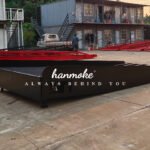
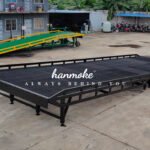
Three families cover nearly all of this work, and they are not interchangeable. A container loading board is a bridge: 1,250 mm (4 ft 1 in) long by 2,100 mm (6 ft 11 in) wide on our HRCN-A, rated 6 t, checkered plate with forklift pockets. It spans a step of a few hundred millimetres at a dock face or onto a yard ramp platform; it is not an incline and will not climb 1,300 mm.
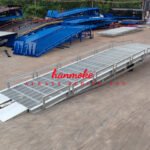
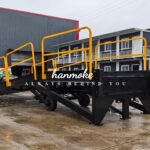
A mobile yard ramp is the incline. Our HRYS standard build is 10,200 mm (33 ft 6 in) overall — 7,570 mm slope plus a 2,630 mm platform — 2,200 mm (7 ft 3 in) wide, lifting 1,200 to 1,680 mm, rated 10 t dynamic. That works out to a 15.9% grade at the low end and 22.2% at full height. Both are above the 10% threshold in OSHA 29 CFR 1910.178(n)(7)(i), which requires a loaded forklift to travel with the load uphill on grades over 10%. Train for that, or the ramp becomes the accident.
| Task | Equipment | Typical spec | What rules it out |
|---|---|---|---|
| Bridge a step into a container already at dock height | Container loading board (HRCN-A) | 6 t, 1,250 × 2,100 mm | Rise over ~300 mm (12 in) |
| Forklift from grade into a container on the ground | Mobile yard ramp (HRYS / HRHS) | 10–30 t, 10,200–10,300 mm long | Yard run-up shorter than ramp + 3 m |
| Repeated heavy steel coil or block handling | Heavy-duty yard ramp (HRHS / HRES) | 20–30 t, 10,300 × 2,200 mm | Soft or unpaved surface |
| Peak-season overflow with no fixed bay | Yard ramp plus plate, nested storage | Two units per 40 ft HQ | No crane or forklift to reposition |
Two numbers decide whether a quote is usable. Capacity is per-axle dynamic load, not an average — a 3 t forklift with a 1.5 t load needs 2.5 to 3 times the combined weight. And grade decides whether the truck climbs it loaded at all.
Frequently Asked Questions
Will automated terminals eliminate mobile yard ramps?
No. Roughly 97% of terminals by count are still conventional, and devanning, transload and empty handling remain manual work that needs a bridge from grade to container floor.
Can a 6 t container ramp take a forklift?
A 6 t rated board takes a small forklift or a laden pallet truck across a short step, but check the per-axle load. A 2.5 t counterbalance truck with a load is close to the limit, and repeated crossings crack welds at the lip.
What grade can a loaded forklift climb?
Forklift makers publish 15% to 20% gradability for a loaded truck on concrete, less on steel deck. OSHA 1910.178(n)(7)(i) requires travelling with the load uphill above 10%, so a steeper ramp changes the procedure, not just the equipment.
How long does delivery take from China?
Standard hydraulic ramps run 20 to 30 days after deposit and drawing approval, plus 25 to 35 days transit. Two nested units fit a 40 ft high-cube; confirm the loading plan before booking.
If you are specifying equipment for a devanning shed, a transload yard or an overflow site, send us the container floor height, the forklift model with its loaded weight, and a photo of the approach. We will come back with the ramp length and grade that work, or tell you the job needs a plate instead. Request a quote, or browse the mobile yard ramps and dock plates and boards. Still unsure which bridge type fits? Read the container ramp vs yard ramp comparison first.